
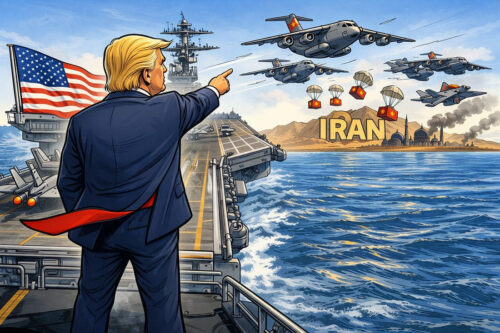
 The Middle East is on edge once again. U.S. carrier strike groups are repositioning, Iran’s missile forces are on alert, and Washington’s rhetoric has hardened into unmistakable warning. I have glanced various news (links below) which I have analysed.On his Truth Social platform, Trump shared an aerial photograph of the carrier, which appears in transit on its way to join a second US vessel – the USS Abraham Lincoln – already stationed in the Middle East.
https://truthsocial.com/@realDonaldTrump/116065926200307090
According to the BBC, President Donald Trump stated that a “change in power in Iran would be the best thing that could happen,” his clearest public endorsement yet of regime change in Tehran. The BBC also reported his warning that Iran must halt nuclear escalation or face “serious consequences.”
The tone has only sharpened. Al Jazeera reported Trump threatening Iran with “something very tough” if U.S. demands are not met. Meanwhile, as quoted by Associated Press, Trump dismissed decades of negotiation, saying: “For 47 years, they’ve been talking and talking and talking.”
This is not casual rhetoric. It is layered signaling.
Military Leverage Made Visible
The redeployment of the USS Gerald R. Ford aircraft carrier group has added weight to the words. As reported by Reuters, U.S. military planners are preparing for the possibility of “weeks-long operations against Iran” should diplomacy fail.
Trump himself, quoted by Sky News, made the linkage explicit: “In case we don’t make a deal, we’ll need it.” That remark ties military readiness directly to diplomatic leverage.
The BBC further noted that the dual-carrier presence represents one of the most significant U.S. naval concentrations in the region in recent years — a posture difficult to dismiss as symbolic.

Escalation Beyond Words
Washington’s pressure campaign extends beyond warships.
According to Reuters, citing Axios, Trump and Israeli Prime Minister Benjamin Netanyahu have agreed the U.S. should intensify efforts to curb Iran’s oil sales to China — targeting Tehran’s primary economic lifeline.
There are news of China sending its fighter jets to help Iran
The maritime domain is also tightening. Reuters reported that the U.S. issued fresh navigational warnings to vessels transiting the Strait of Hormuz amid rising tensions — a move signaling concern about potential Iranian retaliation against global shipping lanes.
Meanwhile, France24 reported Trump warning that failure to comply with U.S. demands could bring “very traumatic consequences.” Such language goes beyond calibrated diplomacy; it implies consequences that could be kinetic and sustained.
Diplomacy Under Timelines
Despite the military signaling, diplomacy has not collapsed. The Associated Press confirmed that U.S. and Iranian officials are preparing for another round of nuclear talks in Geneva.
But this diplomacy operates under compressed timelines. As reported by Axios, the White House has imposed a hard deadline for enrichment freezes — a tactic designed to intensify pressure but one that reduces room for maneuver.
Deadlines increase leverage. They also increase risk.
Proxy and Great-Power Dimensions
Iran’s regional proxies have escalated rhetoric in the Red Sea, threatening disruption if Tehran is struck. The Houthis’ positioning of missiles near shipping lanes adds another layer to the escalation ladder.
Simultaneously, reports of Chinese defensive technology transfers to Iran complicate the operational calculus. This is no longer a simple bilateral confrontation; it sits within broader strategic competition.
Is War Imminent?
At present, immediate large-scale U.S. strikes appear possible but not inevitable.
The structure resembles coercive diplomacy backed by visible force. Trump’s own phrasing — “something very tough,” “very traumatic consequences,” and “In case we don’t make a deal” — frames military action as conditional, not preordained.
However, escalation could accelerate if:
A proxy strike causes U.S. casualties
Israel undertakes unilateral action
Geneva diplomacy collapses under deadline pressure
Military deployments reduce political flexibility. Public regime-change rhetoric hardens Iranian threat perception. Economic measures squeeze survival calculations.
History shows that wars rarely begin with formal declarations. They begin when deterrence signaling and perceived humiliation intersect.
The Strategic Test
Washington is projecting unmistakable readiness. As Reuters reported, preparations include potential “weeks-long operations.” France24’s reporting of “very traumatic consequences” underscores seriousness. Al Jazeera’s account of “something very tough” reinforces the tone.
Tehran is calculating endurance. Israel is calculating urgency. China is calculating leverage.
If Geneva yields compromise, this episode will be remembered as coercive diplomacy that extracted compliance without firing a shot.
If talks fail, today’s deterrent posture could quickly transition into execution.
The coming days will determine whether this is strategic theater — or the threshold of a consequential regional conflict.