
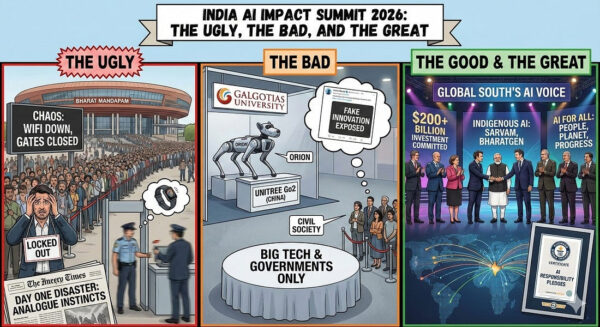
 The curtains have come down on the India AI Impact Summit 2026 at Bharat Mandapam, New Delhi — the first global AI summit ever hosted in the Global South. Over five days (extended to six due to overwhelming response), more than 20 heads of state, 60 ministers, 500 global AI leaders, and delegations from over 100 countries converged on Delhi. As the dust settles, here is a 10-point balance sheet — three ugly, three bad, and four good-to-great takeaways.
1. Day One Chaos: An AI Summit Run on Analogue Instincts
The opening day was an unmitigated disaster of crowd management. Over 2.5 lakh people had registered through a QR-code system, and roughly 80,000 descended on Bharat Mandapam simultaneously. What followed was straight out of a mela gone wrong — interminable queues, no signage, no seat allocations, no water, no food, and gates slammed shut without warning. Exhibitors who had paid for flights, hotels, logistics, and booth space were locked out of their own stalls for hours ahead of the Prime Minister’s visit. Wi-Fi collapsed, UPI payments stopped working, and mobile networks buckled under the load. The irony was savage: a summit showcasing cutting-edge artificial intelligence could not manage basic human logistics. As one start-up founder posted bitterly on X: “An AI Summit that sidelines its own builders?”
2. Theft in a “High-Security Zone”
If the chaos was not embarrassing enough, it turned criminal. Dhananjay Yadav, CEO of Bengaluru-based NeoSapien — a company building India’s first patented AI wearable — alleged that several devices were stolen from his booth during the security sweep for the PM’s visit. When he asked security if he should carry his products out, he was told others were leaving laptops behind and “security will take care.” When he returned hours later, the wearables had vanished — from inside what was supposed to be an impenetrable security cordon. Delhi Police, to their credit, registered an FIR, scanned CCTV footage, identified two suspects, and recovered all six devices within 24 hours. But the damage to optics was done.
3. The Ministerial Apology That Was Itself an Admission
Union IT Minister Ashwini Vaishnaw’s apology on Day Two was gracious but telling. “If anybody has faced any problems yesterday, my apologies,” he said, announcing a dedicated “war room” to handle glitches in real time. Congress President Mallikarjun Kharge pounced, calling the arrangements “utter chaos” and “rank mismanagement”. An event meant to project India’s technological prowess had instead, on its opening day, projected an image of administrative failure at the grandest stage.
4. Galgotias University and the Chinese Robot Dog
This became the summit’s most viral — and most cringeworthy — moment. Galgotias University, a Greater Noida private institution, displayed a robotic dog named “Orion” at its pavilion. In a video that went massively viral, Professor Neha Singh proudly told DD News that Orion was developed by the university’s Centre of Excellence under a ₹350 crore AI initiative. Social media users swiftly identified the dog as the Unitree Go2, a commercially available Chinese product retailing for about ₹2.3 lakh online. IT Secretary S. Krishnan directed the university to vacate its stall. Galgotias first called the controversy a “propaganda campaign,” then issued an apology claiming the professor was “ill-informed” and “not authorised to speak to the press”. A community note on X demolished even that defence. At a summit designed to showcase indigenous innovation, this was a self-inflicted wound to India’s credibility.
5. Civil Society Shut Out, Big Tech Given Centre Stage
TechPolicy.Press flagged a structural concern: the summit’s CEO Roundtable and Leaders’ Plenary granted multinational corporations parity with sovereign governments, while civil society, labour leaders, and human rights defenders had no equivalent high-level platform. For an event themed “Sarvajan Hitaya, Sarvajan Sukhaya” (Welfare for All), this was an uncomfortable gap.
6. The US Came to Compete, Not Cooperate
The United States sent a delegation of over 120 senior executives and officials, but reports suggested Washington’s agenda was centred on “domination” rather than collaboration, framing AI as a geopolitical contest with China rather than a shared global enterprise. This is not inherently India’s fault, but it underscores the tension between India’s inclusive, Global South-first framing and the superpower politics that inevitably intrude.
If presence signalled endorsement, absence told its own story. Nvidia’s Jensen Huang — whose company effectively supplies the picks and shovels of the global AI gold rush — was not in Delhi, despite India’s announcement of expanded GPU capacity and ambitious compute targets. In a summit so focused on infrastructure and silicon sovereignty, the absence of the world’s most influential chip CEO was conspicuous. Equally debated was the Bill Gates question. Despite Microsoft’s major investment commitments and its deep engagement with India’s digital public infrastructure over the years, Gates himself did not attend — prompting online speculation that ranged from scheduling conflicts to political optics, or the Epstein factor. Whether these were routine diary constraints or deliberate positioning choices, the symbolism was unavoidable: some of the most consequential global actors in AI chose to engage from a distance rather than share the Bharat Mandapam stage.
Beyond global figures, domestic absences were just as striking. Most talked about was Bhavish Aggarwal, CEO of Ola Electric, whose “Krutrim AI” had been aggressively teased in the run-up, but who was nowhere to be seen on the main stages. Equally noticeable was Aravind Srinivas, CEO of Perplexity AI — arguably the most prominent India-origin and IIT-educated figure in the global consumer AI race — missing from a summit that otherwise leaned heavily on marquee personalities. And then there was Sridhar Vembu, founder of Zoho, whose products have, at different points, received unusually visible official encouragement and promotion in the national narrative around self-reliance, yet who did not feature as an anchor presence at Bharat Mandapam. These absences may have had mundane explanations — scheduling, positioning, principle, or even quiet disagreement over the summit’s optics and curation. But symbolically, they und
7. India as the Global South’s AI Voice — A Historic First
The single most significant achievement of the summit is positional. India has become the first Global South nation to host a summit in this series — after Bletchley Park (UK, 2023), Seoul (South Korea, 2024), and Paris (France, 2025). This is not symbolic tokenism. It places India at the table where the rules of the AI age are being written. The three Sutras — People, Planet, Progress — and the seven Chakras framework offered a distinctly Indian and developing-world vocabulary for AI governance, centred on inclusion and democratisation rather than the safety-and-regulation preoccupations of Western summits.
8. The Investments: Hard Dollars on the Table
The summit delivered serious commercial momentum. Minister Vaishnaw projected over $200 billion in AI-stack investments within two years, atop $90 billion already committed. Mukesh Ambani pledged up to ₹10 lakh crore over seven years to build India’s AI ecosystem through Jio and Reliance. Microsoft confirmed it is on track to invest $50 billion by decade’s end to extend AI to lower-income countries. Google’s Sundar Pichai pledged subsea cables as part of its $15 billion AI infrastructure commitment, calling India’s AI trajectory “extraordinary”. Anthropic announced its first India office in Bengaluru; OpenAI revealed that India accounts for over 100 million weekly active ChatGPT users, second only to the US. Adani committed $100 billion by 2035 for AI data centres powered by renewable energy. Blackstone picked up a majority stake in Indian AI start-up Neysa in a $600 million round. These are not promissory notes at a trade fair — these are boardroom-level capital allocation decisions.
9. Geostrategic Positioning and Diplomatic Harvest
PM Modi held nine bilateral meetings — with seven heads of state and two global CEOs (Sundar Pichai and Vinod Khosla). The India–France joint statement deepened the strategic partnership, with Macron praising India’s digital transformation. The two leaders announced collaboration on an AI-in-healthcare research centre involving Sorbonne University and AIIMS Delhi. Emmanuel Macron, António Guterres (UN), Kristalina Georgieva (IMF), and presidents of Sri Lanka and Bhutan all attended, giving the event a multilateral heft that few Indian-hosted conferences have achieved. Hosting this summit is a direct input into India’s campaign for a permanent UN Security Council seat and its broader bid to be a rule-shaper, not a rule-taker, in the emerging technology order.
10. Indigenous AI Models and Sovereign Infrastructure
Beyond foreign investment, the summit showcased India’s own AI muscle. Sarvam AI launched 30-billion and 105-billion parameter large language models, plus text-to-speech and vision models, and unveiled the Kaze smart glasses — tested by PM Modi himself. The government-backed BharatGen Param2, a 17-billion parameter multilingual model supporting 22 Indian languages, was also unveiled. The government announced plans to add 20,000 GPUs to the existing pool of 38,000, with compute available at roughly ₹65 per GPU hour. India also set a Guinness World Record — 250,946 pledges for AI responsibility in 24 hours. These are building blocks of digital sovereignty.
The Bottom Line
The AI Impact Summit 2026 will be remembered for both its ambition and its contradictions. The organisational failures of Day One were real and damaging — but so were the $200-billion-plus investment commitments, the diplomatic harvest, and the historic positioning of India as the Global South’s AI convener. The Galgotias fiasco was embarrassing but also clarifying: it exposed the gap between aspiration and capability that India must bridge if it wants to be taken seriously as an AI innovator, not just an AI market. On balance, the substance outweighed the spectacle — but only because the substance was genuinely significant. The challenge now is execution: turning sutras and chakras into silicon and software.