
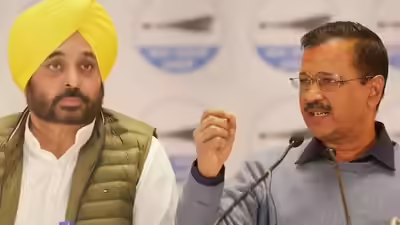
 When Arvind Kejriwal and Bhagwant Mann walked through the gilded gates of Darbar Sahib, the holiest shrine in Sikhism, they chose ritual over reckoning. Before bowing their heads at the sanctum, they owed the Sikh community something far more consequential than a pious visit; they owed them the truth about broken promises.
AAP rode to power in Punjab in 2022 on a wave of trust, buoyed in no small part by pledges made to the Sikh community. Chief among these was the guarantee to deliver justice in the sacrilegious desecration of the Guru Granth Sahib Ji, accountability for the Behbal Kalan police firing, the release of Bandi Singhs, and the restoration of Punjab’s financially broken exchequer. Years on, those guarantees remain unfulfilled, and the silence from Kejriwal and Mann grows louder by the day.
The desecration of the Guru Granth Sahib Ji, the living Guru of the Sikhs, is not merely a religious wound; it is a civilizational one. The incidents of Beadbi that shook Punjab left communities shattered, demanding accountability from those in power. AAP promised that justice would come swiftly under their governance. That promise has been quietly buried under administrative inertia and political calculation. Families who witnessed sacrilege in their own villages, who have been marching for years, and who have waited through multiple government transitions, do not need to see their Chief Minister fold his hands at a marble shrine. They need to see a conviction. A completed inquiry. A prosecuted perpetrator. What they have received instead is silence dressed in symbolism.
On November 14, 2015, Punjab Police opened fire on Sikh protesters at Behbal Kalan, killing two men, Gurjit Singh and Krishan Bhagwan Singh. The demand for justice in this case has become a generational wound in Punjab’s political memory. AAP promised accountability not merely for the officers who pulled the triggers, but for those who gave the orders. The Special Investigation Teams, the judicial commissions, the assurances given in rallies and manifestos, all of these have produced far less than what was promised. Visiting the shadow of the Akal Takht without addressing Behbal Kalan is not piety. It is provocation dressed as piety.
The release of Sikh political prisoners Bandi Singhs, who have served sentences far exceeding those convicted of comparable offences, remains one of the most emotionally charged demands in Sikh political life. AAP explicitly included this commitment in its electoral guarantees for Punjab, positioning itself as the government that would finally hear this cry. Instead, Kejriwal and Mann have offered the same excuse every government before them has offered: that the matter rests with the Centre. This may be legally partially accurate, but political leadership means using every lever of moral authority and institutional pressure to deliver on commitments. That pressure has not been applied with anything approaching the urgency the moment demands.
AAP also promised to put Punjab’s finances in order to end the cycle of debt, mismanagement, and fiscal drift that had plagued the state for decades. The reality has been a continuation of financial stress, with the government struggling to fund its own welfare commitments without borrowing. The guarantee to the people of Punjab was not merely about Sikh religious issues; it was about economic dignity for an agrarian state that has bled its best and brightest for generations. That promise too lies unfulfilled.
There is nothing inherently wrong with elected leaders visiting places of worship. But when a visit is made by those who carry unresolved political debts to the very community whose most sacred space they are entering, the moment demands acknowledgment not performance. Kejriwal and Mann did not stop before entering to address the waiting questions. There was no acknowledgment that the first guarantee made to Sikh voters justice for the Beadbi remains undelivered. There was no renewed commitment with specific timelines. What there was, instead, was the familiar currency of Indian politics: the photograph, the forehead on marble, and the departing motorcade.
The Sikh community, historically astute in distinguishing genuine solidarity from political theatre, has begun to notice. The murmur of disillusionment spreading through Gurdwaras is not about one broken promise — it is about the pattern. AAP came to power by convincing Punjab that it was different. The price of that claim is a higher standard of accountability, not a lower one. Before visiting Darbar Sahib, Arvind Kejriwal and Bhagwant Mann should have clarified where they stand on each of these four unfinished obligations. They did not. And in that silence, they told the Sikh community everything it needed to know.