
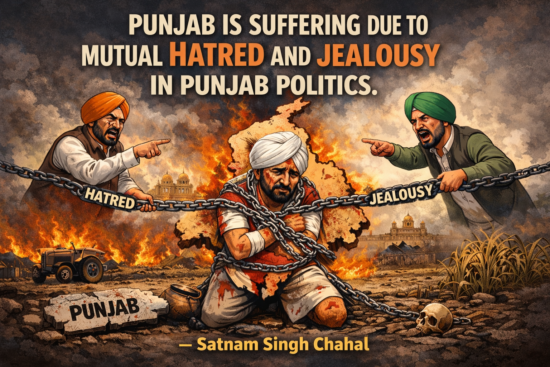
 Chandigarh-Punjab today stands at a critical crossroads where multiple governance and social challenges are unfolding simultaneously. Among the most pressing issues are rising concerns about anti-social activities linked to sections of migrant populations, the unresolved dispute over Chandigarh, and increasing allegations of excesses by the Punjab Police. These issues are not isolated; rather, they reflect deeper structural problems that have evolved over the years and are now shaping public perception and political discourse across the state.
The issue of immigration and its alleged link to anti-social activities has developed gradually over the past decade. Between 2015 and 2018, Punjab experienced a steady inflow of migrant workers, primarily from economically weaker states such as Bihar and Uttar Pradesh. These workers played a crucial role in sustaining Punjab’s agricultural and industrial sectors, filling labour shortages that local youth were increasingly unwilling to occupy. During this period, social harmony largely prevailed, and migration was seen as an economic necessity rather than a problem. However, between 2019 and 2021, as economic growth slowed and unemployment among local youth increased, tensions began to surface. Isolated incidents of theft, drug peddling, and petty crime involving individuals from migrant communities were reported, which gradually started influencing public perception.
From 2022 to 2024, concerns intensified as law and order challenges became more visible. Allegations emerged that certain criminal networks were exploiting vulnerable migrant populations for illegal activities. Social media further amplified these concerns, often without verified evidence, leading to growing mistrust between communities. By 2025 and 2026, the issue had taken on a political dimension, with different groups presenting contrasting narratives. Some blamed migrants for rising crime rates, while others pointed towards systemic failures such as unemployment, weak policing, and lack of governance. The absence of reliable data and a clear policy framework has only added to the confusion, creating fear among residents while also risking the unfair stigmatization of entire communities.
Parallel to this social issue is the long-standing and emotionally charged dispute over Chandigarh, which continues to symbolize questions of identity, federalism, and political will. The roots of this issue date back to 1966, when Punjab was reorganized and Chandigarh was designated as a Union Territory to serve as the shared capital of both Punjab and Haryana. Although this arrangement was intended to be temporary, it has persisted for decades without a permanent resolution. Throughout the 1980s and early 2000s, successive governments at the Centre made promises regarding the transfer of Chandigarh to Punjab, but these commitments were never fulfilled, leaving the issue in a state of prolonged uncertainty.
In the period between 2016 and 2020, political parties in Punjab renewed their demands for full control over Chandigarh, emphasizing its cultural and historical connection to the state. However, Haryana also maintained its claim, making the issue increasingly complex and politically sensitive. The situation escalated further between 2021 and 2023 when the central government introduced administrative changes in Chandigarh, including aligning service rules with central policies. These moves were widely perceived in Punjab as attempts to weaken its claim over the city. By 2024 to 2026, the dispute had intensified into a matter of political symbolism and public sentiment, with repeated resolutions passed in the Punjab Assembly but no tangible progress achieved. For many Punjabis, Chandigarh is no longer just an administrative issue but a question of dignity and rightful ownership.
At the same time, allegations of atrocities and high-handedness by the Punjab Police have contributed significantly to growing public dissatisfaction. Between 2017 and 2019, efforts were made to modernize the police force through digitization and improved infrastructure. However, complaints of misuse of power and lack of accountability persisted, particularly in rural areas. The situation became more visible during the COVID-19 pandemic from 2020 to 2021, when strict lockdown measures led to numerous reports of police excesses. Videos showing public beatings and harsh enforcement practices circulated widely, damaging the image of the police force.
From 2022 to 2024, allegations of custodial violence, illegal detentions, and so-called “encounter” cases began to surface more frequently. Civil society groups, activists, and opposition leaders raised concerns about the absence of accountability mechanisms and independent oversight. By 2025 and 2026, public fear and mistrust had deepened further, with several cases reaching the courts and families of victims demanding justice. The growing perception that justice is delayed or denied has widened the gap between citizens and law enforcement agencies, creating a serious trust deficit.
In conclusion, Punjab’s current challenges are deeply interconnected and reflect broader issues of governance, economic management, and institutional accountability. The concerns around immigration highlight the need for better labour regulation and social integration policies. The unresolved dispute over Chandigarh underscores the complexities of federal relations and political indecision. Meanwhile, allegations against the Punjab Police point to the urgent need for systemic reforms and transparency. If these issues are not addressed with seriousness and clarity, they risk further destabilizing public confidence. However, with strong political will, transparent governance, and meaningful reforms, Punjab still has the opportunity to overcome these challenges and restore its reputation as a stable and progressive state.