
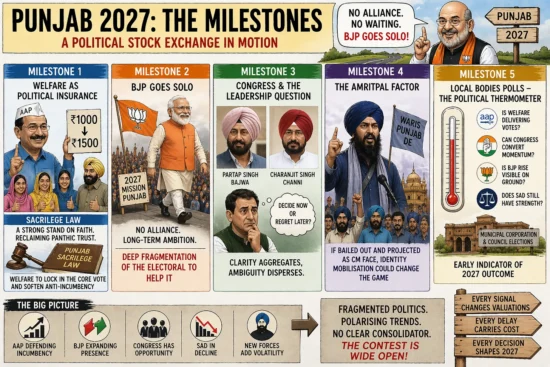
 The ambiguity is finally over. With Nitin Nabin making it explicit that the Bharatiya Janata Party will contest the 2027 Punjab Assembly election on its own, the party has formalised what had long been building through signals and speeches. What Amit Shah indicated at Moga has now been stamped as strategy.This is not merely an electoral adjustment. It is one of the defining milestones shaping Punjab 2027.
The first milestone came from the Aam Aadmi Party government’s announcement of ₹1,000, later raised to ₹1,500. This was not just welfare—it was political insurance, aimed at cushioning emerging anti-incumbency before it hardens.The second milestone is BJP’s solo decision. It signals ambition—but also deepens fragmentation.To understand the deeper churn, one must look at the numbers.
Punjab Vote Share Comparison
At first glance, this looks like a simple redistribution. It is not.The sharp rise in “Independents” in 2024 is not politically neutral. It is closely linked to the emergence of Waris Punjab De and the electoral success of radical leader Amritpal Singh. What appears as independent voting is, in reality, a shift of panthic and protest votes away from traditional players.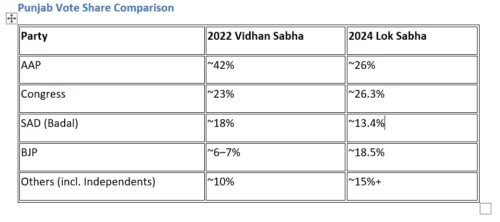
This surge has come largely at the cost of:
Shiromani Akali Dal
and to an extent, AAP
The implication is profound:
👉 The Akali Dal is not just weakening—it is being ideologically displaced.
But the most significant pattern lies elsewhere.
As radical mobilisation rose, BJP’s vote share also surged—from about 6–7% to nearly 18.5%.
This is not coincidence.
👉 It reflects reverse polarisation—
radical assertion on one side leading to consolidation of Hindu voters on the other.In that sense, BJP’s rise is not purely organic expansion. It is partly reactionary growth, tied to the persistence of polarisation.Amid this churn, one party stands out for its resilience:
👉 Indian National Congress
Unlike others, Congress:
did not collapse in 2022
recovered in 2024 remains relatively insulated from polarisation swings It is the only party with a stable and transferable vote base.Yet, it remains indecisive.This brings us to the third milestone.
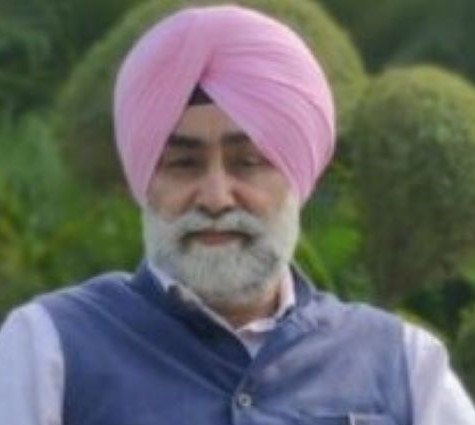
Congress now faces a clear choice. It must decide whether to project leadership or continue with ambiguity. Possible Chief Ministerial faces include Partap Singh Bajwa, the senior most leader and Charanjit Singh Channi a former CM for three months.
The issue is not who—but whether.
The “win first, decide later” approach, as suggested by Bhupesh Baghel, may prove risky in Punjab. In a fragmented contest, clarity aggregates votes; ambiguity disperses them.
AAP, meanwhile, despite its sharp drop, is not out of the game. A fall from 42% to ~26% is significant—but it still represents a large base. With welfare measures and its recent positioning on sacrilege law, the party is clearly attempting to reclaim the panthic space it lost.The fourth milestone lies outside conventional politics. If Amritpal Singh secures bail or parole and is projected as a Chief Ministerial face, Punjab could see intensified identity mobilisation, further complicating electoral arithmetic.The fifth milestone will be the upcoming municipal corporation and council elections. These will act as a political thermometer, indicating whether welfare, polarisation, or leadership clarity is actually translating into ground support.
Conclusion: Fragmentation with polarisation—but no consolidator
Punjab is no longer a simple multi-cornered contest. It is evolving into a layered political arena:
Radical assertion weakening traditional Sikh parties
Reverse polarisation strengthening BJP.Welfare and narrative helping AAP retain ground
Congress holding the only stable base—but lacking decisiveness; has ability to spring surprise.The result is a system marked by:
👉 fragmentation with polarisation—but still no consolidator
The fog is clearing. But clarity of players does not mean clarity of outcome.Punjab 2027 will not be decided by a wave this time. It will be decided by how these competing forces align—or fail to align.Those who act early, decide clearly, and project leadership will gain the edge.The rest will merely add to the political noise.