
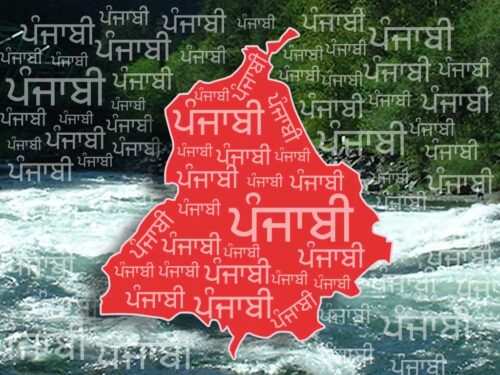
Punjab is one of the oldest and most vibrant civilisations in the world. The word “Punjab” itself comes from the Persian words Panj (five) and Aab (water), the land of five rivers: the Jhelum, Chenab, Ravi, Beas, and Sutlej. These rivers did not merely water the fields; they nourished a language, a culture, a spirit. The Punjabi language, written in the Gurmukhi script in India and the Shahmukhi script in Pakistan, is one of the most widely spoken languages in the world, with over 120 million speakers globally, yet it remains one of the most politically neglected. Punjabi is not merely a means of communication. It is the language of Guru Nanak, the first Sikh Guru, whose Gurbani gave the world its first articulation of universal brotherhood and spiritual equality. It is the language of the great Sufi poets Bulleh Shah, Waris Shah, and Shah Husain, whose verses of love, longing, and divine truth echo across centuries. It is the language of Heer-Ranjha, of Mirza Sahiba, of folk songs sung at harvest, at birth, at weddings, and at death. To silence Punjabi is to silence one of humanity’s most profound poetic and spiritual traditions. Yet throughout history and most sharply since 1947, this magnificent language and its people have faced systematic neglect, political marginalisation, and institutional injustice.
The partition of 1947 was not only the moment of India’s independence, but it was also the moment Punjab was cut in half with a pen stroke by a British lawyer, Sir Cyril Radcliffe, who had never visited the region before and completed the boundary commission in a matter of weeks. The result was a catastrophe of historic proportions. Punjab paid the highest price for the creation of two nations. An estimated 10 to 20 million people were uprooted in the largest forced migration in human history. Millions of Hindus and Sikhs moved eastward from what became West Punjab in Pakistan; millions of Muslims moved westward from what became East Punjab in India.”Trains arrived at stations full of dead bodies. Rivers carried corpses. Villages that had stood for generations were emptied overnight. Families were separated, never to meet again.”Women were abducted, assaulted, and killed in numbers too painful to fully document. Estimates suggest that between 200,000 and 2 million people were killed in the violence that accompanied partition. The Sikh community, whose historical and sacred heartland includes Lahore, Nankana Sahib, Panja Sahib, and Kartarpur, fell almost entirely in Pakistan, and suffered an incomprehensible spiritual and cultural loss. They were a people whose entire religious geography was amputated overnight. The elders of Punjab still carry these wounds. Their stories of homes left behind, of fields abandoned mid-harvest, of the names of streets in cities they can never visit are among the most haunting testimonies of the twentieth century. Punjab sacrificed the most for independence. In return, history largely moved on without acknowledging the depth of that sacrifice.
If the partition was Punjab’s physical wound, the treatment of the Punjabi language became its ongoing humiliation. When India reorganized its states along linguistic lines in 1956, nearly every major linguistic group received its own state. Telugu speakers got Andhra Pradesh. Kannada speakers got Karnataka. Malayalam speakers got Kerala. But Punjabi speakers were denied this recognition. The commission dismissed the Punjabi-speaking people’s demand, in part due to the complex politics of religion and community identity and the deeply unfair assumption that Punjabi was not sufficiently distinct from Hindi.It took another decade of peaceful advocacy including the Punjabi Suba movement led by Master Tara Singh and Sant Fateh Singh before a Punjabi-speaking state was finally carved out in 1966. But even then, the linguistic reorganization was incomplete and punitive. The fertile Punjabi-speaking districts of Haryana and Himachal Pradesh were separated from Punjab. The city of Chandigarh, built as Punjab’s capital, was designated a Union Territory shared between Punjab and Haryana a temporary arrangement that has now lasted nearly sixty years. Punjab still does not have its own full capital city. This treatment stood in stark contrast to how every other major linguistic state was handled, reflecting a political calculation that Punjab weakened, displaced, and still recovering from partition could be shortchanged without consequence.
Few injustices to Punjab are as concrete, as measurable, and as ongoing as the river waters dispute. Punjab’s rivers are its identity. But under agreements imposed upon Punjab without its meaningful consent, its river waters have been allocated to neighboring states including Rajasthan, a non-riparian state that does not even share a river basin with Punjab under classical international water law. The proposed Sutlej-Yamuna Link (SYL) canal designed to carry Punjab’s water to Haryana — has been a festering political wound for decades. Punjab’s legislature unanimously passed resolutions against the canal. The matter has gone back and forth between the Supreme Court, Parliament, and state governments, remaining unresolved to this day. Meanwhile, Punjab’s water table has been plummeting at alarming rates due to decades of intensive farming driven by Green Revolution demands a revolution that Punjab was asked to lead in the national interest, and which has left its soil and groundwater severely depleted.
In the 1960s and 1970s, when India faced starvation, it was Punjab that was called upon to save the nation. Punjab’s farmers adopted high-yield wheat and rice varieties, used chemical fertilizers and pesticides on a massive scale, and pumped water from the ground in ways never done before. Punjab became India’s breadbasket contributing, at its peak, more than 40% of India’s wheat procurement, despite being one of the country’s smallest states by area. The national benefit was immense. The human and ecological cost fell almost entirely on Punjab.Decades of intensive monoculture farming depleted the soil. Pesticide and chemical overuse contaminated groundwater and contributed to alarming rates of cancer in certain Punjab districts so concentrated in regions like Bathinda that trains carrying patients to cancer hospitals earned the grim nickname “Cancer Train.” Farmers, caught between falling crop prices and rising input costs, sank into cycles of debt. The agrarian distress that gripped Punjab’s farming families was a direct consequence of policies designed to serve the national interest policies imposed without adequate compensation, alternative support, or long-term environmental planning. Punjab gave the nation food security. In return, its land was exhausted, its water depleted, and its farmers left in crisis.
Despite being the official language of Punjab, Punjabi faces systemic neglect in education, administration, and public life. In urban Punjab, English and Hindi dominate business, higher education, and aspirational culture. Many upper- and middle-class Punjabi families actively discourage their children from learning to read and write Gurmukhi, associating it with rural backwardness rather than cultural pride. The result is a generation of Punjabis who speak their mother tongue at home but cannot read the poetry of Guru Nanak or the verses of Waris Shah in their original script. In Haryana and Himachal Pradesh states that were once part of Punjab Punjabi receives little or no official recognition. In Delhi, one of the largest Punjabi-speaking cities in the world, the language has no formal status. In Pakistan, despite Punjabi being the most widely spoken language, Urdu is the national language of prestige and governance. On both sides of the border, the language finds itself politically sidelined in its own homeland.
No account of historical injustices to Punjab can omit the trauma of 1984 a year that left two irreparable wounds on the Punjabi psyche. In June 1984, the Indian Army launched Operation Blue Star, storming the Golden Temple complex in Amritsar the holiest shrine in Sikhism. The military operation caused devastating damage to the sacred complex, including the Akal Takht, and resulted in hundreds of civilian deaths. For Sikhs around the world, the desecration of the Golden Temple was an act of profound spiritual violence the equivalent of an army entering the Vatican or the Kaaba.Then, in October 1984, following the assassination of Prime Minister Indira Gandhi by her Sikh bodyguards, organized violence against Sikhs erupted across India most brutally in Delhi. Over three days, mobs systematically targeted Sikh homes, businesses, and individuals. Thousands of Sikhs were killed. Survivors described scenes of neighbors being burned alive, of homes looted and destroyed, of police standing by or actively facilitating the violence. Independent investigations and survivor testimonies have consistently characterized the events as a pogrom — organized, targeted, and politically facilitated. Decades later, justice remains largely undelivered. A handful of convictions. No comprehensive official accountability. The wounds remain open in the memory of the Punjabi and Sikh community worldwide.
One of the great paradoxes of Punjab’s story is that while the language and culture have been marginalized at home, they have conquered the world. Punjabi music from classical folk forms like dhol and tumbi to bhangra, to the global phenomenon of contemporary Punjabi pop dominates South Asian entertainment and has made deep inroads into global music. Bhangra beats echo in British nightclubs, Canadian community halls, American universities, and Australian festivals. The Punjabi diaspora built largely through successive waves of migration shaped by partition, agrarian crisis, and the violence of 1984 has produced some of the most successful communities in the United Kingdom, Canada, the United States, and Australia. These communities carry Punjab with them: its language, its food, its festivals, its music, its faith. They also carry its grief the memory of partition, the unhealed wound of 1984, and the longing for a recognition that their homeland has too often been denied.
The historical injustices to Punjab and the Punjabi language are not merely matters of the past they have present consequences in the agrarian crisis, in water disputes, in the unresolved status of Chandigarh, in the continued neglect of Punjabi in education and administration, and in the absence of comprehensive justice for 1984. Justice for Punjab would mean genuine investment in Punjabi-medium education and the promotion of Gurmukhi literacy. It would mean fair compensation for Punjab’s agricultural contribution to national food security, and resolution of water disputes through transparent and equitable agreements. It would mean a fair political settlement on Chandigarh after six decades of deferral. It would mean a genuine, comprehensive official acknowledgment of the violence of 1984 and justice for survivors. And it would mean support for Punjabi literary institutions and cultural bodies to ensure that the language of Guru Nanak, Bulleh Shah, and Waris Shah survives and flourishes into the future. The story of Punjab is ultimately a story of extraordinary resilience. A people who have been divided, displaced, neglected, and wronged and who have responded not with surrender, but with creativity, hard work, spiritual depth, and an inextinguishable love of life. The chardi kala the Sikh spirit of eternal optimism is perhaps Punjab’s greatest gift to the world. But resilience should never be mistaken for acceptance. Punjab’s people deserve not only to be admired for how much they have endured, but to finally receive the justice, dignity, and recognition that has been too long withheld.