
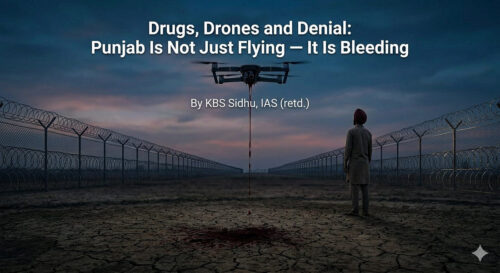
 Punjab does not grow the poison that is killing it. Every gram of heroin, every drone-dropped consignment, every diverted pharmaceutical tablet arrives from somewhere else — from Afghan poppy fields processed in Pakistan, from Himachal Pradesh’s under-regulated pharma hubs, from maritime routes through Gujarat’s ports. Yet the state absorbs it all, and pays with its children.
This is not a new observation. What is new is what this six-part series does with it.
Over the past several months, I have drawn on parliamentary panel reports, RTI data, NIA court filings, enforcement records, academic surveys, and — most importantly — the firsthand testimony of serving and recently retired senior Punjab Police officers at DGP and ADGP ranks, who spoke candidly and on the condition of anonymity. What they told me reframes this crisis in ways that no press release or political speech has yet dared to acknowledge.
The six articles follow a deliberate arc.
Article I — Punjab’s Poisoned Recruiting Ground opens with the figure that should have triggered a national emergency: of 3,65,872 persons who underwent mandatory dope tests for arms licence renewal across Punjab between 2018 and 2025, 55,318 tested positive. In Amritsar, nearly 30 per cent failed. The recruit who fails an Army dope test in 2025 began using at fourteen.
Article II — The War That Mistakes the Foot Soldier for the General asks the question no government answers: of the tens of thousands arrested under the NDPS Act, how many were kingpins and how many were couriers? An 89 per cent conviction rate built on the bottom of the pyramid is administration, not strategy.
Article III — Punjab Does Not Grow This Poison maps the full supply chain — Golden Crescent land routes, drone escalation from 3 drops in 2021 to 179 in 2024, the Mundra port seizure linked by the NIA to Lashkar-e-Taiba financing, and the Himachal pharmaceutical backdoor that no production quota currently controls.
Article IV — What the Officers Know is the heart of the series. A serving DGP-rank officer confirms the drones are carrying arms alongside drugs — a deliberate twin-strand narco-terrorist operation. A retired ADGP validates the High Court’s malkhana directive as the most effective judicial intervention in recent memory. And a retired DGP who lost his son — misrepresented by the media as a drug addict when the reality was a psychiatric condition under treatment — delivers a warning to Punjab’s establishment: no family, no collar, no colony is insulated.
Article V — Is Everyone in Punjab on Drugs? confronts the narrative head-on. The 2022 state survey found 84.6 per cent of residents did not report substance use. The opioid-dependent figure from the most rigorous survey is 0.7 per cent of the population. Serious. Not pandemic. The gangster-glorifying music industry and the diaspora WhatsApp chain are doing as much damage as the drugs themselves.
Article VI — Out of the Quagmire is the blueprint. State Narcotics Commission. Psychiatrist mandates at OOAT centres. DC-chaired border district coordination committees. BSF NDPS jurisdiction extended to 50 kilometres. SGPC gurdwaras as anonymous referral points. AI-assisted financial monitoring. And one demand of the political class that no task force can substitute: stand in your own constituency and tell the young men that the leader who protects the peddler is unworthy of the vote.
Punjab can come out of this quagmire. The map is available. The question is whether there is genuine political will across all parties— or whether the drug crisis is merely rhetoric to win votes and pin down political adversaries.