
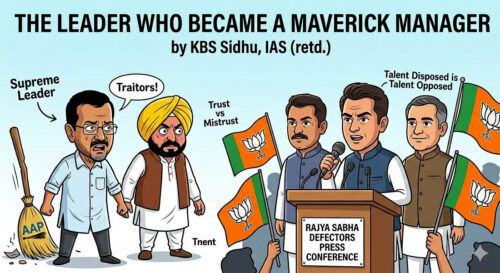
 On the morning of 24 April 2026, seven of ten Rajya Sabha MPs belonging to a major national political party walked out in a single, co-ordinated move and announced their merger with the ruling party at the national level. Three addressed the press conference; four others had already reportedly signed the requisite documents. By the time the sun set, the party’s Upper House strength had collapsed from ten to three.
The party’s supreme leader — its Chairman, its CEO, its dominant majority stakeholder, and the sole node through whom all consequential decisions flowed — responded in the only register he knew: he called them traitors. His chief ministerial representative held a press conference to say that seven people do not constitute a party. The organisation’s institutional machinery swung into the familiar mode of damage containment through narrative — external blame, external agency, external conspiracy. Operation Lotus.
What no one in the organisation asked, at least not publicly, was the harder question: Why? Not why did the BJP engineer it — that is the easy answer, and may even be partly true. But why were seven people — some of them among the organisation’s most capable — willing to be engineered, or even poached? What had the organisation, or the top leader, failed to provide that made the exit not just possible but, for each of them, preferable to staying?
In August 2023, we had published a 21-point Leader-Manager Continuum — an analytical framework examining the distinctive attributes that separate leaders from managers, and the continuum on which every individual in authority occupies a position. What follows is that framework applied as a diagnostic to the events of 24 April 2026. The organisation is not named. The supreme leader is not named. They do not need to be. Every reader will recognise the portrait.
The Ideology Myth
The first and most convenient explanation offered for the implosion was ideological: these MPs had no real commitment to the party’s founding values; they were moneybags, or windbags and outsiders who were never true believers. This explanation is as comfortable as it is hollow.
There is, in truth, no such thing as a binding ideology. Even the Constitution of India — the most precisely drafted foundational document of the republic, solemnly sworn to by every elected representative, every civil servant, every judge — is interpreted and implemented in divergent, often contradictory ways by all who invoke it. If the Constitution, with its 395 articles and seven decades of Supreme Court jurisprudence, cannot produce uniform conduct among those who swear allegiance to it, what exactly is the binding power of a political party’s ideological commitment?
Ideology is a recruitment narrative, not a binding contract. What holds organisations together — political parties, corporations, civil services, armies — is not ideology. It is the lived experience of being valued, heard, respected, and invested in by the leadership. When that experience is absent, no ideology fills the vacuum. The question, therefore, is not whether the departing MPs lacked ideology. The question is what the leader failed to build in its place.
KBS Sidhu
I, Me, Myself — The Centralisation Trap
The Leader-Manager Continuum’s first point distinguishes Trust from Mistrust. Managers, it observes, operate under systems of mistrust — monitoring, controlling, second-guessing. Leaders build on trust, fostering environments in which people can exercise judgement and grow.
The supreme leader of the organisation under examination had, over time, consolidated all significant decision-making in his own person. Whom to send to the Rajya Sabha. Which state each national-level functionary would manage. Who would speak in Parliament and who would not. Who received the party’s microphone and who was consigned to silence. Every consequential variable passed through a single node — and that node was, invariably, himself.
In corporate terms: imagine a Chairman and CEO who is also the dominant majority shareholder, who sits on every committee, approves every appointment, controls every communication channel, and whose personal preferences determine operational decisions at every level. Such a structure is not an organisation — it is an extension of a single personality. It may function with extraordinary efficiency when the personality is at its peak. It becomes catastrophically fragile the moment that personality is embattled, distracted, or absent.
“If you want to go fast, go alone. If you want to go far, go together.” — Ancient proverb, widely attributed to African oral tradition
The philosophical summation is ancient and unsparing: I, me, myself does not take you far. Every leader who has confused the organisation with himself has eventually discovered, usually too late, that the organisation is larger than any single individual — and that subordinating it entirely to one person’s preferences is not strength. It is the most dangerous form of institutional fragility.
Talent Disposed Is Talent Opposed
Point 10 of the Continuum addresses one of the most revealing differentiators between leaders and managers: Fear versus Empowerment. Managers, it observes, fear their second-in-command as potential replacements. Leaders empower and build a robust second line of command.
Consider the trajectory of the organisation’s most capable political strategist — the man who had engineered its single greatest electoral victory, who understood the target state’s political grammar at the grassroots with a precision that no one in the national leadership could match. After his election to the Rajya Sabha, he was relieved of his most consequential responsibility and dispatched to manage a state where the party had no meaningful presence. A sideways posting. A gilded exile.
Consider also the organisation’s most articulate parliamentary voice — a man whose constitutional fluency and media presence gave the party a platform it had never previously commanded in the Upper House. He found himself systematically denied the opportunity to exercise that eloquence within the party’s own institutional structures. He called it, publicly, a coordinated campaign. He said he was the right man in the wrong party.
These are not isolated grievances. They are symptoms of a systemic condition: a leader who is threatened by the capabilities of those around him, and who responds to that threat not by harnessing those capabilities but by clipping them. Talent that is not empowered does not remain dormant. It finds another outlet. And when that outlet is the opposing camp, the organisation pays twice — once for having lost the talent, and once for having created an adversary who knows precisely where the institutional vulnerabilities lie.
The Closed Door — Accessibility and Two-Way Communication
Points 11 and 15 of the Continuum speak directly to communication. Point 11 distinguishes Stating from Listening: managers issue directions; leaders listen, fostering open communication. Point 15 distinguishes Discourse from Interchange: managers dominate discussions; leaders encourage open conversation and a culture of exchange.
Respect, in an organisational context, is not merely what you say to someone. It is whether you are reachable by them. A leader who communicates only downward — who issues directions, sets agendas, determines outcomes, and is functionally inaccessible to those who might wish to offer a contrary view — is not leading. He is broadcasting. And organisations that receive only broadcasts, and have no channel through which to transmit, eventually find other ways to make themselves heard.
The microphone denied in the parliamentary chamber is a metaphor that extends far beyond Parliament. It stands for every meeting not convened, every call not returned, every concern not acknowledged, every capable person who was told, in effect, that their voice did not matter. The resignation letter, in such organisations, is not written on the day of departure. It is written, in the mind, on the day the door was closed.
The Loyalty Illusion — Compliance Is Not Commitment
Point 6 of the Continuum distinguishes Subordinates from Followers. A manager’s team members are subordinates — they comply because they must. A leader’s team members are followers — they align because they choose to. The distinction is everything.
The supreme leader of the organisation had, for years, commanded compliance. His electoral track record was formidable enough that compliance felt, from the outside, indistinguishable from commitment. But compliance is always conditional — on continued success, on perceived fairness, on the credibility of the promise that loyalty will be reciprocated. The moment any of those conditions weakens, compliance evaporates. It leaves no residue. It generates no loyalty debt that the departing member feels obliged to honour.
A leader who demands loyalty without investing in the dignity, visibility, growth, and genuine empowerment of those from whom he demands it is not building loyalty. He is accumulating a deferred liability. On 24 April 2026, seven of those liabilities were called in simultaneously. The organisation discovered, in a single morning, what it had been building for years.
Funds Are Not Enough — Empowerment Is the Multiplier
There is a temptation, in analysing the events of 24 April 2026, to reduce the value of the departing cohort to its financial dimension. Three of the seven are men of substantial means. The BJP has, it might be argued, simply purchased what the organisation neglected.
This reading is superficial. Money is inert without empowerment. A funded but disempowered operative cannot mobilise, cannot inspire, cannot build. Resources become productive only when accompanied by genuine delegation — the authority to make decisions, the trust implicit in being given real responsibility, the institutional standing that allows a person to act rather than merely to execute.
The supreme leader who believes he can substitute financial inducement for genuine empowerment — who offers positions and resources while withholding authority and respect — is making a category error. He is treating human beings as instruments of execution rather than as partners in a shared enterprise. Instruments, when better maintained elsewhere, migrate. Partners, genuinely invested in the enterprise, do not.
Point 4 of the Continuum makes the point from a different angle: Penalties versus Incentives. Managers rely on penalties; leaders use incentives. But the deepest incentive — more powerful than any financial consideration — is the sense of ownership, of being trusted, of mattering to the outcome. That is what empowerment provides. And that is precisely what was withheld.
It Is Not 10 Minus 7 — The Factorial Function
The conventional arithmetic of 24 April 2026 runs as follows: the organisation had ten Rajya Sabha MPs; seven left; three remain. A subtraction problem. Painful but manageable.
This arithmetic is wrong — or rather, it is the wrong kind of arithmetic entirely. What left the organisation on 24 April was not seven individuals. It was a network — seven nodes, each carrying distinct capabilities, each connected to the others, and each connected outward to financial resources, institutional relationships, cadre networks, and political intelligence that the organisation had been accumulating for years.
In network theory, the value of a network does not grow linearly with the number of nodes. It grows exponentially — or, as this writer would frame it, by something approaching a factorial function. Seven people who know each other, trust each other, and bring complementary strengths — political strategy, constitutional fluency, financial resources, organisational memory, industrial networks, mass recognition — do not produce the sum of seven individual contributions. They produce a combined force that is orders of magnitude greater than any additive calculation would suggest, because every connection between any two of them creates a channel of collaboration, mutual reinforcement, and shared intelligence.
The converse is equally true and equally devastating. Losing seven interconnected nodes from a network of ten does not leave a network of three. It leaves a remnant — three individuals shorn of the connective tissue that made the original ten a functioning whole. The organisation’s Rajya Sabha presence has not been reduced by 70 per cent. It has been reduced by something far closer to its entirety.
The receiving organisation, meanwhile, has not merely gained seven MPs. It has gained a network — with all the multiplicative potential that entails. This is the dimension of the implosion that no commentator has yet adequately framed.
The Institutionalisation Deficit — Personality Versus Structure
Point 18 of the Continuum distinguishes External Advice from Introspection. Managers seek external consultants to navigate challenges; leaders engage in regular introspection to improve and evolve. Point 21 — the final and perhaps most consequential point — distinguishes Discouraging Dissent from Encouraging Discussion. Managers aim for uniformity; leaders welcome diverse opinions and foster a culture of inclusion.
An organisation built around a personality — rather than around institutions, processes, and structures that outlast any individual — is inherently fragile. It may achieve spectacular results when the personality is at its peak. But it has no institutional immune system. When the personality is embattled — legally, politically, electorally — the organisation has nothing to fall back on, because nothing was built to stand independently of the personality.
The organisation under examination had, over a decade, constructed precisely this kind of personality-dependent structure. Its founding narrative, its electoral brand, its communication strategy, its internal decision-making — all roads led to one person. Institutions were not built; they were simulated. Processes were not established; they were improvised. Dissent was not channelled; it was suppressed. And when the personality came under sustained pressure, the simulation could no longer hold.
The Traitor Narrative — The Response That Deepens the Wound
Point 3 of the Continuum distinguishes Blame from Credit. A manager apportions blame, emphasising responsibility enforcement. A leader distributes credit, acknowledging individual and collective efforts. The post-implosion response of the supreme leader was, in this dimension, the response of a manager in its most defensive form.
The instinct to call departing members traitors is emotionally understandable and organisationally fatal. It is emotionally understandable because betrayal — whether real or perceived — produces rage, and rage seeks an object. It is organisationally fatal because it forecloses the only response that could actually arrest the damage: introspection.
A leader who calls every departing member a traitor is implicitly declaring himself blameless. And a leader who is blameless has nothing to correct. He will make the same decisions, maintain the same structures, close the same doors, and deny the same microphones — until the next cohort reaches the same conclusion as the last.
Worse, the traitor narrative sends a signal to those who remain. The organisation’s MLAs, its second-tier leaders, its workers, its donors — all of them observe the supreme leader’s response and draw their own conclusions about what awaits them if they ever fall out of favour. The snowball does not stop because it has been labelled a snowball. It gathers mass. The avalanche, having begun, finds more slope.
The Lesson the Leader Must Not Miss
Point 18 of the Continuum offers the most important prescription available to any leader in the aftermath of institutional failure: introspection. Not external advice. Not crisis management consultants. Not narrative warfare. Introspection.
The questions that introspection demands are uncomfortable precisely because they assign causation internally rather than externally. Not: who betrayed me? But: what did I fail to build? Not: which external agency engineered this? But: what did I deny these people — recognition, accessibility, empowerment, genuine partnership — that made departure preferable to staying? Not: how do I punish the traitors? But: what must I change so that the next cohort does not reach the same calculation?
The window, in the specific case that has triggered this analysis, is not years. It is months. Punjab goes to the polls in February 2027. The anti-incumbency arithmetic that produced a historic majority in 2022 cuts both ways: the higher the crest, the steeper the possible correction. Governance delivery has been uneven; structural challenges remain unaddressed; the fiscal position is strained. An organisation that spends the intervening months repeating the traitor narrative, rather than rebuilding trust, re-empowering its remaining cohort, and demonstrating the institutional capacity for self-correction, may find that the seven who left in April 2026 were not the culmination of the crisis but merely its opening act.
What manifested as seven MPs on one morning can return, sooner than any comfortable forecast suggests, as a larger number with a direct and irreversible impact on the organisation’s ability to govern. The cataclysm of April 2026 need not be the final act. But that determination rests entirely with the leader — and it rests on whether he has the courage to ask not “who betrayed me” but “what did I fail to build.”
The Continuum Never Lies
In 2023, this writer proposed a 21-point Leader-Manager Continuum as an analytical tool for self-assessment. The continuum was offered as an invitation to introspection — to ask, honestly, where on the spectrum between pure management and genuine leadership one actually stands.
The events of 24 April 2026 are, among other things, what happens when that question is never asked. When a leader mistakes control for strength, compliance for loyalty, financial inducement for empowerment, and narrative management for institutional building. When the door remains closed, the microphone is denied, dissent is suppressed, and talent is disposed of rather than invested in. When I, me, myself becomes the governing philosophy of an organisation that was built to serve a larger purpose than any single individual.
The continuum never lies. It simply waits — patiently, impartially — for the evidence to accumulate. On 24 April 2026, the evidence arrived. All at once. In the space of a single morning.
Share The KBS Chronicle