
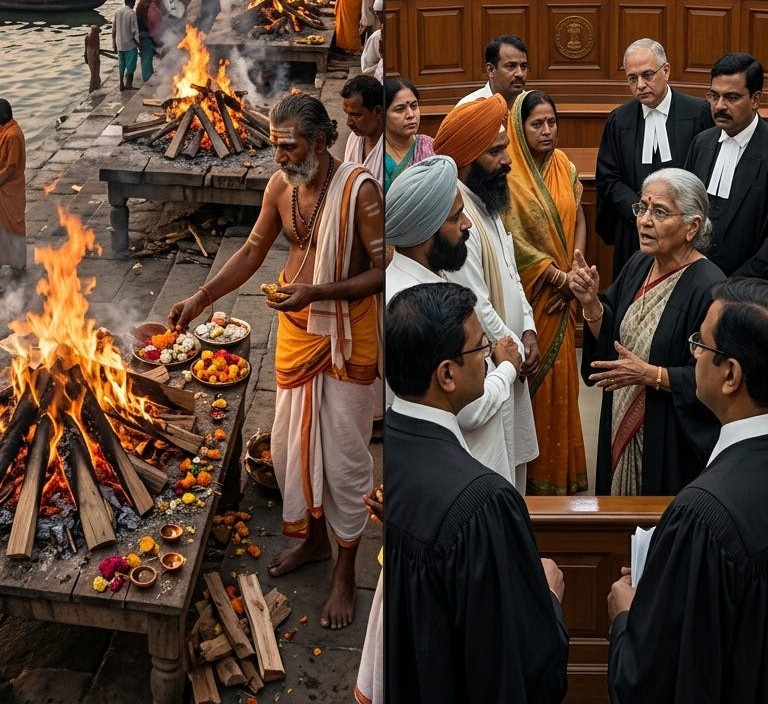
 At Manikarnika Ghat in Varanasi — that most sacred of Hindu cremation grounds, where moksha is said to be whispered by Shiva himself into the ear of the dying — a profound social irony plays out every hour of every day. Here, at the very threshold of liberation, the caste system reveals its most self-consuming logic: untouchability not merely imposed on the lowest of the low, but fracturing and replicating itself within the highest of the high.
The priests who perform the last rites at Manikarnika belong to a community known as the Mahabrahmans — technically Brahmins, formally twice-born, theoretically occupying the apex of the varna pyramid. Yet no mainstream Brahmin will dine with them, no Brahmin family will give their daughter in marriage to them, and no pandit of the conventional order will sit beside them in ritual company. Their sin? They accept the ritual dan — the gifts and dakshina — offered in the name of the dead, thereby absorbing the deceased’s accumulated sins and spiritual pollution. They perform, in other words, the most sacred duty in Hinduism: easing the passage of the soul. And for this, they are socially ostracised by the very community they belong to.
But the irony does not end there. When a Mahabrahman dies, his own community cannot perform his last rites. Another, even more marginalised sub-group — itself Brahmin by nominal classification but socially invisible — must step in. And when that sub-group’s members die, yet another layer of the excluded must attend to their bodies. Pollution, like hierarchy itself, is a recursive structure. The twice-born are not exempt from being rendered, within their own fold, ritually untouchable.
This is not a curiosity confined to the burning ghats of Kashi. Across India, the caste system has generated hundreds of such micro-hierarchies of exclusion. Among Scheduled Castes, the same dynamic operates at scale. The Valmikis of Punjab, traditionally assigned manual scavenging, are looked down upon by Ramdasia Sikhs; the Mazhabis are kept at distance from the Jatavs of Uttar Pradesh; the Madigas of Andhra Pradesh find themselves perpetually outcompeted by the better-organised Malas for every scholarship, every government post, every reservation benefit that the Constitution intended for all of them equally.
The great constitutionalist B.R. Ambedkar — himself a Mahar, and thus subject to discrimination even within the broad Scheduled Caste universe — spent his intellectual life documenting precisely this phenomenon. Caste, he argued, is not a binary between the Brahmin and the Untouchable. It is a system of graded inequality, where every community has someone above to be subordinated by and someone below to subordinate. No one is exempt. No one is safe. The twice-born Mahabrahman of Manikarnika and the Madiga agricultural labourer of Guntur are, in their own very different registers, both victims of the same logic.
It took the Supreme Court of India seven decades after the Constitution’s adoption to acknowledge this sociological truth in law. But in August 2024, it did.
II. The Constitutional Bench Speaks: Graded Inequality Gets Judicial Recognition
The judgment in State of Punjab v. Davinder Singh, delivered by a seven-judge Constitutional Bench of the Supreme Court on 1 August 2024, is among the most consequential pronouncements on reservations since the Constitution itself was enacted. By a majority of 6:1 — with only Justice Bela Trivedi dissenting — the Court upheld the power of state governments to sub-classify Scheduled Castes and Scheduled Tribes for the purposes of reservation, enabling them to identify the most disadvantaged sub-groups and provide them preferential access to the benefits constitutionally guaranteed.
The immediate occasion was a Punjab law that had sought to give priority within SC reservations to Valmikis and Mazhabi Sikhs — historically among the most deprived communities even within the SC category. But the Punjab and Haryana High Court had struck it down, relying on the Supreme Court’s own 2004 ruling in E.V. Chinnaiah v. State of Andhra Pradesh, which had held that Scheduled Castes constituted a homogeneous class and could not be further sub-divided. Davinder Singh overruled Chinnaiah, and in doing so, changed the constitutional landscape fundamentally.
The majority reasoned that the President’s list under Article 341, which identifies Scheduled Castes, does not create a monolithic class but merely collects together communities that share the common characteristic of historic discrimination and social disadvantage. Within that broad umbrella, the degree of disadvantage can — and does — vary enormously. A sub-classification that recognises this variation and directs benefits accordingly is not a violation of equality: it is, in fact, the truest expression of it. Equality does not demand identical treatment of the unequal. It demands proportionate recognition of differentiated need.
Punjab’s own history is, in fact, the most instructive illustration of both the wisdom and the fragility of sub-classification. As far back as 1975, under Chief Minister Giani Zail Singh’s Congress government, Punjab issued an executive circular reserving 50 per cent of the SC quota — that is, half of the 25 per cent reservation available to Scheduled Castes — for the Valmiki and Mazhabi Sikh communities, who were recognised as the most socially and educationally backward even within the SC universe. Mazhabi Sikhs constitute 31.6 per cent of Punjab’s total SC population; Valmikis constitute another 11 per cent. Together they represent nearly half the SC community, yet they had been systematically cornered out of the benefits that went disproportionately to better-organised SC communities. The 1975 circular was an act of administrative justice — but it rested on executive instructions alone, without legislative backing, and was therefore structurally vulnerable. The Punjab and Haryana High Court struck it down in 2006. Punjab’s legislature responded by enacting the Punjab Scheduled Caste and Backward Classes (Reservation in Services) Act, 2006, re-legislating the same sub-classification. The High Court struck that down too in 2010, citing E.V. Chinnaiah. The state then appealed to the Supreme Court — and it is precisely that appeal, State of Punjab v. Davinder Singh, that produced the landmark 2024 verdict. In a profound sense, the 50-year journey from Giani Zail Singh’s 1975 circular to the 7-judge bench’s 2024 ruling is Punjab’s own constitutional odyssey: a state that knew, from lived experience, that sub-classification was necessary, and that spent five decades in litigation to establish that it was also lawful.
Chief Justice D.Y. Chandrachud, writing for the majority, was emphatic that such sub-classification must not be arbitrary or driven by political calculation. It must be grounded in empirical data — sociological surveys, occupational analyses, educational attainment studies — and must pass the test of rational nexus to the constitutional objective of securing substantive equality. The state cannot simply decree that Community A within the SC list shall receive 60 per cent of reserved seats and Community B the remaining 40 per cent on a political whim. The exercise of sub-classification must be defensible on evidence.
Justice B.R. Gavai, in his concurring opinion, went a step further and articulated what is perhaps the most debated — and politically charged — aspect of the judgment. He observed that the logic of sub-classification, taken to its natural conclusion, also suggests that the creamy layer principle — currently applied to OBCs but explicitly excluded from SCs and STs by the Supreme Court’s earlier jurisprudence — may need reconsideration in the SC context as well. If reservation is intended to uplift the most disadvantaged, then those members of an SC community who have already achieved economic and social parity with the general population arguably no longer require its protection. To extend reservation indefinitely to the well-off within an SC family, Justice Gavai suggested, may be to dilute the very purpose for which it was created.
This observation is, for now, obiter — meaning it is not binding as ratio decidendi. But it has opened a constitutional conversation that will not close easily. The political implications are vast. The 50 per cent ceiling on reservations, the creamy layer question, and now sub-classification together form a triad of unresolved tensions that the Court has placed squarely before the nation.
The lone dissent by Justice Bela Trivedi deserves respectful acknowledgment. She argued that the President’s list under Article 341 is a constitutionally sealed document and that any re-stratification within it by state legislatures amounts to an impermissible interference with a central list that only Parliament can amend. This is a coherent textual argument, and it reflects a genuine concern: that sub-classification powers in the hands of states could become a tool for politically motivated tinkering with a list that was designed to be stable and judicially protected. The majority’s response — that sub-classification for preferential reservation is not the same as amending the list — is persuasive but not without its own tensions.
What is beyond dispute is that Davinder Singh has fundamentally altered the constitutional grammar of reservation. The question is no longer whether sub-classification is permissible. It is: how will it be done, by whom, on what evidence, and with what safeguards against abuse?
III. Manikarnika Meets the Constitution: Ancient Hierarchy, Modern Law
The Mahabrahman of Banaras and the Madiga of Guntur have more in common than either would likely acknowledge. Both are the victims of a system that uses ritual, custom, and social practice to enforce a hierarchy within a hierarchy. Both are told, in effect, that their marginalisation is natural, ordained, structural — and that the benefits intended for ‘their community’ do not, in practice, reach them.
The Supreme Court’s judgment in Davinder Singh is, read sociologically, a juridical acknowledgement of this truth. It says, in constitutional language, what the burning ghats of Kashi say in their ancient, terrible silence: that there is no flat equality within any caste grouping, that the most disadvantaged are often invisible behind the more organised, more articulate, more politically connected members of their own nominal category, and that a justice system that ignores these internal gradations is not delivering justice — it is merely allocating privilege more efficiently to those already best placed to capture it.
The data bears this out with painful clarity. In Andhra Pradesh, the Mala community — better educated, more urbanised, and with a longer history of engagement with colonial and post-colonial institutions — cornered a disproportionate share of SC reservations for decades, while the Madiga, predominantly rural, predominantly agricultural, and lacking the social networks to navigate bureaucratic processes, remained at the very bottom of the development ladder. The Madiga Reservation Porata Samiti has been agitating for sub-classification since the 1990s, not against reservations but for their equitable internal distribution. Davinder Singh is, in a profound sense, the constitutional vindication of their three-decade struggle.
IV. The Path Ahead: Justice in Principle, Peril in Practice
The judgment’s promise is real. Its risks are equally real, and must be managed with the same intellectual seriousness that the Court brought to its constitutional reasoning.
The most immediate risk is political weaponisation. Sub-classification requires states to collect empirical data, conduct sociological surveys, and make rational determinations about relative disadvantage. In practice, state governments — especially those facing elections — may be tempted to sub-classify along lines that maximise their vote arithmetic rather than their developmental impact. The creation of new sub-quotas for politically significant sub-groups, without genuine data, would be a betrayal of the judgment’s spirit while being technically compliant with its letter. The Court’s insistence on empirical grounding must be taken seriously by High Courts reviewing state sub-classification schemes.
The second risk is intra-SC conflict. By formally acknowledging that different SC communities have different claims on reservation benefits, the judgment creates a zero-sum arithmetic within the reserved pool. Gains for Valmikis necessarily mean reduced availability for Jatavs in states where the SC quota is fixed. This has already generated tension in Punjab, where the Ramdasia-Mazhabi divide is old and deep, and in Andhra Pradesh where Mala-Madiga rivalry is a live political fault line. Political parties that have historically consolidated SC votes by projecting inter-community solidarity now face the challenge — or the temptation — of exploiting these intra-SC divisions for electoral advantage. The dominant caste parties have always understood that a divided Dalit vote is a weaker Dalit vote. Sub-classification, poorly managed, could become the most elegant divide-and-rule mechanism in post-colonial Indian politics.
The third risk relates to Justice Gavai’s creamy layer observation. If extended to SCs without adequate safeguards, a creamy layer exclusion could perversely harm the very communities the judgment seeks to protect, by removing the most educated and economically mobile members of each sub-group from reservation eligibility at precisely the moment when those communities need role models and institutional anchors within the reserved services. The creamy layer, if introduced for SCs, must be calibrated with extraordinary care and must not use the same income thresholds applied to OBCs, given the qualitatively different nature of caste discrimination faced by SCs.
What is needed, urgently, is a National Commission for Scheduled Caste Sub-Classification — a body with constitutional status, sociological expertise, and the mandate to conduct state-by-state surveys and recommend sub-classification schemes that are evidence-based, periodically reviewable, and insulated from electoral cycles. The existing National Commission for Scheduled Castes could be reconstituted and empowered for this purpose. Without such an institutional framework, the judgment risks becoming a litigation bonanza for lawyers and a political football for parties, while the Mahabrahman of Manikarnika and the Madiga of Guntur wait, as they always have, for a justice that keeps announcing itself and keeps arriving late.
The Supreme Court has, in Davinder Singh, done something rare and difficult: it has brought the law into alignment with social reality. The task now is to ensure that implementation does the same. The burning ghats of Kashi will not wait for the political class to find its conscience. But the Constitution, at least, has spoken.