
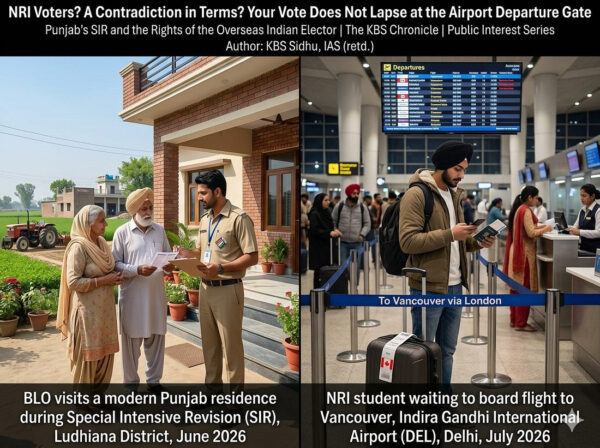
 A question that recurs with striking frequency as the Special Intensive Revision (SIR) of electoral rolls gathers momentum across Punjab is this: what happens to the Punjabi student in Toronto, the professional on an H-1B visa in Houston, the nurse working in Birmingham or the trader settled in Dubai? They hold valid Indian passports. They have not taken foreign citizenship. They are, in the most fundamental constitutional sense, citizens of India. Yet the Booth Level Officer who visits their family home in Ludhiana or Jalandhar or Amritsar will find them absent — and under the SIR’s enumeration logic, absent for more than six months at that. Does their name get deleted? Are they simply written off the democratic ledger?
The short answer is: they should not be, and the law makes specific provision for them. The longer answer requires a clear understanding of a statutory category that is little understood outside official circles — the Overseas Elector — and of the procedural steps that the diaspora must now take before the final electoral roll for Punjab is published on 1 October 2026.
I. The Scale of the Punjab Diaspora
Punjab punches far above its demographic weight in the matter of emigration. Estimates place the Punjabi diaspora at between 1.5 and 2 crore persons worldwide, with the largest concentrations in Canada, the United Kingdom, the United States, Australia, and the Gulf states. A significant proportion of this diaspora consists of first-generation emigrants who continue to hold Indian passports — students on study visas, professionals on work permits, and long-term residents who have chosen not to naturalise. They retain deep familial, financial, and emotional ties to Punjab. Many own property there. Many return for marriages, harvests, and religious observances. They are not strangers to the constituencies in which they were born or raised. They are, however, absent in the technical sense that electoral law ordinarily requires.
The SIR exercise, now entering its door-to-door enumeration phase from 25 June to 24 July 2026, will produce a draft electoral roll by 3 August 2026. Claims and objections will be entertained until 2 September 2026. The final roll will be published on 1 October 2026 — and it is on that roll that the Punjab assembly elections of early 2027 will be fought. The window for action is therefore narrow and closing.
II. The Legal Architecture: Section 20A and the 2010 Amendment
The right of the overseas Indian to be registered as a voter is not a matter of administrative grace. It is a statutory entitlement, enacted by Parliament through the Representation of the People (Amendment) Act, 2010, which inserted Section 20A into the Representation of the People Act, 1950. The amendment came into effect on 10 February 2011.
The provision has a precise scope. It covers every Indian citizen who:
(a) has not acquired the citizenship of any foreign country;
(b) has attained the age of 18 years on the qualifying date (the first day of January of the year of revision of the electoral roll); and
(c) is absent from his place of ordinary residence in India owing to employment, education, or otherwise — whether temporarily or not.
Such a person is entitled to have his name registered in the electoral roll of the constituency in which his place of residence in India as mentioned in his passport is located.
The significance of this formulation cannot be overstated. The anchor is the passport address — not the address at which the person currently sleeps, not the address from which he pays property tax, but the address recorded in the valid Indian passport. It is an elegant solution to an otherwise intractable problem: how does a constitutional democracy maintain the franchise of a mobile citizenry without requiring physical presence?
The Registration of Electors (Amendment) Rules, 2011 gave procedural effect to Section 20A. These Rules for the first time defined “Overseas Elector” as a citizen of India within the meaning of Section 20A, aged 18 years or above, whose place of residence in India as mentioned in the passport falls within a particular constituency.
III. The Critical Distinction: NRI Voter versus OCI Cardholder
A widespread confusion in the diaspora conflates two entirely separate categories: the Non-Resident Indian (NRI) holding an Indian passport, and the Overseas Citizen of India (OCI) cardholder who has taken foreign citizenship.
The distinction is absolute in law. An OCI cardholder has no voting rights in India. The OCI scheme, introduced through an amendment to the Citizenship Act, 1955 in August 2005, provides a form of permanent residency and certain civil rights, but expressly excludes the franchise. An OCI holder has, in legal terms, given up Indian citizenship and with it the right to vote.
An NRI holding a valid Indian passport, by contrast, has done no such thing. He remains an Indian citizen in the full constitutional sense. His franchise does not lapse because he boards a flight. It does not expire after six months of absence. It does not require annual renewal. It exists as a matter of citizenship, and Section 20A provides the specific mechanism by which it is given effect on the electoral roll.
The Punjabi student who has been in Canada for three years on a study permit, has not applied for Canadian citizenship, and whose Indian passport lists a Patiala address — that student has an absolute legal right to be on the electoral roll of the Patiala constituency concerned.
IV. The Instrument: Form 6A
The prescribed form for registration as an Overseas Elector is Form 6A. It is distinct from Form 6, which is used by ordinary resident voters seeking fresh registration. The distinction matters during the SIR exercise, because Booth Level Officers distributing Form 6 at the doorstep are not the primary channel for Form 6A — that form is filed directly with the Electoral Registration Officer (ERO) of the constituency.
Form 6A requires the following information and documents:
Personal details: Full name, gender, date of birth, place of birth, and the name of a family member for identification purposes.
Passport particulars: Passport number, date and place of issue, and the address in India as recorded in the passport.
Address abroad: Current residential address outside India, along with a functional mobile number and email address.
Visa details: The relevant visa page of the passport.
Photograph: One recent passport-size colour photograph affixed to the form.
Document copies: Self-attested photocopies of the relevant pages of the passport — specifically the photo page, the personal particulars page, the address page, and the page bearing the current visa endorsement.
V. The Three Routes to Filing Form 6A
The Election Commission of India has provided three distinct routes by which an Overseas Elector may submit Form 6A. Each has its own procedural requirements.
Route 1 — Online filing (recommended). Form 6A is available on the National Voters’ Service Portal at voters.eci.gov.in. The form can be filled and submitted entirely online. The applicant must upload scanned copies of the relevant passport pages and the visa page. This is the most practical route for an applicant who is physically abroad, as it requires no postal logistics and generates an acknowledgement immediately.
Route 2 — By post. The completed Form 6A, accompanied by self-attested photocopies of the relevant passport pages, may be sent by post directly to the Electoral Registration Officer of the constituency in which the passport address falls. The ERO’s details — name, designation, and office address — are available on the website of the Chief Electoral Officer of Punjab (ceopunjab.nic.in). Each postal submission should include copies of: the photo page, the personal particulars page, the India address page, and the page bearing the current visa endorsement. All copies must be self-attested.
Route 3 — In person before the ERO. An applicant who is visiting India may appear in person before the ERO or the Assistant Electoral Registration Officer (AERO) of the relevant constituency. In this case, the original passport must be produced for verification; it will be returned immediately after inspection. A photocopy of the relevant pages must also be provided.
Forms are additionally available, free of cost, at Indian Missions and Consulates abroad. An applicant may also submit Form 6A through a consulate or mission, which will forward the application to the concerned ERO in India.
VI. What Happens After Submission: The Verification Process
Once Form 6A is received by the ERO, the following sequence of verification takes place.
The Booth Level Officer assigned to the polling station area in which the passport address falls will visit the home address mentioned in the passport. He will enquire with family members or others present to verify the applicant’s connection to that address.
In cases where no family member is available or willing to provide a declaration, or where the home is unoccupied, the documents will be forwarded for verification to the concerned Indian Mission in the country in which the applicant resides.
The ERO’s decision — whether to include or reject the application — will be communicated to the applicant by post at the foreign address provided in Form 6A, and also by SMS to the mobile number given in the form.
Once registered, the applicant’s name appears in a separate section labelled “Overseas Electors” at the end of the roll for the relevant polling station area — not in the main alphabetical roll of ordinary resident voters. This is an administrative distinction; the vote itself is equal in weight to any other.
VII. The SIR Exercise and the NRI: What the BLO Visit Does and Does Not Mean
A particular concern has been raised by families of overseas Punjabis during the current SIR. When the Booth Level Officer visits the family home, finds the NRI member absent, and records that absence — does this trigger deletion?
The answer requires some care. The SIR is designed to verify the ordinary resident electors on the existing roll. A person already registered as an Overseas Elector under Form 6A is in a separate section of the roll and should not be affected by the BLO’s ordinary enumeration of resident voters.
However, a person who was previously registered as an ordinary resident voter — say, before he emigrated — and whose name is still on the main roll as a resident elector, is in a different position. If the BLO records him as absent for more than six months with no forwarding address, his name becomes a candidate for deletion as a non-resident. This is the scenario that has caused alarm.
The remedy is straightforward. A person in this situation should surrender his existing EPIC (Voter ID card) and file Form 6A to be registered as an Overseas Elector. The law is explicit: an individual can appear on only one roll. The transition from ordinary elector to overseas elector is a recognised procedure, and the voter portal makes provision for it.
Families at home should also be aware that they may bring the NRI member’s Form 6A application to the attention of the BLO during the door-to-door visit, or directly to the ERO’s office, so that the record reflects the overseas elector status rather than an unexplained absence.
VIII. The Unresolved Grievance: Registration Without the Ability to Vote
This article would be incomplete without acknowledging the central irony of the overseas elector’s situation, an irony that has been before the courts and Parliament alike without definitive resolution.
Section 20A entitles the overseas elector to registration. Section 20A(3) further states that every person registered thereunder, if otherwise eligible to exercise the franchise, “shall be allowed to vote at an election in the constituency.” The legal right to vote is unambiguous. The practical mechanism, however, remains deeply restrictive.
As of mid-2026, the overseas elector must be physically present at the assigned polling station in India on election day to cast his vote. There is no provision for postal ballots, no mechanism for electronically transmitted ballot papers, and no proxy voting arrangement in force. A committee of the Election Commission, reporting to the Supreme Court as long ago as 2014, had recommended a phased implementation of an e-postal ballot system for overseas electors, with pilot testing in select constituencies before scaling to parliamentary elections. The government introduced the Representation of the People (Amendment) Bill, 2017, which proposed proxy voting for NRIs — allowing an authorised representative in India to vote on the NRI’s behalf. That Bill was never passed.
The consequence is stark. Out of an estimated 1 crore or more NRIs worldwide who hold Indian passports, only approximately 1.19 lakh were registered as overseas electors for the 2024 general election. The registration figure is itself a measure of the futility that the in-person requirement creates: why register if one cannot travel back on polling day?
For Punjab specifically, with assembly elections approaching in early 2027 and a diaspora whose political engagement is demonstrably high, the absence of a remote-voting mechanism represents a significant democratic deficit. The vote of the Punjabi farmer’s son in Brampton and the Punjabi nurse in Milton Keynes is, in practical terms, a vote that exists on paper and nowhere else.
IX. The Qualifying Date and the SIR Window: A Calendar for Action
For the current SIR in Punjab, the qualifying date is 1 October 2026. An applicant must have attained the age of 18 years on 1 January 2026 to be eligible for inclusion in this revision.
The operative calendar is as follows:
BLO door-to-door visits: 25 June to 24 July 2026
Publication of draft electoral roll: 3 August 2026
Period for claims and objections: 3 August to 2 September 2026
Notice phase and disposal of claims: 3 August to 28 September 2026
Publication of final electoral roll: 1 October 2026
Form 6A applications may be submitted at any time — the SIR exercise has no special deadline for overseas elector applications as distinct from the ordinary elector claims process. However, applications filed during the claims and objections period (3 August to 2 September 2026) stand the best chance of being processed and included in the final roll published on 1 October 2026. Applications filed after the disposal deadline of 28 September 2026 will be processed in the subsequent summary revision.
X. A Checklist for the Punjab Diaspora
Overseas Punjabis and their families may wish to work through the following steps before the SIR window closes.
Step 1 — Confirm citizenship status. Has the NRI family member taken foreign citizenship? If yes, he or she has no electoral registration rights in India. If the Indian passport remains valid and no foreign citizenship has been acquired, the right to register persists.
Step 2 — Check whether already registered. The voter portal at voters.eci.gov.in allows name search by constituency. A search under the “Overseas Electors” section will confirm whether the person is already on the roll.
Step 3 — Check for inadvertent deletion. If the person was previously on the roll as an ordinary resident elector and no Form 6A was ever filed, the current SIR may have flagged him for deletion. Families should check the draft roll when published on 3 August 2026, and file an objection if a name has been wrongly removed.
Step 4 — File Form 6A online. Navigate to voters.eci.gov.in, select Form 6A, fill in the details as per the passport, upload scanned copies of the required passport pages, and submit. Keep the acknowledgement reference number.
Step 5 — If previously registered as an ordinary elector, surrender the EPIC. Submit the EPIC along with Form 6A. The voter portal provides for this. The same EPIC number will, if appropriate, be retained on the new overseas elector entry.
Step 6 — Track the application. The ERO’s decision will be communicated by post and SMS. The voter portal also allows status tracking. If the application is not decided within the stipulated period, a representation may be made to the ERO directly, or to the Chief Electoral Officer, Punjab.
Conclusion: A Right That Must Be Claimed
The right of the overseas Indian to be on the electoral roll is not automatic. It is a right that requires an application — Form 6A — and that application will not be filed by the BLO who visits the family home, nor by the political party worker who maps voters in the locality. It must be filed by the NRI himself, or at his direction by a family member acting on his behalf with proper authorisation.
Punjab’s diaspora is among the most politically aware and financially engaged in India. It has built hospitals, gurudwaras, educational institutions, and housing colonies across the state. It has a legitimate and deep stake in who governs the land to which it remains connected. The law has recognised that stake since 2011. The electoral machinery has been configured to give it effect through Form 6A. The current SIR, with the final roll date of 1 October 2026, provides the immediate occasion.
The passport in the drawer overseas is not merely a travel document. For the Indian citizen who has not given up his nationality, it is also — if he chooses to make it so — the key to the electoral roll. The choice, and the procedural obligation, is his.
Share The KBS Chronicle