
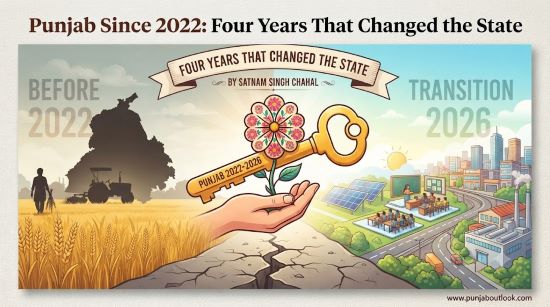
 Punjab has always occupied a unique position in India’s political, economic, and social landscape. As the country’s border state with Pakistan, the birthplace of the Green Revolution, and home to one of the world’s largest Punjabi diasporas, Punjab has influenced national discussions far beyond its geographical boundaries. The state has contributed enormously to India’s agriculture, defence, industry, culture, and global identity. However, despite its agricultural achievements, entrepreneurial spirit, and rich cultural heritage, Punjab entered the 2022 Assembly elections facing several serious challenges, including rising public debt, unemployment, concerns over drug abuse, declining industrial growth, agricultural difficulties, and increasing migration of young people seeking opportunities abroad.
The Punjab Assembly election of 2022 became one of the most significant political turning points in the state’s modern history. The electorate rejected the traditional political arrangement that had largely revolved around the Indian National Congress and the Shiromani Akali Dal for several decades. The Aam Aadmi Party (AAP), which campaigned on promises of clean governance, improved education, better healthcare, employment opportunities, affordable electricity, and an end to corruption, received an overwhelming mandate from the people of Punjab.
For many voters, the 2022 election represented more than a routine change of government. It reflected a desire for a new style of politics based on accountability, transparency, efficient administration, and direct delivery of public services. The victory also gave AAP a major political boost at the national level, as Punjab became the party’s first full-majority government outside Delhi. The election result demonstrated that voters were willing to move away from traditional political loyalties when they believed a new political alternative could address their concerns.
Four years later, as Punjab moves closer to the 2027 Assembly elections, the political environment has become more complex. The enthusiasm and expectations that followed the 2022 mandate now exist alongside difficult questions about governance, economic management, institutional capacity, employment generation, and the pace of reforms. Supporters of the government point to initiatives in education, healthcare, electricity, and administrative reforms as signs of progress. At the same time, critics raise questions regarding unemployment, industrial development, fiscal management, agricultural policies, law and order, and the ability of the government to fulfill its broader election commitments.This chapter examines Punjab’s political journey from 2022 to 2026 and analyzes the major developments that have shaped public debate. The objective is not to support or oppose any political party but to provide readers with a broader understanding of the changing political, economic, and social environment of Punjab.
The Political Earthquake of 2022
The 2022 Assembly election fundamentally transformed Punjab’s political landscape. The Aam Aadmi Party achieved a historic victory by securing a decisive majority, while both the Congress and the Shiromani Akali Dal experienced one of their weakest performances in the state’s electoral history. The result reflected widespread public dissatisfaction with established political parties and demonstrated a strong demand for change.Several factors contributed to this political transformation. Growing frustration among youth regarding unemployment and limited economic opportunities played an important role. Many voters expressed concerns about corruption, administrative inefficiency, and the need for greater transparency in government functioning. After years of competition between traditional political forces, sections of the electorate appeared willing to experiment with a new political alternative.AAP’s campaign focused heavily on issues directly connected with everyday life. Promises related to improving government schools, strengthening healthcare facilities, providing affordable electricity, creating employment opportunities, and establishing a corruption-free administration appealed to many sections of society. The election also highlighted the increasing influence of younger voters, many of whom evaluated political parties based on development, jobs, education, and public services rather than traditional party identities.
A Government With Extraordinary Expectations
The new administration that took office in 2022 inherited not only the responsibility of governing Punjab but also exceptionally high public expectations. The scale of the electoral mandate created a belief among many citizens that rapid improvements would follow across multiple sectors.People expected progress in employment generation, reduction of corruption, improvement in law and order, expansion of healthcare and education facilities, better support for agriculture, promotion of industrial investment, and stronger action against the drug problem. These expectations reflected the urgency of Punjab’s challenges but also created a difficult environment for any government because many of the state’s problems had developed over decades and required long-term solutions rather than immediate changes.The challenge before the government was to balance short-term public demands with long-term structural reforms. Effective governance required not only announcing new policies but also ensuring proper implementation, financial sustainability, administrative coordination, and measurable outcomes.
Punjab’s Economic Challenges
Economic issues remained at the centre of public debate during this period. Punjab continued to face concerns related to public debt, limited industrial expansion, employment generation, and pressure on government finances. A significant portion of the state budget was committed to salaries, pensions, interest payments, and welfare schemes, leaving limited resources available for large-scale capital investment and infrastructure development.The state faced the difficult task of balancing welfare commitments with financial sustainability. Providing immediate relief and support to citizens remained an important political priority, but long-term economic growth required investment in industry, technology, infrastructure, education, and entrepreneurship.Economists, business organizations, and policymakers repeatedly emphasized the need for a new economic strategy that could attract investment, create quality employment opportunities, encourage small and medium enterprises, and reduce dependence on traditional sectors. The future strength of Punjab’s economy depends on its ability to move beyond historical strengths and develop new sources of growth.
Agriculture at a Crossroads
Agriculture remains one of the most important pillars of Punjab’s economy and rural society. The state played a historic role in India’s Green Revolution, but the agricultural model that brought prosperity in previous decades now faces several challenges.Farmers continue to deal with rising input costs, declining groundwater levels, environmental concerns, climate change, and uncertainty regarding agricultural markets. The debate over crop diversification, sustainable farming methods, and the future of Minimum Support Price policies has become increasingly important.The challenge before policymakers is no longer simply increasing agricultural production. The larger question is how Punjab can protect farmer incomes while ensuring environmental sustainability. Long-term solutions require cooperation among farmers, government institutions, agricultural experts, and market stakeholders.
Employment and Migration
Employment emerged as one of the most important political and social issues during this period. A large number of educated young Punjabis continued to seek opportunities abroad, particularly in countries such as Canada, Australia, the United Kingdom, the United States, and Europe.For many families, migration has become a pathway toward economic security and a better future. Overseas education and employment have created new opportunities, but the continuing migration of young and skilled people has also raised concerns about Punjab’s demographic future, workforce availability, and economic development.While remittances from abroad contribute significantly to family incomes and local economies, the long-term challenge remains creating enough quality employment opportunities within Punjab so that young people have meaningful choices at home.
Education and Healthcare
Education and healthcare remained among the most closely examined areas of governance. The government introduced initiatives aimed at improving public schools, healthcare facilities, and service delivery systems.Supporters viewed these efforts as important steps toward strengthening public institutions and improving access to essential services. However, questions were also raised regarding implementation, staffing shortages, infrastructure requirements, and the need for sustained investment.The success of reforms in education and healthcare will ultimately depend on consistent implementation, adequate financial resources, professional management, and measurable improvements in outcomes.
Law and Order
Law and order continued to be a major concern in Punjab’s public discussions. Issues related to organized crime, drug trafficking, cross-border smuggling, and public safety remained significant challenges.Government agencies reported enforcement actions against criminal networks and drug-related activities, while critics argued that deeper structural reforms were necessary to achieve long-term improvements in policing and criminal justice.As Punjab approaches the 2027 Assembly elections, law and order is expected to remain one of the important issues influencing public opinion.
The Role of the Punjabi Diaspora
Punjab’s global diaspora continues to play an important role in the state’s economic, social, and political life. Non-Resident Punjabis contribute through investments, remittances, charitable activities, educational initiatives, and advocacy on issues affecting Punjab and Punjabis worldwide.Advances in communication technology have further strengthened connections between Punjab and overseas communities. Diaspora Punjabis closely follow developments related to governance, agriculture, economy, immigration, and social issues.The relationship between Punjab and its diaspora represents a significant opportunity for investment, knowledge exchange, and global cooperation.
A Changing Political Landscape
Although AAP remains the governing party, Punjab’s political environment has become increasingly competitive. The Congress continues efforts to rebuild its organizational strength, while the Shiromani Akali Dal is attempting to reconnect with its traditional support base. The Bharatiya Janata Party is working to expand its independent presence in the state, and newer political entrants such as Janata Dal (United) have shown interest in creating a political base in Punjab.These developments indicate that the 2027 Assembly election may witness a more complex and competitive political contest. The outcome will depend on governance performance, political alliances, public expectations, local leadership, and the ability of parties to address Punjab’s long-term challenges.The next chapter will examine in detail “The Rise of AAP and the Challenges of Governance”, focusing on the factors behind AAP’s historic victory, its governance approach, major initiatives, achievements, criticisms, and the political challenges ahead of 2027.
Disclaimer: This article and accompanying images are for informational and illustrative purposes only. Some visuals may be AI-generated or digitally enhanced and may not depict actual events or persons.Views expressed are based on publicly available information and analysis.