
 During the violent years of Punjab’s militancy period, thousands of families were left searching for missing sons, brothers, husbands, and fathers. Many disappeared after being taken into custody, while others were reported missing during the intense counter-insurgency operations of the early 1990s. For years, families lived with uncertainty — not knowing whether their loved ones were alive, imprisoned, or dead.It was in this atmosphere that Jaswant Singh Khalra emerged as one of the most prominent voices demanding answers. A former bank employee, social activist, and General Secretary of the Human Rights Wing of the Akali Dal (Amritsar), Khalra devoted himself to documenting alleged human rights violations and bringing attention to families who claimed their relatives had disappeared.
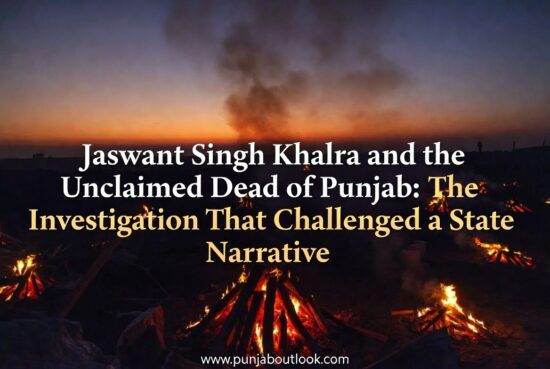
His investigation into the disposal of unidentified bodies in Punjab became one of the most significant human rights inquiries of the decade.In February 1995, an investigation presented in Chandigarh by the Human Rights Wing of the Akali Dal (A) revealed official records from Patti in Amritsar district that raised serious questions about the fate of hundreds of people classified as “unidentified” or “unclaimed.”The report, prepared after examining municipal records, alleged that 538 bodies were cremated or buried as unclaimed in Patti between 1991 and 1994. According to the investigators, many of these individuals may not have been militants but ordinary residents whose identities were never properly established.The evidence presented included copies of the Patti Municipal Committee’s stock registers, which recorded expenses related to cremations, including purchases of firewood used for last rites.
The report argued that if one subdivision could account for more than 500 such cases, the total number across Punjab could have been far higher. It estimated that thousands of unidentified bodies may have been disposed of throughout the state during that period.For Jaswant Singh Khalra, the issue was not merely political it was a humanitarian question.
He began collecting information from families who claimed their relatives had disappeared after being detained by security agencies. He travelled across Punjab, met grieving families, examined records, and documented cases that he believed required independent investigation.Khalra repeatedly argued that even during a period of armed conflict, the rule of law and human dignity could not be ignored. He maintained that every person had the right to identification, due process, and a proper final farewell.His campaign focused on the families who were left without answers people who did not know whether to mourn their loved ones or continue searching for them.
One of the most controversial aspects of Khalra’s investigation involved his claims regarding mass cremations of unidentified bodies by authorities.He alleged that official records from several cremation grounds showed large numbers of bodies being disposed of without adequate identification procedures. His findings drew national and international attention and became part of broader discussions about accountability during counter-insurgency operations.Khalra’s supporters described his work as a historic effort to preserve the memory of thousands who had disappeared. His critics, however, questioned some of his conclusions and the interpretation of records. The debate reflected the deep divisions that continued to surround Punjab’s violent past.
Khalra’s activism came at great personal risk. He continued his work despite warnings and pressure. On September 6, 1995, he was allegedly abducted from outside his home in Amritsar. His disappearance created national and international concern.After investigations and legal proceedings, several police personnel were convicted in connection with his abduction and murder. His death turned him into a symbol of the human rights movement in Punjab.For many families of the disappeared, Khalra became remembered as a person who gave voice to their pain when few others were willing to listen.Nearly three decades later, the questions raised during Khalra’s investigations remain an important part of Punjab’s historical discussion. His work forced society to confront difficult questions:
How should a democracy deal with allegations of excesses during periods of internal conflict?
What rights do families have when a person disappears in state custody?
How can justice be delivered when victims remain unidentified?
Supporters remember Khalra as a courageous human rights defender who stood for truth, justice, and dignity. His critics continue to debate aspects of his findings, but there is no denying that his investigations brought international attention to the issue of missing persons and accountability in Punjab.The records from Patti and other cremation grounds became more than government documents they became symbols of unanswered questions and the pain of families searching for closure.
The story of Jaswant Singh Khalra is ultimately the story of a man who chose to document the suffering of ordinary people during one of Punjab’s most difficult periods.His message was simple but powerful: even in times of violence, every human life matters, every family deserves answers, and every person deserves dignity in life and in death.The unclaimed bodies investigation remains one of the most significant chapters in Punjab’s modern history, and Khalra’s name continues to be associated with the pursuit of truth and accountability.
Referances:Daily Ajit Disclaimer: This article and accompanying images are for informational and illustrative purposes only. Some visuals may be AI-generated or digitally enhanced and may not depict actual events or persons. Views expressed are based on publicly available information and analysis.