
 Editor’s Note: History belongs to everyone, not to any single political party, government, or ideology. The purpose of this chapter has been to present one of the most sensitive episodes in India’s modern history through a balanced historical lens. Understanding the past honestly—acknowledging both the security challenges faced by the state and the profound grief experienced by affected communities—is essential if future generations are to learn the value of dialogue, constitutional democracy, justice, and lasting peace.-Editor
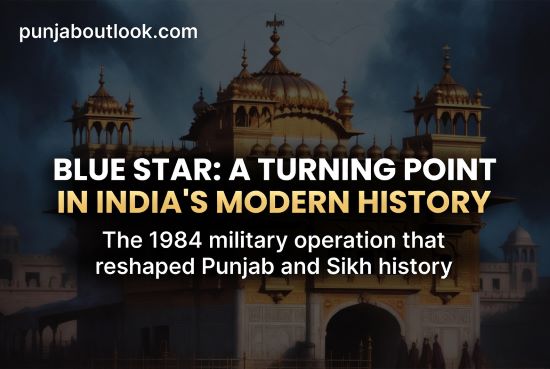
Operation Blue Star did not conclude Punjab’s crisis; rather, it marked the beginning of an even more turbulent chapter in the state’s history. While the military operation succeeded in removing armed militants from the Golden Temple complex and other religious premises, it also profoundly altered the political, religious, and psychological landscape of Punjab. The events of June 1984 left deep emotional wounds that extended far beyond the borders of India and continue to influence public discourse, historical scholarship, and collective memory more than four decades later.
For the Government of India, the operation represented a difficult but necessary decision taken after repeated efforts to restore law and order had failed. Successive governments have maintained that armed militants had transformed the Golden Temple complex into a fortified position, accumulated sophisticated weapons, and challenged the authority of the Indian state. Officials argued that no democratic government could permit armed groups to establish such positions within a religious shrine while violence across Punjab continued to escalate. From this perspective, the operation was presented as an unavoidable security measure intended to protect constitutional order, restore public safety, and prevent further deterioration of the law-and-order situation.
For a large number of Sikhs, however, Operation Blue Star became one of the most painful events in the history of the community after Independence. The military action inside the Harmandir Sahib (Golden Temple) complex, the damage sustained by the Akal Takht, and the loss of life created profound sorrow and anger. Many Sikhs who opposed militancy nevertheless regarded the operation as a deeply traumatic event because it occurred at the faith’s holiest shrine. The emotional impact extended well beyond Punjab to Sikh communities throughout the world, where demonstrations, prayer meetings, and public discussions reflected widespread grief and concern.
The operation also generated continuing debates among historians, military analysts, political scientists, and human rights scholars. Some researchers argue that deteriorating security conditions left the government with very limited options. Others contend that further political negotiations or alternative security strategies might have reduced casualties and prevented damage to the shrine. Questions concerning intelligence assessments, operational planning, timing, civilian presence within the complex, and casualty figures continue to be examined through academic research, memoirs, official documents, and independent investigations. Although many facts surrounding the operation are well documented, several aspects remain the subject of scholarly debate.
The immediate political consequences of Operation Blue Star were profound. Trust between many sections of the Sikh community and the Government of India declined sharply. Moderate political voices found it increasingly difficult to create space for dialogue, while polarization deepened across Punjab. Families who lost loved ones during the operation carried emotional scars that would influence public opinion for many years. The relationship between security, religion, and politics became significantly more complicated than before June 1984.
The operation also reshaped India’s internal security policies. Security agencies expanded intelligence operations, strengthened coordination among law-enforcement institutions, and reviewed strategies for responding to armed insurgencies. Military academies and police training institutions later studied Operation Blue Star as one of the most complex urban military operations conducted within a religious site, examining both its operational challenges and its political consequences.
Internationally, governments, scholars, and media organizations closely followed developments in Punjab. Sikh communities across the United Kingdom, Canada, the United States, Europe, Southeast Asia, and Australia expressed deep concern regarding the events. The operation became an issue discussed not only in Indian politics but also within the broader Sikh diaspora, influencing community organizations, academic research, and international perceptions of developments in Punjab.
Beyond politics and security, Operation Blue Star became part of Punjab’s collective memory. Families passed stories from one generation to another. Writers, poets, journalists, filmmakers, and historians attempted to document the experiences of those who lived through those difficult days. Different communities remembered the events through different lenses, reflecting the complexity of a history in which grief, fear, sacrifice, duty, and loss were experienced simultaneously by different sections of society.
History rarely provides simple answers to complex events. Punjab’s crisis during the early 1980s emerged from a combination of political disagreements, constitutional questions, economic concerns, religious sensitivities, militant violence, and state responses. Operation Blue Star was one moment within that larger historical process. Understanding it requires careful examination of official records, judicial findings, scholarly research, eyewitness accounts, and the diverse experiences of those who lived through the conflict.
The events of June 1984 also demonstrated an enduring lesson about democratic societies. Political grievances, if left unresolved for prolonged periods, can become increasingly difficult to address. Likewise, security responses to violent challenges often produce consequences that extend far beyond their immediate objectives. Democracies are therefore continually challenged to balance national security, constitutional governance, religious freedom, civil liberties, and human rights while responding to complex internal conflicts.
Four decades later, Operation Blue Star remains one of the defining moments of independent India. It continues to influence debates concerning federalism, counter-insurgency, minority rights, constitutional governance, and national security. For historians, it represents a subject requiring continuous research rather than simplistic conclusions. For policymakers, it offers lessons regarding conflict prevention, political dialogue, and crisis management. For Punjab, it remains a reminder of the enormous human cost that accompanies prolonged political confrontation and violence.
The story of Punjab did not end with Operation Blue Star. In many respects, the state’s greatest tragedy was yet to unfold. On 31 October 1984, Prime Minister Indira Gandhi was assassinated by two members of her security detail. The assassination shocked India and the world. In the days that followed, thousands of Sikhs became victims of horrific anti-Sikh violence, particularly in Delhi and several other parts of the country. Those events would deepen the wounds already created during the summer of 1984 and fundamentally reshape Punjab’s future.
The next chapter examines the assassination of Prime Minister Indira Gandhi, the anti-Sikh violence that followed, the response of the government and civil society, the various commissions of inquiry, judicial proceedings, and the continuing search for justice. As with every chapter in this book, the discussion will rely upon documented historical evidence, official records, judicial findings, and credible scholarship while clearly distinguishing between established facts, allegations, and differing historical interpretations.