
 The United States is one of the world’s most diverse nations, home to people from virtually every religion, ethnicity, and cultural background. While crime affects every section of society, the experiences of different communities are not identical. Some groups face higher levels of hate crimes because of their religious or ethnic identity, while others are more frequently affected by general crimes such as theft, robbery, fraud, or assault. Understanding these differences is essential to forming an accurate picture of public safety in America.
One of the most important distinctions is between overall crime and hate crime. Overall crime includes offenses committed for motives such as financial gain, personal disputes, or other criminal reasons. Hate crimes, however, are offenses motivated by bias against a person’s religion, race, ethnicity, or other protected characteristic. The FBI and the U.S. Department of Justice collect separate statistics on hate crimes because such offenses not only harm individuals but also create fear within entire communities.
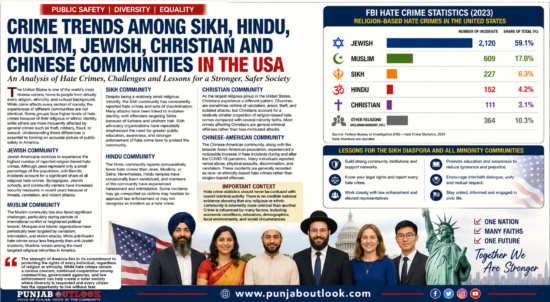
Among all religious communities, the Jewish community continues to experience the highest number of reported religion-based hate crimes in the United States. Although Jewish Americans represent only a small percentage of the population, anti-Semitic incidents account for a significant share of all reported religious hate crimes. Synagogues, Jewish schools, and community centers have increased security measures in recent years because of threats, vandalism, and violent attacks.
The Muslim community has also faced significant challenges, particularly during periods of international conflict or heightened political tension. Mosques and Islamic organizations have periodically been targeted by vandalism, intimidation, and violent attacks. While anti-Muslim hate crimes occur less frequently than anti-Jewish incidents, Muslims remain among the most targeted religious minorities in America.
Despite being a relatively small religious minority, the Sikh community has consistently reported hate crimes and acts of discrimination. Many attacks have been linked to mistaken identity, with offenders targeting Sikhs because of turbans and unshorn hair. Sikh advocacy organizations have repeatedly emphasized the need for greater public education, awareness, and stronger enforcement of hate crime laws to protect the community.
The Hindu community reports comparatively fewer hate crimes than Jews, Muslims, or Sikhs. Nevertheless, Hindu temples have occasionally been vandalized, and members of the community have experienced harassment and intimidation. Community leaders believe that some incidents remain unreported because victims may hesitate to approach law enforcement or may not recognize an incident as a hate crime.
As the largest religious group in the United States, Christians experience a different pattern. Churches are sometimes victims of vandalism, arson, theft, and isolated attacks, but Christians account for a relatively smaller proportion of religion-based hate crimes compared with several minority faiths. Most crimes affecting Christians are general criminal offenses rather than bias-motivated attacks.
The Chinese-American community, along with the broader Asian-American population, experienced a noticeable increase in hate incidents during and after the COVID-19 pandemic. Many individuals reported verbal abuse, physical assaults, discrimination, and vandalism. These incidents are generally recorded as race- or ethnicity-based hate crimes rather than religion-based offenses, demonstrating that prejudice can arise from multiple forms of identity.
Available FBI data indicate that Jewish Americans remain the most frequently targeted religious community in hate crime statistics, followed by Muslims and Sikhs. Hindus report fewer incidents, while Christians account for a relatively smaller share of religion-based hate crimes despite being the country’s largest faith group. Chinese Americans are primarily affected by race-based rather than religion-based hate crimes.
It is equally important to recognize that hate crime statistics should never be confused with overall criminal activity. There is no credible national evidence showing that any religious or ethnic community is inherently more criminal than another. Crime is influenced by numerous factors, including economic conditions, education, demographics, local environments, and social circumstances. Generalizing about criminality based on religion or ethnicity would therefore be inaccurate and unfair.
The experiences of Sikh, Hindu, Muslim, Jewish, Christian, and Chinese communities also provide valuable lessons. Although the scale and nature of incidents differ, one common theme is that organized, informed, and united communities are generally better equipped to respond to threats. Strong community institutions, legal awareness, documentation of incidents, and close cooperation with law enforcement can improve safety and ensure that victims receive support.
For the Sikh diaspora, repeated hate crimes highlight the importance of educating the wider public about Sikh identity and beliefs. Many anti-Sikh attacks have resulted from ignorance or mistaken identity. Expanding educational outreach in schools, universities, workplaces, and public institutions, while encouraging the prompt reporting of hate crimes, can help reduce prejudice and improve understanding.
The Jewish community offers another important example through its long-standing investment in community security, legal advocacy, incident reporting, and coordination with law enforcement. While these measures cannot eliminate hate crimes, they have strengthened preparedness and improved responses to security threats. Similarly, Muslim, Hindu, and Chinese-American organizations have focused on public awareness campaigns, victim support services, legal assistance, and community engagement to address discrimination and violence.
The broader lesson is that protecting minority communities requires more than policing alone. Public education, interfaith dialogue, civic participation, and respect for constitutional rights all play a critical role in reducing prejudice and preventing violence. Community members should be encouraged to report crimes, preserve evidence, and pursue justice through lawful institutions rather than allowing fear or misinformation to create further divisions.
The United States continues to face challenges in protecting all communities from hate-motivated violence, but it also provides examples of resilience and cooperation. Strengthening hate crime investigations, supporting victims, improving community outreach, and fostering mutual respect remain essential steps toward building a safer society. Ultimately, the protection of every religious and ethnic community strengthens democracy itself, ensuring that diversity remains one of America’s greatest strengths rather than a source of division.