
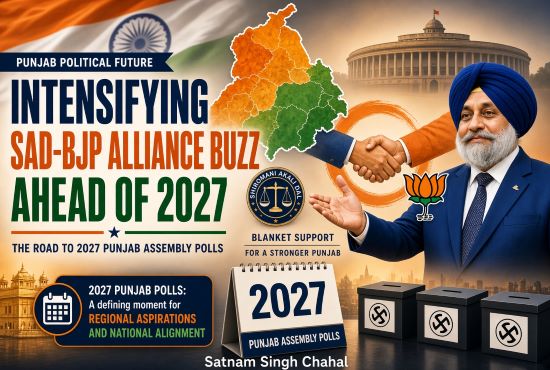
 With the 2027 Punjab Assembly elections drawing closer, speculation over a possible reunion between the Shiromani Akali Dal (SAD) and the Bharatiya Janata Party (BJP) has gained fresh momentum. Though neither party has formally announced an electoral alliance, recent political developments and SAD president Sukhbir Singh Badal’s outreach to the Centre have fuelled discussion over whether the two former allies could once again come together. Adding another dimension to the political discourse, Badal has extended the SAD’s blanket support to the proposal for a uniform 50 per cent increase in the number of Assembly seats across all states, while making it clear that the party wants women’s reservation and delimitation to be addressed as part of the process.
In a social media post, Badal said:
“Our party supported the proposal which was put up by Govt of India at the floor of the House of uniform increase of 50% of seats of all states. The party emphasised that women reservation and Delimitation should be done…”The statement assumes significance as the debate over delimitation, representation and women’s reservation acquires greater political importance ahead of the next electoral cycle.
The possibility of a renewed SAD-BJP alliance has been one of the most closely watched developments in Punjab politics. The two parties shared a long-standing political partnership before parting ways. Their alliance had played a major role in shaping Punjab’s electoral politics for decades.The political equation changed dramatically after the SAD withdrew from the BJP-led National Democratic Alliance amid differences over the farm laws and the farmers’ agitation. Since then, both parties have attempted to strengthen their independent political bases in Punjab.The BJP has increasingly sought to emerge as an independent political force in the state, while the SAD has been working to rebuild its traditional support base.Yet, with the 2027 Assembly election approaching, the possibility of tactical cooperation between the two parties cannot be ruled out.
Sukhbir Badal’s recent meeting with Prime Minister Narendra Modi has further intensified political speculation in Punjab.Although there has been no formal announcement of an alliance, the meeting has been closely watched by political observers and rival parties. Any change in the SAD-BJP relationship could have a direct impact on the electoral arithmetic in Punjab.The BJP has previously indicated that it intends to contest the 2027 Assembly election on its own. However, political alliances in Punjab have historically been shaped by changing electoral circumstances, and the question of whether the two parties eventually return to an alliance remains open.
Badal’s latest statement is also significant beyond the question of alliances.By backing a uniform 50 per cent increase in Assembly seats, the SAD has supported an expansion that could substantially alter the size of legislative assemblies. At the same time, the party has stressed that women’s reservation and delimitation should be carried out alongside the exercise.The SAD’s position suggests that while the party is willing to support the Centre’s proposal, it wants representation-related issues to be addressed together rather than in isolation.For Punjab, delimitation carries particular political significance because changes in constituency boundaries and the distribution of seats can influence the state’s electoral landscape.
The 2027 Punjab election is likely to be a fiercely contested multi-cornered battle. The ruling Aam Aadmi Party, Congress, BJP and SAD are all expected to compete for political space, while smaller and emerging political formations could further fragment the vote.A possible SAD-BJP understanding could therefore have consequences well beyond the two parties.For the SAD, an alliance could provide access to the BJP’s organisational network and national political reach. For the BJP, a partnership with the SAD could potentially provide an established regional political vehicle and strengthen its position in constituencies where the Akali Dal has traditionally had influence.At the same time, any alliance would have to address the political legacy of their split and the changes that have taken place in Punjab since the two parties last fought an election together.
For now, the SAD has stopped short of announcing any formal alliance with the BJP. The party’s support for the Centre’s proposal and Badal’s interaction with the Prime Minister should therefore be viewed as important political signals rather than confirmation of a seat-sharing arrangement.But in Punjab’s rapidly evolving political landscape, such signals can carry considerable weight. With the 2027 Assembly election approaching, the key question is no longer simply whether the SAD and BJP can work together on individual issues. The bigger question is whether the former allies can overcome their differences and once again build a common political platform in Punjab.For the moment, the alliance remains unconfirmed — but the political conversation around a SAD-BJP reunion is clearly back on the table.