
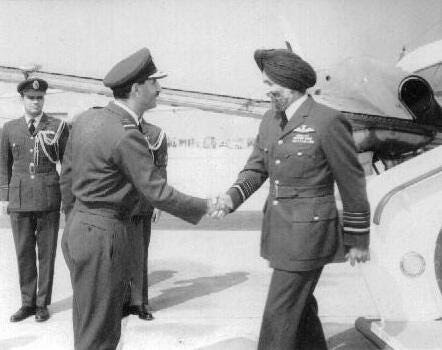
Arjan Singh, then Chief of the Air Staff of the Indian Air Force, arrives at PAF Station Peshawar in 1966 to meet his Pakistani counterpart, Nur Khan, in the aftermath of the 1965 Indo-Pak War.
This Chronicle has written and spoken at some length on leadership lessons closer to home, from the Ramayana and the Mahabharata — but leadership does not check passports before it decides where to turn up. So let me, for once, draw one from a neighbour with whom we do not enjoy the most cordial of relations: from a Chief of the Pakistan Air Force, no less.
The man is Air Marshal Malik Nur Khan, and the episode belongs to August 1965 — the weeks when Operation Gibraltar was unravelling in the Kashmir Valley, just before matters escalated into the full-fledged war of September that year. I set aside, deliberately and entirely, the merits or otherwise of that operation and of the war it fed into. What holds my attention is a narrower, cleaner thing: the conduct of a Chief barely forty days into the job, faced with one impossible sortie — a stranded force running short of both food and ammunition, poor night weather over a narrow valley, and only one attempt permitted.
The chair is new, and the decision is not delegable
Every officer who has held a chief’s chair — civil or uniformed, it matters little — knows the particular vertigo of the early weeks: the temptation to let the system run on its accumulated momentum while one still learns where the files are kept, and the opposite temptation, more dangerous, to prove oneself too quickly through some gesture. Nur Khan did neither. He consulted the army formation running the Kashmir operation, satisfied himself that the mission was necessary, and then made a choice that no manual would have obliged him to make: he boarded the aircraft himself.
Not to fly it. Group Captain Zahid Butt commanded that cockpit, and Nur Khan did not so much as gesture toward the controls. He went along as something else entirely — as the highest available authority, present in person at the exact coordinate where the decision would actually have to be taken, rather than parked in a briefing room forty minutes and one radio relay away. And let it be said plainly: this was not a symbolic gesture from a safe distance. He put his own life on the line, in exactly the same aircraft, over exactly the same guns and ridgelines, as the crew he was leading. Leading from the front, in his case, was not a figure of speech.
The overshoot, and what presence actually buys you
Here is the part of the story that repays close reading. The standing instruction to the crew was unambiguous: one attempt, and if it failed, turn back. That was not caution for caution’s sake — the narrow valley and the exposed second pass it would have demanded made a repeat run a genuinely costlier risk, and no crew commander would have been faulted for honouring the order to the letter. Butt’s first run did overshoot the drop zone, wedged as it was between ridgelines in bad night weather with rudimentary navigation aids, and by the letter of his orders that should have been the end of the sortie.
It was not, because the Chief was sitting in the cockpit, and the Chief overwrote his own standing instruction on the spot. Not through a signal relayed down some chain of command, but simply by being the man whose call it now was, in person, at the one moment it needed making. Any crew commander operating strictly to orders would have turned for home and been entirely within his rights to do so — the risk on the second pass was real, not manufactured. That is the counterfactual worth sitting with: had Nur Khan not been in that cockpit, the mission ends on the first pass, exactly as the instruction said it should. “As a leader, I wanted have the highest level of decision-making, for the caotain, inside the cockpit,” he is specifically quoted as having said, much later in the year 2000, of his own reasoning — and whatever the precise provenance of that line, it captures exactly what he did (short video).
This, I would submit, is the entire content of the lesson, stripped of its wartime wrapping: presence is itself a decision-making mechanism, and it is also an override mechanism. A written order is a decision taken in advance, for a situation imagined in advance. The man who wrote it, present at the point where the situation turns out to be different from what was imagined, is the only person with the standing to tear it up in real time. That is not indiscipline. That is command doing the one thing a standing order cannot do for itself — adapting to the actual valley, the actual weather, the actual night, rather than the one it was drafted for in a briefing room some days earlier.
Tactical success, strategic failure
One honest qualification is owed here, and I’d rather offer it myself than have a sharp-eyed reader supply it in the comments. The sortie’s own objective — get rations and ammunition to a beleaguered, cut-off force before it starved or ran dry — was achieved. The load went in on the second pass, and by most accounts it gave the stranded men enough to hold on and, in time, make their way back rather than being annihilated where they stood. Judged narrowly, on its own terms, the mission succeeded.
Operation Gibraltar as a whole did not — that larger failure belongs to a different, wider story, and is not this piece’s subject. But the two verdicts sit side by side without contradiction, and it is worth saying so plainly: a Chief’s presence in a cockpit can win the argument over one drop zone on one night. It cannot, by itself, win a war built on a mistaken premise. The leadership lesson survives that distinction intact — arguably it is sharper for it. Nur Khan did not have the luxury of fixing Gibraltar’s strategy from where he sat. He had the narrower job in front of him, and he did that job.
Postscript: what became of him
Nur Khan remained Commander-in-Chief of the PAF until 31 August 1969, retired from uniform, and was almost immediately drawn back into public life — Deputy Chief Martial Law Administrator and cabinet minister under Yahya Khan, then Governor of West Pakistan from September 1969. It was a short, combative stint: reforming education and labour policy enough to unsettle the establishment he answered to, and out of the chair within five months.
His more durable legacy lay elsewhere. He had already built PIA into a genuinely world-class carrier as its Managing Director from 1959 to 1965, and Bhutto’s government brought him back to run it again from 1973 to 1978, this time into the wide-body age of DC-10s and 747s. He later headed the Pakistan Hockey Federation across two stints and chaired the Board of Control for Cricket in Pakistan from 1980 to 1984, and tried electoral politics late in life, winning a National Assembly seat in 1985 before losing in 1988 and stepping back for good.
He died on 15 December 2011, and the PAF renamed his old base — Chaklala, from where the 1965 sorties had flown — as PAF Base Nur Khan in his honour. That airfield had one more brush with Indian ordnance still ahead of it: in the early hours of 10 May 2025, during India’s Operation Sindoor — the retaliatory strikes launched after the Pahalgam terror attack that April — Indian missiles struck PAF Base Nur Khan itself. Pakistan denied serious damage at first; Prime Minister Shehbaz Sharif later admitted publicly that his Army Chief had woken him at 2:30 am with the news. Sixty years on from the sortie that gives this piece its name, the base carrying his name came under fire again — a coda its namesake, gone since 2011, was spared having to witness.