
 From the unresolved legacy of 1966 to border security, terrorism costs and inadequate financial support, Punjab continues to ask: Who will speak for Punjab? Punjab has reached a point where it must ask some uncomfortable questions—not against India, not against any community, and not against any political party alone, but in the interest of constitutional fairness, federalism and the future of its people. Why are so many of Punjab’s fundamental issues still unresolved decades after the reorganisation of the state? Why do questions originating around the Punjab Reorganisation Act of 1966 continue to generate disputes? Why does a border state that carries an extraordinary national security burden continue to struggle for adequate financial and institutional compensation? And perhaps the most important question of all: why has Punjab’s political class failed to speak with one united voice on the complete Punjab agenda?
The Punjab Reorganisation Act, 1966 fundamentally reorganised the old state of Punjab, but the reorganisation did not end every dispute. Questions relating to Chandigarh, territorial claims, river waters, institutional arrangements and other consequences of reorganisation have continued to occupy Punjab’s political and constitutional landscape. Nearly six decades later, the people of Punjab are entitled to ask whether these matters have become permanent political instruments rather than problems to be solved. A democracy cannot function on the principle that an issue is old enough to be ignored. If a dispute has remained unresolved for decades, the answer should not be another committee, another resolution, another political speech or another election promise. There must be a clearly defined constitutional, legal and political process with accountability.
Punjab also occupies a unique position on India’s security map. As an international border state, its geography means that national security responsibilities inevitably have consequences for the state’s police, administration, infrastructure and economy. The Union government’s 2021 decision to expand the BSF’s jurisdiction in Punjab from 15 kilometres to 50 kilometres inside the international border created a major federal debate. The Union government justified the expansion on security grounds, including concerns relating to drones, weapons and narcotics, while Punjab raised concerns regarding the constitutional division of responsibilities between the Union and the state. The issue itself demonstrates how deeply national security and Punjab’s state responsibilities are interconnected.
This raises a much larger question: if Punjab carries a disproportionate national security burden, should Punjab also be expected to bear a disproportionate share of the financial burden? National security is, by definition, a national responsibility. Punjab should not have to choose between spending its limited resources on schools, hospitals, roads, agriculture and rural development and spending additional resources dealing with security challenges that have implications far beyond the state’s borders.
The same principle applies to the dark period of terrorism in Punjab. Terrorism in Punjab was not merely a local law-and-order problem. It was a national security crisis that affected the integrity, security and stability of India. Punjab Police personnel, government employees, civilians, businesses and families paid an enormous price. Thousands of families suffered loss, displacement and economic destruction. The state machinery was placed under extraordinary pressure for years. Therefore, a legitimate question arises: when a security crisis has national implications, should the affected state be left to absorb the extraordinary financial burden from its own limited resources?
India has already recognised, in other security contexts, the principle that states facing extraordinary national-security challenges can receive Union assistance and reimbursement for specified expenditures. Punjab therefore has every right to ask whether a transparent, audited and equitable framework should also exist for exceptional security expenditure arising from threats that have national implications.
Punjab’s security burden did not end with terrorism. The state continues to face challenges associated with its international border, cross-border narcotics, drones, arms smuggling and border-area security. The men and women living in border villages are not simply residents of remote areas; they are also part of India’s first line of defence. Yet border communities frequently struggle with inadequate infrastructure, employment opportunities, healthcare, education and connectivity.
The national government cannot expect people to remain economically strong and socially rooted in sensitive border areas merely by appealing to patriotism. If the nation expects border communities to remain there, build their homes there and protect the social fabric of these areas, then the Union and state governments must jointly provide the infrastructure and economic opportunities necessary to make that possible. Border villages should be developed as vibrant communities, not treated merely as security buffers.
Another major issue concerns the nature and adequacy of financial assistance provided to Punjab. Punjab’s political leadership has repeatedly argued that the state faces exceptional financial pressures because of its geographical position, agricultural economy, environmental problems, disasters and security responsibilities. The question should not simply be whether Punjab deserves “more money.” The stronger and more rational question is whether Union financial assistance is based on objective assessment of actual needs, extraordinary burdens and measurable losses.
The floods that devastated Punjab exposed this question once again. Punjab sought a substantial special package to deal with the destruction of agricultural land, homes, roads, public infrastructure and rural livelihoods, while the Union government announced a relief package that Punjab leaders argued was inadequate compared with the scale of the damage. Whatever one’s political position, the larger issue cannot be dismissed. A predominantly agricultural border state facing repeated floods and other disasters needs a predictable and scientifically determined system of financial support rather than a political battle every time a disaster occurs.
Punjab should not have to beg for assistance after every flood, every major security crisis or every extraordinary event. There should be a permanent mechanism for assessing the additional burden carried by border states. Such a framework could take into account international-border length, the population living in border districts, exceptional security expenditure, disaster vulnerability, agricultural losses, infrastructure damage, national food-security contribution, cross-border threats and economic disruption caused by security operations.
Such a mechanism would be better than political bargaining because it would replace arbitrary negotiations with objective criteria. Punjab would know what assistance it is entitled to seek, and the Union government would have a transparent framework through which such demands could be evaluated.
But perhaps the most painful question is not directed at Delhi. It is directed at Punjab itself. Where is the united Punjab voice?
Punjab’s political parties frequently raise individual issues. One party speaks about Chandigarh. Another raises river waters. Another focuses on federalism. Another raises financial dues. Another speaks about border security. Another raises agriculture. Yet where is the comprehensive Punjab agenda that brings all these questions together?Why can Punjab’s political parties not sit together and prepare one document identifying every major unresolved issue of the state? Why can they not agree that regardless of which party forms the government in Chandigarh or New Delhi, certain fundamental issues will remain matters of Punjab’s collective interest?
Political parties are expected to disagree. That is democracy. But political differences over ideology, elections and governance should not prevent agreement on fundamental state interests. If Chandigarh is an issue, every party should state its position. If river waters are an issue, every party should state its position. If border security is an issue, every party should state its position. If Punjab’s financial burden is an issue, every party should state its position. If the economic consequences of terrorism and national-security responsibilities are an issue, every party should state its position.
The people of Punjab deserve to know not only what political parties say during elections, but what they are prepared to fight for collectively after the elections are over.Punjab’s demand should also not be presented as a confrontation between Punjab and India. That would weaken the argument. The stronger argument is that a strong India requires strong states and genuine cooperative federalism. Punjab has made enormous contributions to India’s food security, national defence and economic development. Its farmers, soldiers, workers, entrepreneurs and diaspora have contributed far beyond the state’s size.The demand, therefore, is not for privilege. It is for fairness, predictability and constitutional accountability.
Punjab needs a comprehensive Punjab Issues Resolution Charter bringing together the state’s outstanding concerns. It should include the legacy of the 1966 reorganisation, Chandigarh, territorial questions, river-water disputes, border security, financial compensation for exceptional security burdens, border-area development, disaster relief, agricultural concerns, pending financial claims and the state’s broader fiscal position.Every major political party should be invited to endorse such a charter. Every Member of Parliament from Punjab should be asked to support it. Every MLA should be asked where they stand. And every election manifesto should be measured against it.The people of Punjab should no longer accept politics that remembers Punjab’s problems only when cameras are present.
Punjab has waited long enough. It has waited through governments of different political colours. It has seen promises, committees, resolutions, court cases, negotiations and election campaigns. But the fundamental question remains: If Punjab’s problems are important enough to be discussed for decades, why are they not important enough to be solved?If national security is truly national, why should Punjab repeatedly carry the financial and administrative burden? If Punjab is strategically indispensable, why should its border communities remain economically vulnerable? If Punjab has contributed so much to the nation, why does it have to repeatedly knock on Delhi’s doors for special assistance when extraordinary circumstances strike? And finally, why is there no united political voice demanding a comprehensive settlement of Punjab’s outstanding issues?
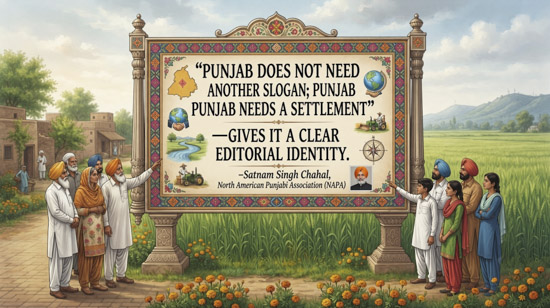
The time has come for Punjab’s political parties to stop competing over who can speak the loudest and start demonstrating who can work together for the longest. Punjab does not need another slogan. Punjab needs a settlement. Punjab does not need another temporary package. Punjab needs a permanent and equitable financial framework. Punjab does not need another political promise. Punjab needs measurable commitments, timelines and accountability.And Punjab does not need its political leaders to speak only when elections are approaching. It needs them to speak together now.
Satnam Singh Chahal, Executive Director of the North American Punjabi Association (NAPA), said that Punjab’s unresolved issues should no longer be treated as election-time rhetoric but as matters requiring a permanent institutional mechanism between the Union and the state. “Punjab has carried national responsibilities for generations. It is time for the nation and Punjab’s political leadership to sit together, put every unresolved issue on one table, establish objective financial and constitutional mechanisms, and give the people of Punjab a clear answer. The question is no longer who is responsible for the past. The question is who will take responsibility for solving Punjab’s future.”
Disclaimer: This article and accompanying images are for informational and illustrative purposes only. Some visuals may be AI-generated or digitally enhanced and may not depict actual events or persons.Views expressed are based on publicly available information and analysis