
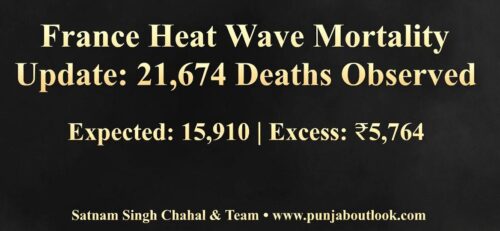
 Public Health France (Santé publique France) has released its consolidated assessment of the exceptional heat wave that gripped the country from mid-June into early July 2026. The agency reported 5,764 excess deaths during the period spanning June 17 to July 2. In the regions most affected by the extreme temperatures, authorities recorded 21,674 deaths from all causes. Statistical modelling based on data from previous years indicated that, in the absence of the heat wave, those same areas would have been expected to register approximately 15,910 deaths. The difference of roughly 5,764 represents the excess mortality linked to the prolonged and intense heat episode.
This figure marks the highest excess mortality associated with a heat wave in France since the catastrophic summer of 2003. Officials noted that the majority of the excess deaths were concentrated over three particularly severe days, June 25, 26, and 27, when temperatures reached historic peaks in many parts of the country. The impact was felt across age groups. While people aged 75 and older accounted for 3,719 of the excess deaths, the agency observed a marked rise in mortality starting from age 45 and affecting all groups from 15 years upward a pattern described as unusual compared with previous heat events.
Geographically, Île-de-France recorded the highest number of excess deaths at 1,999, followed by the Grand Est (635), Pays de la Loire (553), Centre-Val de Loire (511), Nouvelle-Aquitaine (445), Normandy (426), Hauts-de-France (424), Bourgogne-Franche-Comté (373), Brittany (225), and Auvergne-Rhône-Alpes (214). Corsica, Occitanie, and Provence-Alpes-Côte d’Azur did not show excess mortality linked to this episode.
Ninety-two departments were placed under heat-wave alerts during the period, affecting 98.5 percent of the population of metropolitan France. Early provisional figures released at the end of June had pointed to around 1,000 excess deaths in the first few peak days, but those estimates were based largely on electronic death certificates and significantly undercounted deaths occurring at home and those still recorded on paper forms.
Health authorities emphasize that while the excess mortality coincides with the heat wave, final attribution of every individual death to heat-related causes requires further analysis. Full accounting is expected later in the summer. The episode underscores both the severity of the 2026 heat wave and the ongoing challenges of protecting vulnerable populations during extreme weather events.