
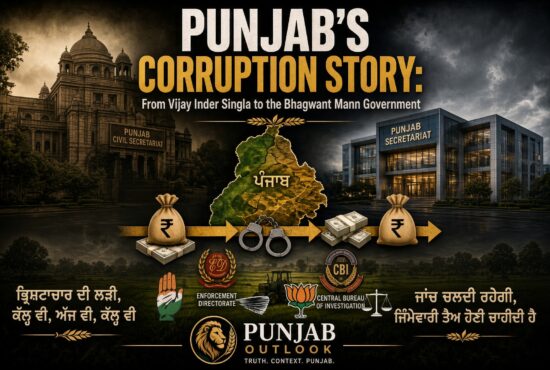
Punjab has witnessed repeated corruption controversies involving ministers, MLAs, government officials, contractors and influential political figures. Every government comes to power promising transparency, clean administration and an end to corruption. Yet, the people of Punjab continue to hear about alleged commissions in government contracts, questionable tender allocations, forest department irregularities, property scams, bribery and disproportionate assets.
The Aam Aadmi Party came to power in March 2022 with a strong promise of eliminating corruption. Bhagwant Mann repeatedly spoke about zero tolerance and accountability. However, the controversy involving his own Health Minister, Dr Vijay Singla, just over two months after the government was formed, raised serious questions about the gap between political promises and actual governance.To understand the scale of the problem, it is important to examine the chronology of major corruption-related allegations, investigations and arrests in Punjab.
2017–2022: During the Congress government, Vijay Inder Singla served as Education Minister and Public Works Department Minister. His tenure as PWD Minister attracted allegations concerning tender allocations, construction quality and government contracts. Questions were also raised about certain public works and the quality of infrastructure projects.After the Congress government lost power in 2022, the Punjab Vigilance Bureau began examining allegations against several former ministers. In September 2022, some of Singla’s associates were questioned regarding PWD tender allocations.
On March 15, 2023, the Vigilance Bureau summoned Vijay Inder Singla in connection with a disproportionate assets inquiry. Investigators reportedly examined property records connected with him, his family members and close associates. In June 2023, Vigilance officials visited his residence to assess properties and other assets.It is important to distinguish this investigation from a conviction. The allegations and inquiry do not establish guilt. Nevertheless, the episode raised questions about transparency in public works contracts and the need for independent investigation.
May 2022: One of the biggest early controversies of the AAP government emerged on May 24, 2022, when Chief Minister Bhagwant Mann announced the dismissal of his Health Minister, Dr Vijay Singla.Singla was accused of demanding a commission in connection with government tenders and departmental purchases. According to the FIR, the allegations involved a demand for a percentage of contracts worth approximately ₹58 crore.The minister was arrested along with his OSD, Pardeep Kumar. The Chief Minister publicly presented the action as an example of zero tolerance towards corruption, even within his own party.Singla denied the allegations and described them as a conspiracy. He was subsequently granted bail.The Vigilance Bureau filed a chargesheet in December 2022. However, a May 2025 Hindustan Times report stated that charges had not yet been framed in the case at that time.The incident was particularly significant because it occurred just over two months after AAP formed the government.
September 2022–Another controversy emerged around then Food Processing Minister Fauja Singh Sarari.In September 2022, an audio clip allegedly involving Sarari and his OSD, Tarsem Lal Kapoor, circulated publicly. The recording was alleged to contain a discussion about extracting money from contractors involved in foodgrain transportation.Sarari denied wrongdoing and claimed the audio had been doctored. He eventually resigned from the Cabinet on January 7, 2023.The controversy raised questions about the government’s response to allegations involving a sitting minister and the standard of accountability expected from public representatives.
June 2022: Former Congress Forest Minister Sadhu Singh Dharamsot was arrested by the Punjab Vigilance Bureau in June 2022 in a case involving alleged corruption and irregularities in the Forest Department.The investigation concerned allegations of illegal payments connected with tree felling permissions and other departmental activities.Further investigations also examined allegations of assets disproportionate to known sources of income.In September 2025, the Enforcement Directorate announced supplementary prosecution proceedings against Dharamsot and four others under the Prevention of Money Laundering Act. The ED stated that its investigation concerned alleged bribes connected with permissions for tree felling.These are serious allegations that must be decided through the judicial process.
October 2022: Former Industries Minister Sunder Sham Arora became another prominent name in Punjab’s corruption investigations.On October 15, 2022, the Vigilance Bureau arrested Arora after alleging that he had offered a ₹1 crore bribe to a senior Vigilance official to settle pending inquiries against him.According to the investigation, ₹50 lakh was allegedly being handed over as an advance payment when he was caught.The Enforcement Directorate subsequently investigated allegations relating to industrial plots and disproportionate assets.In a September 2025 press release, the ED described its investigation into alleged irregularities involving Punjab Small Industries and Export Corporation industrial plots and investments linked to Arora’s family.
February 2023: On February 23, 2023, Bathinda Rural AAP MLA Amit Rattan Kotfatta was arrested by the Punjab Vigilance Bureau.The case originated from allegations that a bribe was demanded in connection with the release of a ₹25 lakh village development grant.His alleged associate, Rashim Garg, had earlier been arrested while accepting ₹4 lakh.The MLA denied wrongdoing and challenged the proceedings. He was granted bail by the Punjab and Haryana High Court in May 2023.A May 2025 Hindustan Times report noted that the case had become entangled in legal proceedings and the trial had not started at that time.
2022–2023: The Vigilance Bureau also examined several former Congress ministers and political figures.
These included:
* Bharat Bhushan Ashu – investigated in connection with alleged irregularities in the foodgrain transportation and labour-related tender system.
* OP Soni – investigated in a disproportionate assets case.
* Brahm Mohindra – questioned in connection with corruption-related inquiries.
* Balbir Singh Sidhu – faced Vigilance scrutiny.
* Manpreet Singh Badal – faced allegations relating to the purchase of a property in Bathinda.
* Bharat Inder Singh Chahal – former media adviser to the previous Chief Minister, investigated in a disproportionate assets case.
* Gurpreet Singh Kangar – examined in connection with Vigilance inquiries.
The investigations covered several departments, including food and civil supplies, transport, forests, industries and public works.
2023–2024: The Vigilance Bureau’s investigations also brought several departmental irregularities into the public domain.The foodgrain transportation controversy concerned alleged irregularities in transportation contracts and related payments.The Punjab Small Industries and Export Corporation plot controversy involved allegations of irregularities in the transfer and handling of valuable industrial plots.The transport department also faced investigations concerning alleged illegal verification practices.These cases highlighted the importance of transparent tendering, independent auditing, proper record-keeping and accountability among senior officials.
May 2025: On May 23–24, 2025, Jalandhar Central AAP MLA Raman Arora was arrested by the Vigilance Bureau.The investigation involved allegations concerning bribery and illegal payments linked to building approvals and municipal matters.A municipal official, Nishant Vashisht, had already been arrested in connection with allegations of demanding money from applicants and commercial establishments.The Vigilance Bureau alleged that Arora’s name had emerged during the investigation.Arora’s arrest became another major controversy for the ruling party because it followed the earlier cases involving Vijay Singla and Amit Rattan Kotfatta.
Septeber 2025: The Enforcement Directorate announced additional prosecution proceedings against former Forest Minister Sadhu Singh Dharamsot and other accused in September 2025.The proceedings were connected with alleged financial irregularities in the Forest Department and money laundering investigations.This demonstrated that investigations initiated during the previous government continued to move through different legal stages.
March 2026: Another major political controversy emerged in March 2026 involving former Transport and Jails Minister Laljit Singh Bhullar.He resigned amid allegations connected with the suicide of a government official who had reportedly accused him of coercion and threats.This matter should be distinguished from a proven corruption conviction. However, it raised serious questions about ministerial accountability, administrative pressure and the relationship between political power and government officials.
Septer 2026: According to a report published by The Tribune on September 21, 2026, Punjab’s Vigilance Bureau registered 1,107 corruption cases and arrested 1,146 accused between March 16, 2022, and August 31, The Bureau also reported that courts convicted 248 accused in 154 corruption cases during this period..Its figures included 529 trap cases involving 638 arrests, 546 other criminal cases involving 492 arrests and 32 disproportionate assets cases involving 16 arrests.These figures represent government-reported enforcement activity. They also demonstrate the scale of corruption-related investigations that the state continues to face.
Punjab’s corruption problem cannot be reduced to one minister, one political party or one government.The Vijay Inder Singla inquiry, the arrest of Dr Vijay Singla, the Amit Rattan Kotfatta case, the Fauja Singh Sarari controversy, the investigations involving former Congress ministers and the Raman Arora case all raise a common question.Why do allegations of corruption repeatedly emerge in departments responsible for public money, construction contracts, development grants, land and government approvals?Why should contractors, ordinary citizens and government employees face pressure to pay illegal commissions to obtain work that they are legally entitled to receive?The government must publish transparent information about every major Vigilance investigation, including the amount of alleged public loss, the stage of investigation, chargesheets filed, charges framed, trial progress, convictions and acquittals.Political announcements about zero tolerance are not enough. What Punjab needs is a permanent institutional system that makes corruption difficult, exposes wrongdoing and ensures that influential people cannot escape accountability simply because they hold political connections.
From Vijay Inder Singla’s PWD-related controversies and subsequent Vigilance inquiry to the corruption cases involving ministers and MLAs under the AAP government, Punjab has repeatedly witnessed serious allegations concerning the misuse of public office.Every party promises a clean administration when it seeks power. But the people of Punjab deserve more than slogans, press conferences, arrests and political accusations.They deserve transparent investigations, independent institutions, speedy trials and convictions wherever guilt is established.Public money belongs to the people of Punjab. Government departments are not private businesses, ministerial offices are not personal establishments, and political power is not a licence to demand commissions.
Punjab needs accountability that applies equally to Congress, Akali Dal, AAP and every other political party.The question is not which party is making the loudest claims against corruption. The question is whether Punjab will finally establish a system in which nobody is above the law.
Disclaimer: This article and accompanying images are for informational and illustrative purposes only. Some visuals may be AI-generated or digitally enhanced and may not depict actual events or persons.Views expressed are based on publicly available information and analysis