
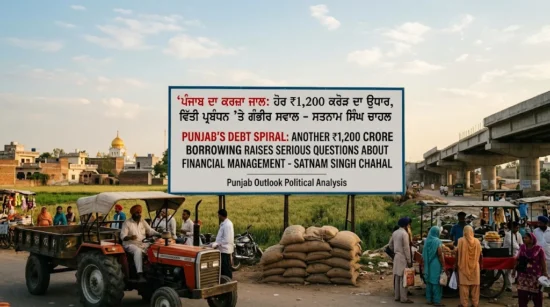
Punjab’s mounting debt burden has once again brought the financial management of the Aam Aadmi Party government under serious scrutiny. The latest borrowing proposals and the state’s budgetary figures have raised an important question: how long can Punjab continue to depend on fresh loans to meet its financial obligations without creating a sustainable economic foundation? The proposed ₹1,200-crore borrowing through the re-issue of 7.65% Punjab State Government Securities 2043 has added to concerns about the state’s growing dependence on market borrowing.
According to the Reserve Bank of India’s auction records dated October 19, 2026, Punjab accepted ₹800 crore through its 7.65% Punjab SGS 2043 securities, while another ₹316.418 crore was accepted through its 7.75% Punjab SGS 2035 securities. The combined accepted amount was approximately ₹1,116.42 crore. The cut-off yield for the 2043 securities was 8.2002%. These figures underline the continuing dependence of the state on market borrowing and the financial commitments that such borrowing creates for future years.
According to the PRS Legislative Research analysis of Punjab’s 2026-27 Budget, the state has budgeted total borrowings of ₹1,32,197 crore during the financial year. This includes ₹80,000 crore in short-term Ways and Means Advances from the Reserve Bank of India. The budget also estimates net borrowings of ₹38,471 crore. Punjab’s outstanding liabilities are projected to reach 45.1% of its Gross State Domestic Product by the end of 2026-27. Such a high debt-to-GSDP ratio reflects the pressure on the state’s financial position and raises concerns about its ability to maintain sufficient resources for future development.
The budget projects Punjab’s fiscal deficit at ₹39,971 crore, equivalent to 4.1% of GSDP, while the revenue deficit is estimated at ₹21,955 crore. A revenue deficit means that the government’s regular income is insufficient to meet its day-to-day expenditure. This is particularly concerning because a government that cannot meet its routine expenditure from its own revenue increasingly depends on borrowing or other financial arrangements. Borrowing for productive infrastructure is understandable, but depending on fresh loans to manage recurring expenditure can create a dangerous financial cycle.
Another major concern is the growing amount of money required for interest payments, salaries and pensions. Punjab’s 2026-27 Budget estimates interest payments at ₹28,755 crore, salaries at ₹39,115 crore and pension expenditure at ₹22,465 crore. Together, these three commitments amount to ₹90,335 crore, representing approximately 72% of the state’s estimated revenue receipts. This leaves limited financial flexibility for investment in education, healthcare, agriculture, industrial development, infrastructure and employment generation.
The interest burden is especially important because every long-term government security creates obligations that continue for years. The 7.65% Punjab SGS 2043 security carries a stated coupon rate of 7.65%, while the October auction recorded a cut-off yield of 8.2002%. The government must explain how these loans will generate sufficient economic returns to justify their long-term cost. The people of Punjab should not be left paying interest on borrowings without knowing whether the money has created productive assets or improved the state’s economy.
The government may argue that borrowing is permitted under fiscal rules and that funds are being used for development and capital expenditure. The 2026-27 Budget has projected capital outlay of ₹18,381 crore. However, the public deserves a transparent account of how much of the actual borrowing is being invested in productive projects and how much is being used to meet existing financial commitments. There must be a clear distinction between borrowing for new roads, irrigation, industrial infrastructure, hospitals and educational institutions and borrowing to finance recurring expenditure or earlier liabilities.
Punjab’s financial risks are not limited to direct government borrowing. According to PRS, outstanding government guarantees were estimated at ₹23,654 crore as of March 31, 2026, equivalent to 2.7% of GSDP. These guarantees represent potential liabilities that could create additional pressure on the state treasury if the concerned public-sector entities fail to meet their financial obligations. Therefore, the government must disclose the complete financial position of state-owned corporations, boards and public-sector enterprises.
Punjab needs a stronger economic strategy to increase its own revenue rather than depending continuously on loans. Industrial investment, agricultural diversification, food processing, tourism, information technology, export-oriented businesses and small enterprises must receive greater attention. The government must also improve revenue collection, prevent financial leakages and ensure that public expenditure produces measurable benefits. Welfare programmes are important, but their financing must be planned responsibly so that future generations are not burdened with unsustainable financial commitments.
The Punjab government should immediately publish a comprehensive Debt White Paper explaining the total outstanding debt, annual interest payments, principal repayment schedules, short-term borrowings, government guarantees, off-budget liabilities and the financial obligations of public-sector enterprises. It should also explain the purpose of every major borrowing, where the money has been spent and what economic benefits have been achieved. The opposition parties should demand a detailed financial review in the Punjab Assembly instead of limiting the debate to political allegations.
Previous governments also bear responsibility for the financial challenges accumulated over the years, but that cannot become an excuse for the present government to avoid accountability. Governments change, political promises change, but the debt remains with the people of Punjab. The AAP government must explain how its borrowing strategy will improve the state’s long-term financial position and create employment and economic opportunities for Punjabi people.
The real question is not whether Punjab can legally borrow another ₹1,200 crore. The real question is whether the state can afford to continue borrowing at this pace without damaging its future economic prospects. Punjab needs development, employment, industrial revival and stronger public services, not an endless cycle in which one government takes loans and future generations are left to repay them. Every additional borrowing must be justified through transparency, accountability and measurable economic results.
Disclaimer: This article and accompanying images are for informational and illustrative purposes only. Some visuals may be AI-generated or digitally enhanced and may not depict actual events or persons.Views expressed are based on publicly available information and analysis