
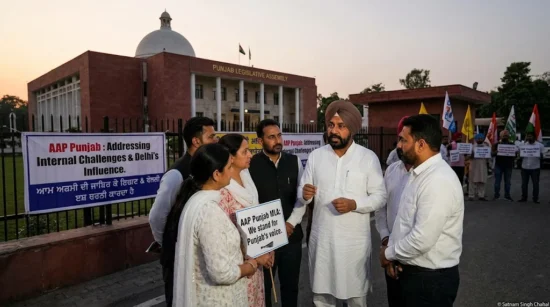
Chandigarh: The internal political situation within the Aam Aadmi Party (AAP) in Punjab has increasingly become a subject of public discussion as the state approaches the 2027 Assembly elections. After securing a historic mandate of 92 seats in the 117-member Punjab Legislative Assembly in 2022, the party is now facing questions over internal disagreements, dissatisfaction among elected representatives, defections and the selection of candidates for the next elections.
When AAP came to power in Punjab, it promised a new style of politics, corruption-free governance, improved education and healthcare, employment opportunities and decisive action against drugs. The people gave the party an overwhelming mandate, expecting meaningful changes in the state’s political and administrative culture. However, the present political developments have raised questions about how effectively the party has converted its electoral success into administrative stability and organisational unity.
Delhi’s influence and Punjab’s political leadership
One of the recurring political debates surrounding the Bhagwant Mann government concerns the relationship between the Punjab leadership and the party’s central leadership in Delhi.
Opposition parties have repeatedly questioned the extent of influence exercised by Delhi-based leaders over important decisions concerning Punjab. They argue that the state’s political and administrative priorities should be determined primarily by its elected leadership.
AAP, on the other hand, maintains that coordination between its national and state leadership is part of its organisational structure.
Nevertheless, an important democratic question remains: when the people of Punjab elect their government, they expect their elected representatives to take responsibility for decisions affecting the state. Transparency, accountability and clarity in decision-making are essential for maintaining public confidence.
Senior leaders’ departures raise organisational questions
AAP also faced a significant setback at the national level in 2026 when seven of its Rajya Sabha members left the party and joined the BJP, including six members representing Punjab. The development generated considerable discussion about organisational cohesion and the relationship between the party leadership and its senior representatives.
The departure of senior parliamentarians raised questions about the reasons behind their dissatisfaction and whether sufficient efforts had been made to address their concerns.
Growing differences between MLAs and party leadership
Differences between elected representatives and the party leadership have also become visible in Punjab.
Maur MLA Sukhveer Singh Maiserkhana publicly raised concerns about teacher shortages in government schools, including schools attended by his own children. Following his criticism, AAP suspended him from the party in October 2026, citing alleged anti-party activities.
Another prominent case involved Kunwar Vijay Pratap Singh, the former IPS officer and MLA from Amritsar North. He had repeatedly raised questions concerning justice in the sacrilege cases and the government’s handling of related matters. His differences with the party leadership eventually resulted in his suspension.
These incidents have brought renewed attention to the question of how much room elected representatives have to express disagreement within the party, particularly when they raise issues concerning public services and governance.
Candidate selection creates another political challenge
The announcement of AAP’s first list of 40 candidates for the 2027 Assembly elections on October 31, 2026, created further political discussion.
Two sitting MLAs, Harmeet Singh Pathanmajra from Sanaur and Chetan Singh Jouramajra from Samana, were not included in the first list. Neither constituency received a new candidate in that announcement, so their exclusion from the initial list was not, by itself, a formal denial of their tickets.
However, both legislators resigned from AAP’s primary membership on November 1. The following day, they joined the BJP along with former AAP MLA Kunwar Vijay Pratap Singh.
All three subsequently left the Punjab Assembly, and their departures further highlighted the political differences emerging within the ruling party.
Chetan Singh Jouramajra had previously served as a Cabinet minister in the Bhagwant Mann government. Harmeet Singh Pathanmajra had represented Sanaur, while Kunwar Vijay Pratap Singh had represented Amritsar North.
Their departure has raised questions about the party’s internal communication, candidate-selection strategy and its ability to maintain unity among elected representatives ahead of the next Assembly elections.
Punjab’s real problems still demand answers
While political developments and internal disagreements continue to attract attention, Punjab’s fundamental problems remain unresolved concerns for ordinary citizens.
Unemployment, drug trafficking, the agricultural crisis, rising government debt, industrial challenges, the quality of public education and healthcare services require sustained attention.
The government must present a transparent account of its performance in these areas. Political disagreements should not overshadow the need to address public concerns.
When an elected representative raises questions about teacher shortages, drug-related problems or administrative failures, the government should respond with facts and solutions. Differences within a political party should not become more important than the public issues that elected representatives are expected to address.
The 2027 Assembly elections will test the party’s leadership
For AAP, the coming months will be important in determining how it manages internal disagreements, candidate selection and its relationship with elected representatives.
The party will also have to explain its record in government and demonstrate how much progress has been made on the promises presented to voters in 2022.
Opposition parties, meanwhile, will need to present their own policies and practical alternatives rather than relying exclusively on disagreements within the ruling party.
For Punjab’s people, the most important issue is not the internal politics of any particular party. Their concerns are employment, public safety, agriculture, education, healthcare, economic development and the future of the younger generation.
In 2022, the people of Punjab gave AAP an overwhelming mandate in the hope of bringing political and administrative change. As the state moves towards the 2027 elections, the party faces important questions about its governance, internal unity and accountability. Ultimately, voters will judge political parties not merely by their statements and election promises, but by their performance, transparency and willingness to answer public questions.
Disclaimer: This article and accompanying images are for informational and illustrative purposes only. Some visuals may be AI-generated or digitally enhanced and may not depict actual events or persons.Views expressed are based on publicly available information and analysis