
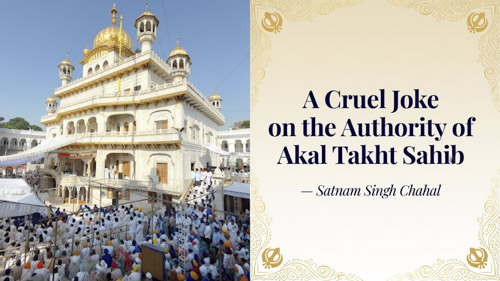
 Akal Takht Sahib, located opposite Sri Harmandir Sahib in Amritsar, occupies a unique and respected position in Sikh history. Established by Sri Guru Hargobind Sahib Ji in 1606, it represents the temporal authority of the Sikh community, known as Miri-Piri. Its original purpose was to provide the Sikh Panth with an independent institution for justice, collective decision-making, protection of religious principles and defence of community interests. However, an important question has repeatedly emerged throughout modern Sikh history: has Akal Takht Sahib remained independent of political influence, or have political parties, governments and powerful Sikh organisations increasingly influenced its decisions?
This question is not about the sanctity of Akal Takht Sahib or the respect it commands among Sikhs. It concerns the independence of its institutional functioning. The distinction between the spiritual and temporal authority of the Takht and the political interests of those who exercise influence over its administration deserves serious examination.
The history of political involvement in Sikh religious institutions can be traced through several important developments. In 1606, Guru Hargobind Sahib Ji established Akal Takht Sahib and introduced the principle of Miri-Piri, bringing together spiritual responsibility and temporal authority. The institution was intended to serve the collective interests of the Sikh Panth rather than any individual political organisation.
In 1920, the Shiromani Gurdwara Parbandhak Committee (SGPC) was established during the Gurdwara Reform Movement. The movement sought to free Sikh shrines from hereditary mahant control and establish community management. The Sikh Gurdwaras Act of 1925 subsequently provided a statutory framework for the management of major Sikh shrines. Although these developments strengthened community control, the relationship between the SGPC, the Shiromani Akali Dal and the appointment of religious leadership gradually created a close connection between religious administration and organised Sikh politics.
During the 1950s and 1960s, the Punjabi Suba movement led by Master Tara Singh and later Sant Fateh Singh brought Sikh religious identity, Punjabi language and political demands into the centre of public discussion. Akal Takht Sahib and other Sikh institutions became important centres of mobilisation. Although the movement addressed genuine questions concerning Punjabi language and Sikh identity, it also established a continuing pattern in which religious authority and political campaigns operated in close proximity.
During the Emergency imposed by Prime Minister Indira Gandhi in 1975, the Akali Dal launched its Democracy Bachao Morcha against restrictions on democratic freedoms. Thousands of Akali volunteers participated in the agitation. Supporters regarded the movement as a defence of democracy, but the episode also demonstrated how Akal Takht Sahib could become a focal point for party-led political mobilisation.
In 1982, the Akali Dal under Sant Harchand Singh Longowal launched the Dharam Yudh Morcha in support of demands associated with the Anandpur Sahib Resolution. Sant Jarnail Singh Bhindranwale also became associated with the movement and operated from the Darbar Sahib complex. Consequently, Akal Takht Sahib became central to one of the most consequential political and religious periods in modern Sikh history.
June 1984 remains one of the darkest chapters in Sikh history. Operation Blue Star, carried out by the Indian Army, severely damaged Akal Takht Sahib and caused profound pain among Sikhs throughout the world. The subsequent government-sponsored reconstruction was rejected by many Sikhs, and the reconstructed structure was demolished in 1986 before the Takht was rebuilt through community participation. This episode remains a powerful reminder that the independence, dignity and protection of Sikh religious institutions must remain beyond government and political control.
Another important controversy emerged in 1986–87 when Akal Takht Sahib imposed religious sanctions against Punjab Chief Minister Surjit Singh Barnala following police action inside the Golden Temple complex during Operation Black Thunder. The decision became politically controversial because observers argued that religious sanctions could have consequences for competing political leaders and factions. It raised questions about the relationship between religious accountability and political competition.
The controversy surrounding Bhai Ranjit Singh in 1999 further exposed institutional tensions. The SGPC executive suspended him as Akal Takht Jathedar amid political disagreements involving then Chief Minister Parkash Singh Badal and SGPC president Gurcharan Singh Tohra. This episode raised a fundamental question: if a Jathedar is expected to exercise independent religious authority, should an administrative committee have the power to remove him during a political dispute?
In 2000, the removal of Giani Puran Singh and the appointment of Giani Joginder Singh Vedanti further exposed the absence of a transparent and broadly accepted appointment system. The issue was not simply who occupied the position but whether the appointment and removal of the highest religious office-holder could be determined through a process vulnerable to institutional and political pressure.
In August 2008, Giani Joginder Singh Vedanti was removed from the position of Akal Takht Jathedar. His differences with the SGPC and the SAD leadership, including the handling of the Dera Sacha Sauda controversy, were discussed in contemporary reporting. Once again, the independence of the Jathedar’s office became a subject of public debate.
The Dera Sacha Sauda pardon controversy of 2015 became one of the most widely discussed examples of the relationship between politics and religious decision-making. On September 24, 2015, Sikh high priests announced a pardon for Dera Sacha Sauda chief Gurmeet Ram Rahim Singh in connection with the 2007 controversy involving his imitation of Guru Gobind Singh Ji. The decision generated widespread opposition among Sikhs. On October 16, 2015, the pardon was withdrawn because the Panth had not accepted the earlier decision. Critics alleged political motivations behind the original announcement, while the Sikh leadership cited Panthic sentiments as the reason for its withdrawal. The episode damaged public confidence in the decision-making process and raised serious questions about the independence of religious authorities.
In 2023, questions surrounding the departure of Giani Harpreet Singh from the position of acting Jathedar and the appointment of Giani Raghbir Singh again brought attention to the absence of permanent, transparent rules governing the appointment and removal of Jathedars. The Sikh community continued to debate whether the highest religious offices should be protected from political and administrative pressure.
On August 30, 2024, Akal Takht Sahib declared Shiromani Akali Dal president Sukhbir Singh Badal tankhaiya over decisions taken during the SAD-BJP government between 2007 and 2017. On December 2, 2024, religious punishment was pronounced. The Takht also withdrew the title of Panth Rattan Fakhr-e-Quam previously conferred upon the late Parkash Singh Badal. These proceedings raised important questions about political accountability, the relationship between party leadership and religious institutions, and the authority of Akal Takht Sahib to examine the conduct of political leaders.
The controversy intensified on March 7, 2025, when the SGPC executive committee removed Akal Takht Jathedar Giani Raghbir Singh and other Takht Jathedars. The decision followed tensions involving the December 2024 proceedings against Sukhbir Singh Badal and other Akali leaders. Several Sikh organisations and observers questioned the procedure and demanded permanent rules to protect the independence of religious leadership. Giani Kuldeep Singh Gargaj was subsequently given officiating responsibility at Akal Takht Sahib. This episode once again brought the central institutional question into focus: can the Jathedar independently exercise religious authority if the administrative body responsible for his appointment also has the power to remove him?
These historical examples demonstrate why the relationship between the SGPC, the Shiromani Akali Dal and Akal Takht Sahib deserves serious examination. The SGPC is an elected religious management institution, but its political composition has historically been closely connected with Akali politics. Critics argue that this arrangement creates opportunities for political influence over religious administration. However, it would be incorrect to conclude that every religious decision was politically directed. The concern is about the institutional structure and the absence of sufficiently independent safeguards.
The most important question concerns who should appoint and remove the Akal Takht Jathedar. A person holding this position should be able to question political leaders, hold them accountable and issue religious directions without fear of losing the position. If the appointment and removal process remains dependent on an administrative committee vulnerable to political influence, doubts about independence will continue.
The Sikh community should seriously consider a transparent and widely accepted selection process involving respected Sikh scholars, representatives of different Sikh institutions, religious organisations and the wider Panth. The Jathedar should have clearly defined terms of office, and removal should be possible only under established rules, with publicly stated reasons and an independent review process. Religious decisions should be based on established Sikh principles, the teachings of Sri Guru Granth Sahib Ji and properly examined evidence rather than political considerations.
The worldwide Sikh community, including Sikhs living in North America, Europe, the United Kingdom and other countries, should also have a meaningful opportunity to participate in discussions about the future of Sikh religious institutions. Akal Takht Sahib belongs to the entire Sikh Panth, not to any particular political party, family, faction or individual leader.
Political parties come and go, governments change and leadership positions are temporary, but the religious and historical importance of Akal Takht Sahib belongs to generations of Sikhs. Its prestige is far greater than the political influence of any individual or organisation.
The real question is not whether Sikh religious institutions should participate in matters affecting the community. The principle of Miri-Piri makes it clear that Sikh institutions have an important responsibility to defend religious rights, justice and community interests. The question is whether this responsibility can be exercised independently of party politics.
Akal Takht Sahib should be a place from which political leaders are held accountable, not an institution whose own leadership becomes vulnerable to political pressure. The time has come for a serious Panthic discussion on institutional reforms, transparent appointments and the independent functioning of Akal Takht Sahib. Its authority must remain above political competition, and its decisions must command confidence across the Sikh Panth.
Editorial note: This analysis examines institutional structures and documented historical controversies. It does not question the sanctity of Akal Takht Sahib or the religious authority of the Sikh Panth