
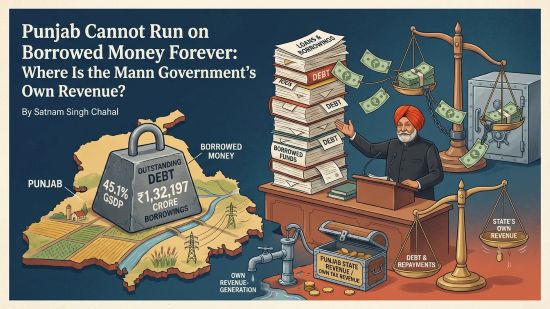
Punjab is facing a serious financial challenge, and the most important question before Chief Minister Bhagwant Mann is whether his government has developed the capacity to run the state through its own revenue or is increasingly depending on loans to meet its financial commitments. Taking loans, announcing welfare schemes, distributing financial assistance, paying salaries and pensions, organising rallies and making development announcements are not, by themselves, achievements of good governance. Any government can continue these activities for some time by borrowing money. The real test of leadership is the ability to strengthen the state’s economy, increase its income, attract investment, generate employment and create sufficient revenue to meet public expenditure without placing an ever-growing debt burden on future generation
According to the Punjab Budget Analysis for 2026-27 published by PRS Legislative Research, the state’s total borrowings are budgeted at ₹1,32,197 crore, while debt repayments are estimated at ₹93,726 crore. The state’s outstanding liabilities are projected at 45.1 per cent of its Gross State Domestic Product (GSDP). The projected fiscal deficit is ₹39,971 crore, or 4.1 per cent of GSDP. These figures underline the scale of Punjab’s financial obligations and the importance of a credible debt-management strategy.
The more important issue is the gap between the state’s income and its expenditure. For 2026-27, Punjab’s revenue receipts are estimated at ₹1,26,190 crore, while its own tax revenue is projected at ₹70,851 crore and its own non-tax revenue at ₹15,687 crore. This means that the state’s own tax and non-tax resources together are estimated at approximately ₹86,538 crore. The remaining revenue receipts are expected from the state’s share in central taxes and grants from the Union Government. Therefore, the government must explain not only how much money it receives but also how effectively it is increasing revenue from its own economic activities, businesses, industries and available resources.
Another worrying aspect is the burden of committed expenditure. According to the 2026-27 budget analysis, Punjab is expected to spend approximately ₹90,335 crore on salaries, pensions and interest payments alone. This amounts to around 72 per cent of its estimated revenue receipts. When such a large portion of income is committed to existing obligations, the government has limited financial flexibility to invest in new infrastructure, industrial development, education, healthcare and employment generation. The question is how the government plans to expand its revenue base so that the state does not remain trapped in a cycle of borrowing and repayment.
Chief Minister Bhagwant Mann must also explain what Punjab has gained economically from the money borrowed during his government’s tenure. How many new industries have been established? How much fresh private investment has actually materialised? How many permanent jobs have been created? How much additional revenue has been generated through GST, excise, property registration and other sources? What has been done to make loss-making public-sector enterprises financially sustainable? How much additional income has been generated from agriculture, industrial production, tourism and other economic activities? These are the questions that should form the basis of any serious assessment of the government’s performance.
Punjab also needs a clear distinction between productive borrowing and borrowing to meet routine financial obligations. Loans used for productive infrastructure can create assets and generate future economic returns. However, when revenue expenditure exceeds revenue receipts, the state faces a revenue deficit, meaning that its regular income is insufficient to meet its regular expenditure. Punjab’s 2026-27 budget estimates a revenue deficit of ₹21,955 crore. This deserves serious public scrutiny because borrowing to cover a recurring gap does not solve the underlying financial problem.
The government should now present a comprehensive financial performance report card before the people of Punjab. It should disclose the growth in its own tax and non-tax revenue since 2022, the total loans raised, the interest paid, the debt repaid, the expenditure on welfare schemes and the actual results of development projects. It should also explain its strategy for attracting industries, improving tax collection, recovering outstanding dues, strengthening public-sector enterprises and reducing unnecessary expenditure. Political announcements and advertising campaigns cannot substitute for measurable economic performance.
Punjab is not asking its government to stop all welfare schemes or necessary development expenditure. People expect better schools, hospitals, roads, employment opportunities, financial assistance for eligible beneficiaries and improved public services. But these commitments must be supported by a financially sustainable economy. The government must understand that every loan taken today becomes a responsibility for tomorrow. The next generation should not be forced to spend its resources repaying debts accumulated without sufficient economic returns.
The central question before Chief Minister Bhagwant Mann is simple: How much has your government increased Punjab’s own income, and how much can it spend without depending on fresh borrowings? Running a state by taking loans is an administrative arrangement, not proof of economic success. The real achievement would be to build an economy that generates enough income to pay its bills, finance public welfare, invest in development and gradually reduce its dependence on debt. Punjab needs revenue generation, industrial growth, financial discipline and long-term economic planning. The people deserve answers backed by figures, not merely promises and announcements.
Reference: PRS Legislative Research, Punjab Budget Analysis 2026–27.