
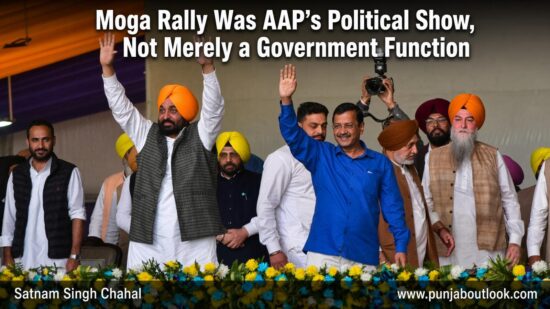
Moga Rally Was AAP’s Political Show, Not Merely a Government Function-Questions over the use of public resources, government machinery and the distinction between the ruling party and the Punjab government
The gathering organised in Moga on November 26, 2026, has raised important questions about the distinction between an Aam Aadmi Party (AAP) political event and an official function of the Punjab government. While the government presented the programme as a state-level Smart Ration Card distribution function, the AAP leadership also projected it as a party Foundation Day gathering and a launch of its political campaign for the 2027 Punjab Assembly elections.
There is nothing unusual about a political party organising a rally, celebrating its foundation day, announcing candidates or seeking public support. These are legitimate political activities. The concern arises when a programme carrying a strong party-political message is organised with the involvement of government departments, public transport and administrative machinery. The people of Punjab have a right to know whether the Moga gathering was primarily a government programme or an AAP political rally presented under an official label.
Reports about the event said that AAP leaders had described the gathering as part of the party’s Foundation Day celebrations and its preparations for the 2027 Assembly elections. Reports also referred to the announcement of 71 candidates. If a party uses the occasion to discuss its electoral strategy, promote its election symbol or appeal to voters to return it to power, those are political activities rather than routine government business.
The speeches delivered at the gathering have added to the debate. AAP National Convenor Arvind Kejriwal reportedly appealed to people to support the party in the next election and urged women to vote for the AAP’s broom symbol. Such appeals are part of democratic campaigning, but they raise questions when delivered at an event simultaneously presented as an official government function. A government platform and public resources must not be used to give one political party an unfair advantage.
The reported deployment of a large number of PRTC buses to bring people to Moga has also attracted attention. Reports put the number at around 680 buses, out of a fleet of approximately 1,350. If buses were diverted from regular routes, ordinary passengers may have faced inconvenience. AAP representatives reportedly said that the party would pay PRTC for the buses. That assurance should be supported by transparent records showing the amount charged, the payment made and whether the full cost—including any operational or public-service impact—was recovered.
The government’s reported decision to designate the gathering as a state-level function and assign a department responsibility for arrangements and expenses does not, by itself, resolve the issue. The public deserves a clear explanation of which expenses were borne by the government, which were paid by the AAP, and how the event’s political and official components were separated. An official order cannot replace transparency about the actual purpose and financing of a programme.
Arvind Kejriwal’s role also deserves clarification. He is the national convenor of the AAP and may campaign for his party like any other political leader. However, if the programme was an official function of the Punjab government, the government should explain why a party leader’s election appeal formed part of the event. The same principle applies to the participation and duties of government officers: public servants are expected to act impartially and must not be drawn into party campaigning.
The Punjab government should publish a complete account of the expenditure on the Moga event, including transport, security, publicity, stage and sound arrangements, food, infrastructure and other administrative costs. It should clarify who authorised the use of PRTC buses, who paid for them, whether the full amount has been recovered, and whether government employees or departments were assigned responsibilities connected with party activities.
These are not anti-party questions; they are questions of public accountability. AAP has every right to hold a political rally, just as every other party does. But a political party and an elected government are not the same institution. The government belongs to all the people of Punjab, including those who do not support the ruling party. Public money, public transport and the administrative machinery must therefore be used for public purposes and in accordance with the rules—not as an extension of a party’s election campaign.
The central issue is not whether AAP had the right to organise a rally in Moga. It did. The issue is whether public resources and government machinery were used for a gathering that also served the party’s electoral interests, and whether the costs were properly authorised and fully paid. The people of Punjab deserve answers supported by documents, not political explanations.
Punjab belongs to its people, not to any political party. A government function should serve the public, while a party rally should be financed and managed by the party. Keeping that distinction clear is essential for democratic fairness, administrative neutrality and public trust.