
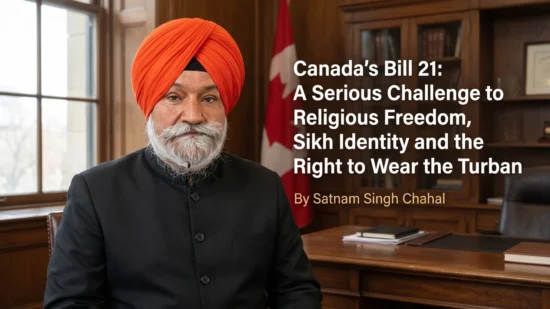
 The debate over Quebec’s controversial Bill 21 has once again brought the fundamental principles of religious freedom, equality and individual rights into the spotlight in Canada. The legislation, which prohibits certain public-sector employees in positions of authority from wearing religious symbols while performing their duties, has particularly serious implications for Sikhs who wear turbans, Muslim women who wear hijabs and members of other religious communities.
For the Sikh community, this is not simply a political or legal disagreement. The turban is an essential expression of Sikh identity, dignity, faith and commitment. It is not an optional fashion accessory that can be removed to satisfy an employment condition. Asking a Sikh to remove the turban as a requirement for holding a public position creates a direct conflict between religious commitment and professional opportunity.
Bill 21 raises an important question: Can a democratic government claim to protect equality while requiring certain citizens to leave an important part of their religious identity outside the workplace?
On November 27, 2026, the Supreme Court of Canada delivered a major judgment in English Montreal School Board v. Quebec (Attorney General), 2026 SCC 41. In a 6–1 decision on the central constitutional issue, the Court upheld Quebec’s use of the notwithstanding clause to protect Bill 21 from challenges based on several fundamental Charter rights.
The decision means that the restrictions on religious symbols will remain in force for covered public-sector positions, including teachers, police officers and certain government officials. Sikh turbans, Muslim hijabs, Jewish kippahs and visible Christian crosses are among the religious symbols affected.However, the judgment was not an unconditional victory for every provision of the legislation. The Court also found that the requirement for members of Quebec’s National Assembly to keep their faces uncovered infringes their democratic rights under Section 3 of the Canadian Charter. That protection cannot be overridden through the notwithstanding clause. The Court also confirmed that judges can declare that legislation protected by the clause is inconsistent with Charter rights, even where that declaration does not invalidate the law.
The implications of this ruling for Sikhs deserve particular attention. Sikh men who wear turbans as an expression of their faith may face restrictions on entering or continuing in certain public-sector careers in Quebec. The law creates a situation in which a person’s religious commitment can become an obstacle to professional advancement.
The Sikh turban represents the principles of equality, courage, responsibility, discipline and commitment to the teachings of the Sikh Gurus. For Sikhs, removing the turban is not comparable to changing an ordinary item of clothing. It involves a deeply held religious obligation and personal identity.Canada has historically been recognised internationally for its multicultural society, immigration opportunities and protection of religious diversity. Sikh Canadians have made substantial contributions to public service, education, business, healthcare, politics, law enforcement and other fields. It is therefore deeply concerning when a legal framework limits their opportunities because of visible religious identity.
The Quebec government has defended Bill 21 on the grounds that the state must remain secular and that public employees exercising authority should not display religious affiliations. However, the principle of state neutrality should not automatically mean that individuals must abandon their religious identity to participate in public life.A person wearing a turban, hijab or kippah does not necessarily compromise the neutrality of a public institution. Professional conduct, fairness, impartiality and respect for the law are the appropriate standards by which public employees should be judged.
The important distinction is between a secular state and a society in which individuals are pressured to become religiously invisible. A democratic government can maintain neutrality without making religious expression a barrier to employment.The Supreme Court’s decision has implications beyond Quebec. It has renewed debate about how far provincial governments can go when using Section 33 of the Canadian Charter, commonly known as the notwithstanding clause.
This clause allows provincial and federal legislatures to override certain Charter protections for renewable five-year periods. Quebec used this constitutional provision to shield Bill 21 from several rights-based challenges.
The ruling has consequently raised concerns among civil liberties organisations, religious communities and advocates of multiculturalism. Critics argue that allowing governments to protect legislation in this manner can weaken the practical protection available to religious minorities.Canadian Prime Minister Mark Carney has said that his federal government will not use the notwithstanding clause, while respecting the Supreme Court’s judgment.
The ruling should encourage Sikh organisations across Canada and internationally to examine its consequences and develop a coordinated response. Sikh institutions, gurdwara management committees, human rights organisations and community representatives should work together to protect the religious rights and professional opportunities of Sikh Canadians.
The response should include constructive engagement with Quebec’s political leadership, federal representatives, human rights institutions and other affected religious communities. Sikh organisations should also consider the available political and legal avenues for challenging discriminatory consequences of the legislation.
The issue should not be treated as a matter affecting only a small section of the Sikh population in Quebec. It concerns the future of religious freedom and equal participation in Canadian public institutions.
It is equally important to clarify that Bill 21 is primarily directed at employees in specified public-sector positions; it is not a general prohibition on Sikh students wearing turbans in schools. The distinction matters when discussing the judgment accurately.
Canada’s strength lies in its diversity. People from different religious, cultural and linguistic backgrounds have built their lives in this country because they believe that they can practise their faith while enjoying equal opportunities.
Religious freedom should not become conditional upon the type of employment a citizen seeks. A Sikh should not have to choose between wearing a turban and becoming a teacher, police officer or public servant. The same principle applies to Muslim women who wear hijabs and members of other religious communities.
The Supreme Court’s decision may have settled important legal questions surrounding Bill 21, but it has not settled the moral and democratic debate about equality, religious freedom and discrimination.
A truly secular state should be neutral towards all religions, not make religious identity a disadvantage. Canada’s commitment to multiculturalism will be judged not by how it treats the majority, but by how fairly it protects the rights of its minorities.The Sikh community must remain united, peaceful and determined in defending its religious identity and constitutional rights.
Sources and legal reference:
Editorial note: This article distinguishes the Supreme Court’s actual ruling from broader concerns about its consequences for religious minorities. The Court upheld most of Bill 21; it did not strike down the entire law.