
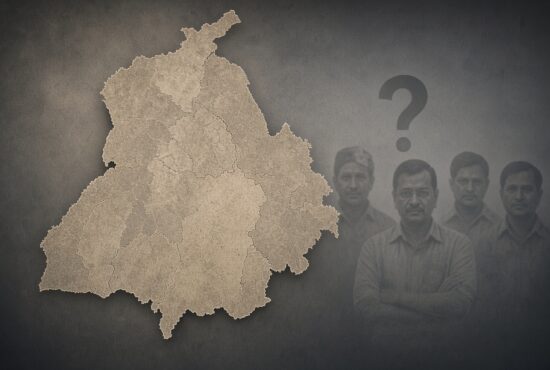
Punjab has an elected Chief Minister, a Cabinet, 117 elected MLAs and a full-fledged administrative machinery. The Chief Minister is Bhagwant Mann, who was elected by the people of Punjab and constitutionally heads the state government. However, an increasingly important political question is being raised across Punjab: Is the government actually being run by the elected leadership of Punjab, or has the real centre of political and administrative power shifted outside the state?
When the Aam Aadmi Party came to power in March 2022, it promised a new political culture, greater decentralisation, transparency and governance that would put Punjab and Punjabis first. People voted for change, expecting that decisions concerning Punjab would be taken by Punjab’s elected representatives, keeping the state’s unique political, economic, cultural and social realities in mind. But four years later, questions about the influence of the party’s Delhi leadership have become an important part of the political debate.
Bhagwant Mann is undoubtedly the public face of the government. His photographs appear on government advertisements, public announcements, inauguration boards and political campaigns. He addresses the people, announces schemes, defends government decisions and faces criticism whenever the administration fails. But the fundamental question remains: how much independent authority does the Chief Minister exercise when it comes to important political appointments, policy decisions, administrative arrangements and the overall direction of governance?
Several media investigations have highlighted the growing presence of Delhi-based AAP leaders and advisers in Punjab’s political and administrative structure. A report published by The Indian Express on October 27, 2026, examined the influence of Delhi-linked political figures, advisers and former associates of the Delhi government across various sectors in Punjab. The report also discussed the roles of Manish Sisodia, Satyendar Jain, Jasmine Shah and Bibhav Kumar in the broader Punjab political and administrative set-up. AAP, however, has defended the involvement of outside professionals and leaders, arguing that expertise is not restricted by geographical boundaries. (The Indian Express)
There is nothing inherently wrong with taking advice from experienced people, irrespective of where they come from. Punjab belongs to every Indian citizen in terms of constitutional equality, and professional expertise should never be judged merely by someone’s birthplace. However, there is a significant difference between seeking professional advice and allowing unelected political figures from outside the state to exercise disproportionate influence over its governance. Advice is welcome; accountability and decision-making authority must remain with the elected government of Punjab.
The question becomes even more important when political leaders from outside Punjab are seen playing prominent roles in decisions concerning Punjab’s education, development, welfare schemes, political strategy and administrative priorities. If these decisions are being shaped by people who do not face the same direct electoral accountability before the people of Punjab, then the government must explain the exact nature of their authority and responsibilities.
The issue is not about opposing Delhi, Haryana, Uttar Pradesh or any other state. It is about protecting Punjab’s democratic autonomy and ensuring that the mandate given by Punjab’s voters is respected. Punjabis did not elect an unelected political establishment sitting outside the state to govern them. They elected 117 MLAs and a Chief Minister, and those representatives must remain answerable to the people.
The irony is that whenever something goes wrong, the Chief Minister has to face the public, the media and the Opposition. But whenever questions are raised about the influence of the party’s national leadership, the responsibility becomes less clear. This creates an uncomfortable situation in which political influence and constitutional accountability may appear to operate on different levels.
AAP leaders have repeatedly rejected allegations that Delhi controls Punjab’s government, insisting that Bhagwant Mann is firmly in charge. That is precisely why the government should welcome transparency rather than treat every question as political criticism.
Punjab is not merely another electoral territory for a national political party. It has its own history, language, culture, agricultural economy, border-related challenges, Sikh institutions, river-water disputes, unemployment crisis, migration concerns and serious financial problems. These issues require a leadership that understands Punjab’s ground realities and is directly accountable to its people.
The people of Punjab deserve to know who takes the final decisions. Who decides the priorities of the government? Who has the final word on important appointments? How much authority rests with the elected Chief Minister, and how much influence is exercised by the party’s central leadership and its advisers? These are legitimate democratic questions, not acts of disloyalty or political hostility.
Bhagwant Mann cannot simply be the face of the Punjab government while the people remain uncertain about where its actual political decision-making power lies. If he is the Chief Minister, he must be seen exercising the authority and responsibility of that office. If the government is taking decisions under his leadership, he must own them. And if influential political figures from outside Punjab are shaping those decisions, the public deserves transparency about their roles.
Punjab has seen governments controlled by powerful political families, centralised party structures and influential individuals in the past. The people voted for change because they wanted a different system, not a new version of the same political culture.
Punjab needs a government of Punjab, by the elected representatives of Punjab and accountable to the people of Punjab. The Chief Minister’s chair is in Chandigarh, the people of Punjab are the stakeholders, and the ultimate authority of democratic accountability must never be shifted elsewhere.
Disclaimer: This article and accompanying images are for informational and illustrative purposes only. Some visuals may be AI-generated or digitally enhanced and may not depict actual events or persons.Views expressed are based on publicly available information and analysis