
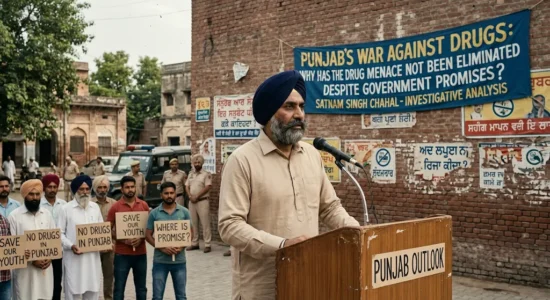
Chandigarh: Punjab has witnessed repeated political promises to eliminate illegal drugs, protect its youth and dismantle the networks responsible for the narcotics trade. Successive governments have announced campaigns, conducted raids, registered thousands of FIRs and arrested thousands of alleged drug traffickers. However, the fundamental question remains: if the government has been taking such extensive action, why does the illegal drug trade continue to remain a serious concern in Punjab?
The recent registration of a 251-page FIR by the Central Bureau of Investigation (CBI), following directions from the Punjab and Haryana High Court on October 5, 2026, has brought another important issue into the discussion: administrative accountability and alleged corruption within government-related circles.
The FIR names Rajbir Singh Ghuman, Officer on Special Duty to Chief Minister Bhagwant Mann, along with Nitin Gohal, Jitin Gohal alias Raja, Romi Raja Mahajan, Bir Devinder and Rajdeep Singh Nagra. The allegations concern an alleged network involving bribes and improper influence over transfers and postings of government officers, administrative approvals, policy formulation, tenders, licensing and other government-related matters.
According to the material referred to in the FIR, the Enforcement Directorate had raised allegations of interference in government functioning and the alleged exchange of financial benefits for official favours. The Punjab and Haryana High Court directed an independent CBI investigation after expressing dissatisfaction with the manner in which the matter had been handled by the state police.
It is important to clarify that this FIR is a corruption investigation, not a finding that the named individuals are involved in the drug trade. Nevertheless, it raises a wider question about the integrity, transparency and accountability of the administrative machinery responsible for implementing government policies, including the campaign against narcotics.
Thousands of FIRs, but why is the supply continuing?
The Punjab Government launched its flagship campaign, Yudh Nashean Virudh, on March 1, 2025. The government presented it as a major effort to dismantle drug networks through enforcement, public participation and rehabilitation.
According to figures reported by The Tribune on July 20, 2026, Punjab Police had registered 52,432 FIRs under the NDPS Act and arrested more than 68,850 alleged traffickers during the first 500 days of the campaign. The police also reported attaching or confiscating properties worth approximately Rs 319 crore allegedly acquired through drug money.
The Times of India reported on September 5, 2026, that between March 1, 2025, and September 3, 2026, the campaign had resulted in 59,293 NDPS FIRs and 25,339 arrests based on information received through the Safe Punjab Helpline. The reported seizures included 3,757 kg of heroin, 964 kg of opium, 45 tonnes of poppy husk, 1,288 kg of ganja and 71 kg of methamphetamine.
These figures demonstrate the scale of police enforcement. But they also raise an important public-interest question: why has the supply of illegal drugs not been eliminated despite such extensive enforcement?
The Indian Express, in its recent reporting on Punjab’s drug problem, highlighted continuing concerns about the availability of chitta and the fact that drugs have also been reported inside prisons. Such developments demand an examination of the entire supply chain rather than simply counting arrests and seizures.
The real question: Are the powerful networks being investigated?
The drug trade cannot be defeated merely by arresting small-time sellers and people struggling with addiction. A successful anti-drug strategy must identify the entire chain, including major suppliers, financial networks, transportation arrangements, storage facilities, distributors and anyone providing protection or assistance to illegal operations.
If a person selling a small quantity of drugs is arrested, but the larger supply network continues operating, the basic problem remains unresolved.
The public also deserves answers about how narcotics repeatedly reach vulnerable communities and educational institutions. Are the intelligence systems working effectively? Are financial investigations reaching the people who control the business? Are officials facing accountability when serious failures occur?
The CBI FIR has raised allegations about the possibility of improper influence over government decisions and administrative processes. It is therefore reasonable to demand greater transparency in the functioning of departments responsible for law enforcement. However, no connection between the individuals named in that FIR and drug trafficking should be assumed without evidence.
Political announcements cannot replace measurable results
Punjab’s youth and families need more than slogans and public announcements. They need visible improvements in the availability of drugs, effective prosecution of major traffickers, accessible treatment facilities and protection for people willing to report illegal activities.
The government should publish district-wise information about major drug suppliers arrested, financial investigations completed, properties confiscated, convictions secured and cases ending in acquittals. It should also provide independently verifiable information about the effectiveness of de-addiction and rehabilitation programmes.
The distinction between arrests and convictions is particularly important. Registering an FIR is the beginning of a legal process, not proof of guilt. Similarly, seizing narcotics is an enforcement achievement, but it does not automatically demonstrate that the supply chain has been dismantled.
Questions the Punjab Government must answer
Why does the illegal drug trade continue despite thousands of arrests and extensive seizures? How many major suppliers and financial controllers have been successfully prosecuted? What action has been taken against officials found to have facilitated narcotics trafficking? How many drug cases have resulted in convictions after a full trial? Are rehabilitation facilities providing sustained treatment and support to recovering individuals?
The government must also explain what independent monitoring mechanism exists to ensure that the anti-drug campaign is producing lasting results rather than temporary enforcement figures.
Punjab needs accountability, not another slogan
The CBI investigation into alleged corruption involving individuals connected with the Chief Minister’s Office and the continuing concerns about the drug menace are two separate matters. Nevertheless, both underline the importance of transparent administration, independent investigations and public accountability.
The Punjab Government has repeatedly promised to protect the state’s young generation from drugs. That promise must now be measured against ground realities. The ultimate success of an anti-drug campaign cannot be determined by the number of press conferences, political speeches or FIRs registered. It must be judged by whether drugs become less accessible, major trafficking networks are dismantled, corrupt facilitators are held accountable and affected families receive meaningful support.
Punjab cannot afford another generation to suffer while governments continue announcing campaigns. The people deserve answers, measurable progress and a drug-control system that works from the top of the supply chain to the last point of distribution.
The biggest question remains: If the government is serious about eliminating drugs, why is Punjab still struggling to eliminate the networks that keep supplying them?
References and supporting reports
-
The Tribune, October 8, 2026: 251-page CBI FIR against Rajbir Singh Ghuman details alleged bribes for policy changes and transfers.
The Tribune
-
The Indian Express, October 7, 2026: CBI books OSD to Punjab CM for graft.
Chandigarh News – The Indian Express
-
The Tribune, July 20, 2026: 500 days of war against drugs resulted in record arrests, says Punjab DGP.
The Tribune
-
The Times of India, September 5, 2026: Punjab combines drug enforcement with addiction treatment.
The Times of India
-
The Indian Express: Drones above, swimmers below: How drugs keep reaching Punjab.
The Indian Express