
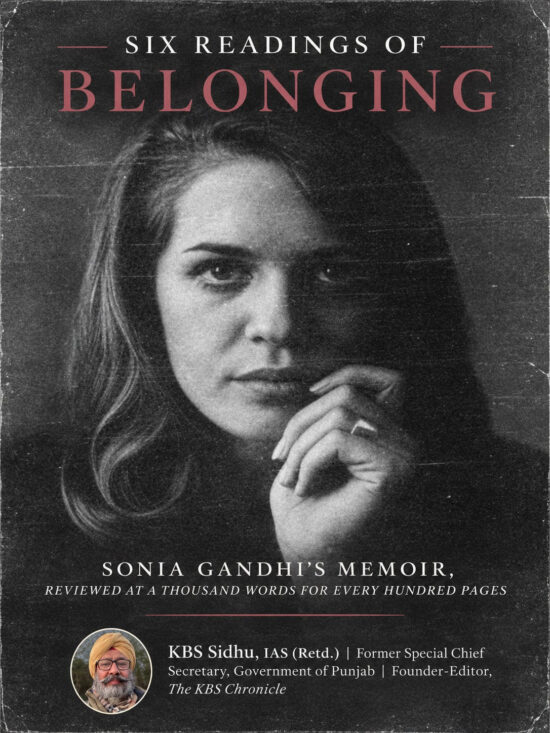
 Belonging: A Journey of Love, Sonia Gandhi’s memoir, runs to 636 pages in the edition before me. It is arguably the most awaited Indian political book in years, and everyone is reading it: book lovers, the ruling party, the opposition, and Congressmen, some of whom are praising it loudly enough to score brownie points with the leadership. The commentary in the media has become a zero-or-one game, worship or dismissal. A book of this length, by this author, deserves more than that. I have, therefore, reviewed it six times, at about a thousand words for every hundred pages, each time from a different seat: the love story; Punjab and the Sikhs; the mandate of 1984 and what became of it; the second Manmohan Singh government; the Congress since 2014; and the book as a political act. The reviews follow the chronology of her life, and each can be read alone. A closing note says where the six leave me.
I. A Bolt of Lightning at the Varsity
Whatever else Belonging is, and five of these six reviews argue that it is a good deal else, it is first a love story, and a simple one. Put the politics down for a thousand words, dear reader, and read it as that. The subtitle, “A Journey of Love”, is the most accurate line on the cover.
A table at the Varsity
It begins on a bright Sunday in January 1965, in a Greek restaurant in Cambridge where an Italian girl of nineteen went because the landlady’s food was inedible. Across the room sat a quiet young man with dark eyes, and she could not place him: Neapolitan, Sicilian, Spanish? A German friend, Christian von Stieglitz, brought him to her table. Her word for what followed is un colpo di fulmine, a bolt of lightning.
She came from Orbassano, a small town near Turin where a “foreigner” meant a man from the south of Italy. That he was Pandit Nehru’s grandson she learnt later, from the friend, and the name told her little. What she noticed was a battered Volkswagen whose dented roof his friends had straightened by lying on the seats and kicking. He sold ice cream, picked strawberries and worked nights in a bakery to pay for a record or a tank of petrol. He would sit through her lunch and order nothing, saying he had eaten.
The return ticket
Two parents stood in the way, and the book is generous to both. Indira Gandhi received the trembling girl in London in June 1965, spoke to her in French, told her that she too had once been young and in love, and then knelt with needle and thread to mend the hem of her evening dress.
Stefano Maino was harder. A sergeant-major of the Bersaglieri who had walked back from the Russian front, he named his daughters after two starving Russian children he had fed. He tried to pack this one off to Leningrad. In November 1966 the young man drove a borrowed, dying Jaguar across the Alps to ask for her, and broke down in the snow at Courmayeur. The father looked into the boy’s eyes, conceded that the love must be true, and still made them wait until she was twenty-one. Then he bought her a return ticket.
She landed in Delhi before dawn on 13 January 1968. Six weeks later, on 25 February, she was married in a garden on Safdarjung Road, in a sari of khadi woven from yarn Pandit Nehru had spun in prison. Her father did not come. He sent a letter of one line: the door of his house would always be open to her.
Under the bougainvillea
The passage that stopped me comes a year later, and I, for one, had not known of it. On 18 January 1969 their first child, a boy, was born two months early. They saw him in the incubator, with thick black hair and long fingers. He died at half past six the next morning.
Hindu custom gives a newborn to the river. She had once seen what the Yamuna does with a body at Okhla, and she would not have it. So the two brothers, Rajiv and Sanjay, carried the child to their father’s bare plot at Mehrauli and buried him deep under a pink bougainvillea in full bloom. For years the couple laid a flower there. A newspaper of the day found something vile to print about it. She remembers the sentence still. I shall not repeat it.
Captain Rajiv
Then came the good years, and she writes of them with an ache. A son arrived in 1970 after eight months flat on her back, and a daughter in 1972. Her husband flew for Indian Airlines and would not let his surname be announced; he was “Captain Rajiv” on the intercom. There was a grey Vespa and a ham radio on which he coaxed her to earn her own call sign.
He was no plaster saint, and she does not make him one. He tore up a May Ball ticket because she was late, and nearly walked out of his own wedding over the photographers. She, for her part, fought him every day for almost a year when the party came for him after Sanjay’s death in 1980. “I broke,” she writes. The marriage survived the quarrel. The life they had chosen did not.
“Why don’t you come with me?”
After 31 October 1984 the love story is told in small things, because small things were all that was left to them. He would leave a meeting on the aircraft to cover her with a shawl. In Xi’an she admired the terracotta warriors, and miniatures of them were her Christmas present that year. In Tehran, on their last anniversary, he set the timer on his camera and took a photograph of the two of them, which he had never done before.
On the afternoon he left for the south he turned at the door and asked her to come along. She was tired and said she would see him in two days. He laughed. She watched him, as she always did, from behind the curtain. He was killed the next night, 21 May 1991, at Sriperumbudur. He was forty-six.
His side of the bed
What follows is the hardest reading in the book, and the most dignified. A daughter of nineteen says, “Papa is dead.” The widow remembers that he had pledged his eyes, and a doctor tells her bluntly why that cannot be. She has never looked at the photograph the newspapers printed. In his travel bag, brought back to her at Allahabad, she finds the first picture he ever took of her.
Her sister begs her to return to Italy: they have killed your mother-in-law and your husband, what are you waiting for? She answers that this is her home. The door in Orbassano was still open, twenty-three years after her father’s letter, and she did not walk through it.
She sleeps, she tells us, on his side of the bed. I believe her. A reader may quarrel with half this book, as I do in the pages that follow, and still close it certain of this much: it was a love match, and it has lasted thirty-five years past his death.
II. When a Big Tree Falls, a Memoir Looks Away
Every Sikh household that opens Belonging will turn first to the same forty pages: June 1984, 31 October, the three days that followed, and the Accord of July 1985. I did the same. I read them as one who later served as Deputy Commissioner of Amritsar and knows that the terror of those years was real, and that it took Sikh lives as readily as Hindu ones. The pages are written with pain. They are also written to acquit.
Blue Star, seen from the dining table
On Operation Blue Star the author’s vantage is domestic. She watches her mother-in-law hold meetings late into the night, leave her meals untouched, and finally act “reluctantly”. She claims no part in the decision, and I take her at her word. What she offers as history is the official brief of 1984, unrevised: Sant Jarnail Singh Bhindranwale was “allegedly” promoted by two Congress factions, a Khalistan flag was to go up on 15 August, and the Prime Minister was left with no choice.
The army entered on 4 June. The book records “considerable damage” to the complex. It does not name Sri Akal Takht Sahib. It does not say that the day chosen brought pilgrims in their thousands for the martyrdom anniversary of Sri Guru Arjan Dev Ji, nor count them among the dead. It grants that Sikhs saw sacrilege, and gives Indira Gandhi her tears before a film of the aftermath. The Sikh tears are taken as read.
Six-thirty, before the pyre
The account of 31 October is the finest writing in the book: the dressing gown, the Ambassador without a siren, the hospital gate that would not open. The timings follow. Death is declared at two in the afternoon. Rajiv Gandhi lands at half past three. By about half past six he is Prime Minister. The cremation is three days away.
“They want me to be sworn in,” he tells her. The book does not say who “they” were. No Parliamentary Party meets in these pages, and the convention of an interim Prime Minister is not mentioned. The man who administered the oath is absent too. Giani Zail Singh, a Sikh, the President of India, whose car was stoned outside the hospital that evening, appears only three years later, as a conspirator angling for a second term. His secretary, Sardar I.S. Bindra, and his press secretary, Sardar Tarlochan Singh, have their own testimony of that week. The memoir has no use for it.
A son, or a Prime Minister?
Here the book undoes its own defence. We are told that the machinery of government had “perhaps even broken down”, and that Rajiv Gandhi, “just and compassionate”, could not have authorised what followed. We are also told, with a wife’s pride, that he had no time to grieve: that same evening he sat with the Cabinet, the Intelligence Bureau, RAW, the Cabinet Secretary and the Army Chief. It cannot be both. If he was a son undone by grief, the oath should have waited. If he was in command from the first night, then more than two thousand Sikhs, by her own count, were killed in his capital on his watch.
The delay in calling out the army is explained thus: the nearest units had Sikh soldiers, there had been mutinies after Blue Star, and so troops were fetched from Dehradun. That paragraph places the delay in protecting Sikhs at the door of Sikhs.
The speech that is not there
The author remembers 19 November 1984 precisely. It was Indira Gandhi’s birthday, and husband and wife signed their will. She does not record what the husband said in public on that day, at the Boat Club: that when a big tree falls, the earth shakes. That sentence is carved into Sikh memory. A book of over six hundred pages has no room for it.
So with the men. Some in charge “looked the other way”, some “stoked passions”. Of hundreds of FIRs, “four or five” led to the arrest of Congress workers. Not one is named, though the courts have named them. Instead we learn that RSS members were also charged, that successive governments failed, and that the Sikhs of Punjab have since voted Congress, which is offered as proof that there was no “rooted animosity”. Dr. Manmohan Singh’s apology to the nation in Parliament in 2005 goes unmentioned, by the very person who made him Prime Minister. She herself came to understand 1984, she writes, only at Bhagalpur in 1989.
Votes first, Accord later
The campaign began on 14 November, eleven days after the pyre. The Congress won 405 seats. The reader is not told that Punjab had no vote in that election. Nothing is said of how that campaign spoke of Sikhs.
Then the hurry of July 1985. The Rajiv–Longowal Accord gets a paragraph for its signing and a page for Sant Harchand Singh Longowal’s murder on the Prime Minister’s birthday. The murder is treated as the end of the story. Chandigarh was to come to Punjab on 26 January 1986. It has not come. The river waters, the territorial claims, the promised inquiry: none of it is in the book, because none of it can be laid at an assassin’s door. Black Thunder, by contrast, is narrated with satisfaction.
A clean chit is not a reckoning
I do not doubt her grief, nor that Sikh families found shelter in her house in those days; she says so and I believe it. She records, too, that Indira Gandhi refused on principle to remove the Sikhs from her own guard. Rajiv Gandhi’s later words in Parliament, that it should never have happened, are quoted and deserve to be.
But the Sikhs, in Punjab above all, did not wait forty-two years to be told that the system failed. They know what they call it, and the word is genocide. They wanted names, an account of those seventy-two hours, and one sentence of responsibility in the first person. What they have been given is a widow’s certificate for her husband, with the mob mentioned in passing.
III. From 405 to 197: A File with the Noting Sheets Removed
On 31 December 1984 Rajiv Gandhi took the oath a second time, with 405 seats behind him, a number neither Pandit Nehru nor Indira Gandhi ever touched. In November 1989 he had 197. Any honest account of those five years must explain the missing two hundred. Belonging devotes eight chapters to the period and explains nothing; it only tells us who was to blame, and it was never the household.
The arithmetic of a fall
The author’s theory of the decline is a single speech. At the Congress centenary in Bombay, in December 1985, the young Prime Minister attacked the “brokers of power and influence”, and the brokers, she suggests, never forgave him. After that it is all conspiracy: the RSS rumour mill, a “media baron”, a “prominent business house from Mumbai”, a President sulking for a second term.
Some of it has substance. In her telling, however, the enemies have no names and the decisions have no authors. Shah Bano is a “compromise” later upheld by the Supreme Court. The locks at Ayodhya open because a district court in Faizabad “suddenly” so ordered. A Foreign Secretary is sacked at a press conference, and that alone is owned as a blunder. The despatch of the army to Sri Lanka is “a political decision that was to have tragic consequences”, as if it had taken itself.
Bofors without the Italian
Then April 1987, and the howitzers. Here the book concedes one thing: the Prime Minister had said there were no agents, and it was later “established that indeed there had been agents”. Having conceded it, the author hurries to February 2004, when the Delhi High Court found not a “scintilla” of evidence against her husband. That finding stands, and I record it.
What lies between those two dates is not in the book. The name Ottavio Quattrocchi does not occur once in these pages. He was an Italian businessman, a friend of the family and a visitor to the house, and his name is why the scandal fastened upon her. She complains, with feeling, that her Italian origin was used against her. She does not tell us who gave her critics the handle.
The Raja who has no name
Vishwanath Pratap Singh was Rajiv Gandhi’s Finance Minister, then his Defence Minister, then his nemesis. In this memoir he is first a nameless man at whose wreath Priyanka takes offence, because he had waved a Swiss account number at rallies. Later he is a petty successor leading cameras through the vacated house to count the geysers, and the Prime Minister who withdrew the Special Protection Group. The last charge is grave, and the Verma Commission bears her out.
How the trusted man became the enemy is left blank. Fairfax is not mentioned, nor his transfer out of Finance in January 1987, nor his resignation that April. St. Kitts, the forged Caribbean account meant to tar his son, is not in the book at all. Close friends who “overreached” and turned hostile are mentioned, and she adds, “I prefer not to name them.” I have handled many files in thirty-seven years. This one has reached the reader with the noting sheets removed.
“Tough fight, let’s see”
The National Front lasted barely a year, and Chandra Shekhar less. He fell, we are told, over a cell of Haryana policemen watching 10 Janpath. So India went to the polls in May 1991.
Ask her husband, in her own pages, whether the Congress would win, and he answers: “It’s going to be a tough fight, let’s see.” That is an honest man’s estimate of an election that could have gone either way. One round of polling was over when he was killed at Sriperumbudur; the remaining rounds were put off to June. The book says only that the election “was completed” and that the Congress won the largest number of seats. It does not say that the party did visibly better after the pyre than before it, nor that it was a minority government that took office. The Congress had now gone to the country on a bereavement twice in seven years. The memoir does not reflect on that.
The sphinx and the scholar
The day after the assassination the Working Committee offered her the presidency. She declined, and I do not grudge the grief of that refusal. The candour stops there.
The choice of P.V. Narasimha Rao is not explained. He had not contested that Lok Sabha election. He had been through heart surgery and was, by every account, packing his books for Hyderabad. The book gives him one paragraph: erudite, experienced, trusted by Indira Gandhi. Who chose him, over Sharad Pawar and Arjun Singh, is not disclosed. Others who were in the room have written that her nod settled it. She is silent.
So also for the five years that followed. She was in “seclusion”; the press called her the Sphinx of Ten Janpath; she and Rao clashed only once, over the pace of the assassination inquiry. Whether the Prime Minister of a minority government reported to a private residence, or ignored it, she does not say. The economic reforms of 1991 are credited to him in a clause elsewhere. The sixth of December 1992 is mourned without his name. His last journey in 2004, and the party office that did not open its gates for it, find no place.
“Was made to step down”
Finally, 14 March 1998. Sitaram Kesri, the sitting Congress president, “was made to step down”, and she was elected in his place. Others have described that afternoon at 24 Akbar Road less gently. She then drove to his house and touched his feet. The gesture was gracious. It is also the only part of the episode she has chosen to narrate.
What the mandate deserved
There is much in these chapters on Rajiv Gandhi’s industry: the drought, the Navodaya schools, the Panchayati Raj Bill lost by three votes. I do not doubt any of it. But a mandate of 405 was the people’s property, not the family’s, and its loss calls for an accounting. The widow has filed a defence brief, dignified and selective.
IV. UPA-II: A Balance Sheet with Only the Assets Side
In May 2009 the Congress came back with more seats than its own managers had dared to forecast. Five years later it was reduced to forty-four. Sonia Gandhi was party president and chairperson of the ruling alliance on both dates. Belonging records the first result with satisfaction and the second without the number. Between them lies the second Manmohan Singh government, and for that the memoir offers a balance sheet with only the assets side filled in.
Who won 2009?
Credit first, since she is careful with it. The victory of 2009, she writes, came from a “combination” of economic growth and social justice. Growth is Dr. Manmohan Singh’s: he steered the country through the global crisis of 2008 and halved the fiscal deficit. Social justice is the work of the National Advisory Council, which she chaired: the Right to Information, the rural employment guarantee, and later the food security law. The apportionment is fair as far as it goes, and it leaves the second half with her.
She also lists her own offices in those years, a thicket of acronyms by her own description: Congress president, chairperson of the Parliamentary Party, chairperson of the UPA, chairperson of the NAC. A core group met the Prime Minister every week, and she sat in it. She chose him in 2004. All this is from her pen. I rely on nothing else.
Dharma of the coalition
Now the liabilities. The second term gets, in substance, two paragraphs. The business world complained of “policy paralysis”, a phrase she keeps in quotation marks. There was “fatigue and complacency”. Ministers “indeed found” to be corrupt were asked to resign. Many accusations were “later proved to be wrong”, and the officials who made them were rewarded by the BJP.
Not one matter is identified. The reader will not find 2G spectrum in this book, nor the coal blocks, nor Adarsh. The Commonwealth Games of 2010 are remembered for a splendid opening ceremony and for the Duchess of Cornwall covering her ears; the rest is “a number of controversies”. It is true that the trial court acquitted the accused in the 2G case in 2017, and a fair reviewer must say so. It is equally true that the Supreme Court cancelled 122 telecom licences and, later, over two hundred coal blocks. Those were not opinions of the media.
Dr. Manmohan Singh, in those years, spoke of the compulsions of coalition. The phrase became “coalition dharma”. The memoir shows us where the coalition came from. In 2004, she tells us, her hand trembled as she telephoned M. Karunanidhi, whose party had been named by the Jain Commission in connection with her husband’s assassination. She made the call for a larger cause, and presents it as the hardest sacrifice of her political life. What that alliance’s hold on the telecom ministry later cost the government is not mentioned.
The ordinance and the outburst
One episode is absent altogether, and it is the one I find hardest to forgive.
In July 2013 the Supreme Court held that a legislator convicted and sentenced to two years or more loses his seat at once, appeal or no appeal. On 24 September the Union Cabinet approved an ordinance to undo that ruling, so that a convicted member could stay on. It was a condemnable measure, and the Cabinet that passed it was her party’s.
Three days later, with the Prime Minister on American soil, her son walked into a press conference in Delhi and declared the ordinance complete nonsense, fit to be torn up and thrown away. The Cabinet of India then quietly withdrew what it had solemnly approved. The measure deserved to die. The manner of its death told the country where authority lay, and what the Prime Minister’s dignity was worth.
The book has a full chapter on Rahul Gandhi: his constituency work, his land-acquisition campaign, his marches. September 2013 is not in it. There is a further irony. The memoir narrates, with a mother’s indignation, how he was convicted in 2023, sentenced to two years and “expelled from Parliament”. That instant disqualification is the very rule the ordinance sought to soften. He was right about the ordinance in 2013. His mother cannot bring herself to say so, because to say so she would have to describe the scene.
Under whose watch?
She anticipates the charge and answers a different one. A former aide to the Prime Minister wrote that files went to her. She denies it flatly, and cites the PMO’s own denial. I accept the denial. A party president does not need files.
The arrangement, as she describes it, was “an unspoken division of responsibility”: the government under him, the party under her. Under that formula, every minister who resigned under a cloud was a party nominee or an ally’s, and ministerial berths, she tells us elsewhere, were matters on which she “put in a word”. When a senior colleague hinted in 2010 that it was time for a change at the top, she changed the subject. Authority of that kind, exercised weekly, carries accountability with it.
Something must be said in mitigation, and she says it herself. In 2010 and 2011 she underwent two major operations abroad, and returned weakened. No one should make light of that. Illness explains her absence in those months. The silence fifteen years later has no such excuse.
The audit she declines
She is loyal to Dr. Manmohan Singh throughout, and gives him the line he spoke at the end, that history would be kinder to him than the media. It is proving so. He was the Prime Minister, however, and answered for his government in Parliament. She was at the helm of the party in power, and has answered nowhere.
The fall of 2014 is ascribed to money, holograms, corporate media and Anna Hazare, said to have been “covertly” run by the RSS. Perhaps all of them played a part. But a party does not go from 206 seats to 44 on the strength of its opponent’s posters. The memoir owed that decade an account of what went wrong under her presidency, and it gives none.
V. Ninety-Nine, and Still Not In: The Congress After 2014
The Congress has now lost three Lok Sabha elections in a row: 16 May 2014, 23 May 2019 and 4 June 2024. It won forty-four seats, then fifty-two, then ninety-nine. The last chapters of Belonging cover exactly this stretch, and they are written by the person who led the party, in name or in fact, through most of it. I opened them hoping for a reckoning and found a mother’s account of her son.
“Marginally”
Take the three defeats as she tells them. In 2014 the party was undone by holograms, corporate money and a hired army on social media. In 2019 the mood was turning, she says, until Pulwama and the air strike swept it away; the Congress improved “marginally”. In 2024 the bank accounts were frozen, two allied Chief Ministers were in jail and the Election Commission was a “willing accomplice”.
Some of this is fair complaint. The freezing of a national party’s accounts on the eve of a poll troubled many who have no love for the Congress. Yet in three chapters there is not one decision of the leadership that is said to have cost a seat. The figure forty-four never appears. Nor does the fact that in 2019 Rahul Gandhi lost Amethi, the family borough she herself calls a second home. We learn of his other constituency, Wayanad, only in the epilogue, when he gives it up.
A century missed, and celebrated
The account of 4 June 2024 is the strangest. Drums approach the house, garlands pile up in the garden, the family embraces. “Though our party hadn’t won,” she writes, the opposition had shown it was alive, and the voters had achieved “nothing short of saving the Constitution”.
I grant the achievement. The BJP was denied a majority of its own, and that mattered. But the cricketer in every Indian will recognise the scene: a batsman out for ninety-nine, carried off on his team’s shoulders, while the other side keeps the trophy. Mr. Narendra Modi was sworn in for a third term five days later. The State defeats that followed are put down, in a sentence, to tampered electoral rolls. And the alliance called INDIA, whose making she describes with pride, is left on the page at its moment of hope. Mr. Nitish Kumar’s exit is recorded. The absence of a convenor, a common face or a common programme since then is not.
The ones who left
Then there are the people who left. She writes warmly of Madhavrao Scindia, her deputy in the Lok Sabha. She does not write that his son walked out in 2020 and took the Madhya Pradesh government with him. Nine State governments, she says, were toppled by “underhanded means”. The means required Congress legislators willing to go.
Mr. Himanta Biswa Sarma, Mr. Ghulam Nabi Azad, Mr. Kapil Sibal and Captain Amarinder Singh (under whom, I should disclose, I served for many years) all left in this period, and none of the departures is in the book. Nor is the letter that twenty-three senior colleagues wrote to her in 2020. They become “dissatisfied people within our own party” and an “old guard” unwilling to make way. My own State went to the polls in 2022 after a change of Chief Minister four months earlier, and the Congress was routed. Punjab is not mentioned.
She recalls, in an earlier chapter, that in 2003 her party ran fourteen States. She does not count them now.
“Only Rahul or me”
On the son himself, she says candidly that she writes “as a mother”. The portrait is of a man maligned by a funded campaign, harassed by thirty cases in eight States, evicted from his house, who then walked 3,800 kilometres on a bad knee and emerged with “a clean heart”. The Bharat Jodo Yatra was a feat of will, and I do not belittle it. He is today Leader of the Opposition, a post his party did not even have the numbers to claim for ten years.
Walking the country has not yet won it, and her own narrative shows where the difficulty lies. In 2019 he resigned the presidency, to his credit, and insisted that no one from the family should succeed him. The party consulted at every level. The verdict, in her words, was that it “would only accept Rahul or me”. So she returned, and stayed three more years.
She offers that sentence as a burden reluctantly borne. I read it as the diagnosis. A party of 140 years, which once had a dozen leaders of Chief Ministerial stature in each generation, told its president that it could imagine only two names, and they were mother and son. She does not ask how it came to that, or under whose stewardship.
A president and a presence
In October 2022 the party elected Mr. Mallikarjun Kharge, with 84 per cent of the vote. She pays him a handsome tribute: a veteran of nine Assembly victories, a man of “gravitas”. She felt, she says, that a mountain had been lifted from her back.
After that, Mr. Kharge appears once more, announcing the alliance. Every scene that follows is narrated through the son and the daughter: the second march, the rallies, the reports “from the ground” for which she waits at home, the victory embrace. Mr. K.C. Venugopal, who runs the organisation, does not appear at all. The elected president is in the book what many believe him to be in the party: an honoured figurehead, there to assist the man who takes the decisions.
Three seats, one family
The epilogue takes stock. She sits in the Rajya Sabha. Her son is Leader of the Opposition. Her daughter is the member for Wayanad. All three are in Parliament, from the same household, in a party that has just lost its third general election.
She closes with faith that Mahatma Gandhi’s India will prevail, and I share the hope. But the opposition which this country needs, and has lacked for twelve years, will not be built on faith and a family. It needs a party that can look beyond one house. On the evidence of her own memoir, this one still cannot.
VI. Belonging, to Whom? A Manifesto in a Memoir’s Binding
Sonia Gandhi tells us on the first page what she has written: “a personal memoir, one for which politics is the background.” Hold on to that sentence, because by Part Seven the author has forgotten it. The Cambridge courtship, the Orbassano kitchen, the two assassinations are all there, and they are told with feeling. Yet when the last page is turned, what remains in the hand is a party document: carefully vetted, electorally timed, and addressed less to posterity than to the voter.
The frame swallows the picture
The architecture gives the game away. Parts One to Five are a life. Part Six is a Congress president’s working diary. Part Seven, titled “Twenty Years On”, is a charge-sheet against the present government, running from demonetisation and GST to the Enforcement Directorate and the Election Commission, which she calls a “willing accomplice”. A memoirist who has declared politics to be her frame has, by the end, let the frame swallow the picture.
Nor is the timing innocent. The book arrives with Punjab and Uttar Pradesh months away from assembly polls, and with her son installed as Leader of the Opposition. The tragedy is real; nobody who reads her account of 31 October 1984, or of the night of Sriperumbudur, will doubt it. It is also deployed.
Regrets, officially sanctioned
Look for what embarrasses the Congress and you will find exactly one item, the Emergency, and even that arrives pre-cleared. The regret on record is Indira Gandhi’s own, quoted from a 1978 tour of Maharashtra. The excesses are Sanjay’s, the sterilisation drive “poorly conceived and callously carried out”. The proclamation itself is presented as something forced upon a cornered Prime Minister by Jayaprakash Narayan, cast here as an instrument of the RSS. The party said sorry decades ago. The book says no more than the party did.
Everything else is defence. November 1984 is a “shameful chapter”, but the system had “broken down”, Rajiv Gandhi could not have authorised anything, and the reader is reminded that RSS men were booked too. On Bofors, agents existed after all, yet the story ends with the Delhi High Court’s clean chit of 2004. On Shah Bano, the Supreme Court is said to have vindicated him in 2001. The demolition at Ayodhya in December 1992 is mourned without one sentence on who was Prime Minister that day.
A decade without a blemish
The Manmohan Singh years, 2004 to 2014, receive the same treatment. There is praise in plenty: 270 million lifted out of poverty, the rights-based laws, a fiscal deficit halved. What is missing is the decade as the country lived it. You will search these pages in vain for 2G or the coal blocks. The nuclear deal and the Left’s walkout are absent, and so is the ordinance her son denounced at a press conference in 2013. Corruption is something the BJP “propagated”, auditors “inflated”, and Anna Hazare fronted for the Sangh. “Policy paralysis” appears only inside quotation marks, as other people’s phrase. Her own admission stops at “fatigue and complacency”.
In the epilogue she confesses to political compromises that still trouble her conscience. She does not name one. A memoir names them.
The glance that wasn’t
Then comes Mr. Narendra Modi. Twelve years of sharing a Parliament have yielded her a namaste, an enquiry after her health, and this observation: “He tends to look away, avoiding eye contact.” The reader is invited to see a furtive man, and the invitation is repeated: his origins “may not have been as humble” as advertised, his language in the House is “coarse”, his claim to be “non-biological” is retailed with relish.
She allows him one thing: that he rose from an underprivileged world, and that his unease in Delhi’s drawing rooms is one she shares. It is the only generous sentence in the chapter.
She insists it is not personal. Perhaps. A political opponent is entitled to her indictment, and some of it, the missing press conferences for one, is a matter of record. But an indictment is not a recollection, and a long chapter of it sits oddly in a book subtitled “A Journey of Love”.
Son rise, daughter in attendance
Now to the family, which is to say the party. Rahul Gandhi gets the heroic arc: the cases, the eviction, the knee, the Bharat Jodo Yatra, and a mother’s verdict that he is “a man with intellect and a clean heart”. It is a character certificate, issued in hard covers by Knopf.
Priyanka Gandhi Vadra is on almost every page. She is nurse, speechwriter, election agent since 1999; she takes charge on the night her father is killed; she sleeps on a hospital floor in Rotterdam. The gratitude is real. Yet, as a politician in her own right, she barely exists. Her years as a party general secretary go unrecorded, and her election from Wayanad gets one sentence in the epilogue. The book itself quotes Rajiv Gandhi calling her the tougher child, “a lot like my mother”. Having printed that, the author hands the inheritance to the other one.
What the book is for
The centrepiece of her own political story is May 2004, and she tells it at length: the allies crowding round her, the children in tears, the “inner voice” speech in the Central Hall. She also tells us that she had decided months earlier never to take the post, and led the whole campaign without saying so. The renunciation was sincere. It was also, by her own account, settled in advance.
I do not call Belonging a dishonest book. I call it a purposeful one, and the purposes are three: to restate the Congress’s account of itself without a single fresh concession, to fix its president emerita in the public mind as a figure of sacrifice, and, therefore, to lend that sacrifice to her son.
Read it for the Italian childhood and for Indira Gandhi at the dining table; those chapters are worth the price. Read the rest as you would read a manifesto.
Mrs. Gandhi turns eighty this December. She sits in the Rajya Sabha, with a son and a daughter in the Lok Sabha, and her story has chapters still to come. I look forward to reading them.
On this volume my view, after six passes, is settled. However one reads it, as romance, as grief or as history, it is a political document. She saw these events as a wife, a daughter-in-law and a party president, and she has written to defend her husband, her family and her party. That holds even for the years before she stepped into power. The Emergency, Blue Star and Bofors are told from inside the household, by a member of it, and no reader should take those chapters for an objective or neutral record.
She did not owe us neutrality, and the book is no less worth reading for the lack of it. Read it with other books open beside it.