
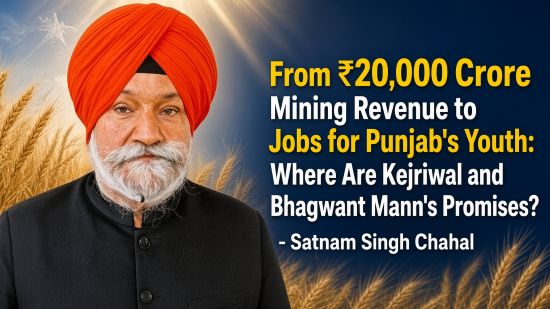
 When the Aam Aadmi Party (AAP) sought the people’s mandate in Punjab in 2022, Arvind Kejriwal and Bhagwant Mann presented an ambitious vision of a transformed Punjab. They promised to improve the state’s financial condition, eliminate corruption, generate enormous additional revenue, create employment, stop the migration of young people and make Punjab a model of development.
The people of Punjab were given the impression that the state possessed enormous untapped financial resources and that all it needed was an honest and efficient government to unlock its potential. The promises were attractive, the political speeches were impressive, and expectations among ordinary Punjabis were exceptionally high.
However, after years in government, an important question needs to be asked: How much of that promised transformation has actually reached the people of Punjab?
The ₹20,000 crore mining promise: Where is the money?
One of the most widely publicised financial promises made by Arvind Kejriwal before the 2022 Assembly elections was that Punjab could generate approximately ₹20,000 crore annually through sand and gravel mining. The party also claimed that eliminating corruption, stopping financial leakages and improving administration would bring tens of thousands of crores into the state treasury.
These were not minor election assurances. They were presented as a major financial solution to Punjab’s economic difficulties.
Yet, in February 2025, Leader of Opposition Partap Singh Bajwa cited government figures indicating that mining revenue during the first three years of the AAP government totalled approximately ₹864 crore, averaging around ₹288 crore annually. In July 2026, the BJP also criticised the government over the enormous gap between the original promise and actual collections.
The government must explain why the promised revenue has not materialised. Where is the promised financial revolution? How much revenue has actually been collected from Punjab’s own mining resources, how much has come through taxes on material entering from neighbouring states, and how much money has been lost through illegal mining?
Punjab cannot be governed through election mathematics that disappear after elections.
Increasing income and reducing corruption: The financial accountability test
Kejriwal and Mann repeatedly argued that Punjab did not lack resources; it lacked an administration capable of collecting revenue and preventing corruption. The government was expected to increase its income, stop wasteful expenditure, recover public money and reduce dependence on loans.
But the people deserve a transparent account of the results. How much additional revenue has been generated through improved administration? How much money has actually been recovered from corruption? What measurable savings have been achieved? And how much has Punjab’s debt increased during the same period?
A government cannot claim financial success simply by announcing new revenue targets. Revenue collected, expenditure saved and debt incurred must be presented separately and transparently. A loan is not income, and an election promise is not money in the treasury.
Jobs for Punjabi youth: The most important promise still under public scrutiny
Employment was among the central issues of the 2022 election campaign. Bhagwant Mann promised that government jobs would be provided on merit, without political recommendations or bribery. The AAP also promised to create employment opportunities and stop the continuous migration of Punjab’s educated youth.
The government has subsequently announced thousands of appointments and regularly publicises recruitment figures. Those achievements should be acknowledged wherever supported by actual appointment records. However, the larger question remains whether the state’s employment crisis has been adequately addressed.
Thousands of Punjabi families continue to worry about unemployment, expensive overseas migration and the lack of suitable opportunities for educated young people. A government appointment figure alone cannot establish that the employment problem has been solved.
There are also serious political questions about the participation of candidates from outside Punjab in recruitment and the appointment of non-Punjabi personnel to important government positions. The issue should not be turned into hostility against people from other states. Every Indian citizen is entitled to equal treatment under the Constitution. Nevertheless, Punjab must ensure that recruitment rules, Punjabi-language requirements, local qualifications and other legally permissible conditions are implemented fairly and transparently.
The government should publish department-wise recruitment data showing the number of applicants, selected candidates, their states of eligibility, vacancies and the application of reservation and recruitment rules. Punjabi youth deserve facts rather than slogans.
The promise of AIIMS in every district: Development or election rhetoric?
Punjab also deserves clarification about claims and expectations surrounding the expansion of major medical facilities. If the political leadership promised an AIIMS-level institution in every district, it must identify the official announcement, the approved projects, the allocated budget and the implementation timetable.
An AIIMS institution is a major medical and educational project requiring substantial investment, specialist staff and infrastructure. It cannot be created through a public speech.
Even if the government has not formally promised a full AIIMS in every district, it has a responsibility to explain how it intends to provide quality healthcare across Punjab. People in smaller towns and rural areas should not have to travel long distances for specialist treatment.
Agriculture inspectors in every village: What happened to the rural commitment?
Punjab’s farmers were also given expectations of stronger agricultural support. One of the promises attributed to the pre-election campaign was that every village would have an agriculture inspector to guide farmers on modern farming, crop protection, soil health and agricultural practices.
If this commitment was made, the government should explain how many villages have actually received dedicated agricultural officers, how many posts remain vacant and what services are available to farmers.
Punjab’s agricultural economy is facing serious challenges involving groundwater depletion, rising cultivation costs, crop diversification and farmers’ financial difficulties. Agricultural extension services should be strengthened instead of remaining confined to election announcements.
Rajya Sabha nominations: Whose interests are being represented?
Another major controversy arose when AAP nominated people from outside Punjab to the Rajya Sabha using the seats allocated to the state. In March 2022, the party nominated Raghav Chadha, Sandeep Pathak and others, alongside candidates with Punjab connections.
The decision attracted criticism because people believed that Punjab’s parliamentary representation should prioritise individuals with a demonstrated understanding of the state’s language, culture, economy and problems.
The constitutional system does not require every Rajya Sabha member elected from a state to be a resident of that state. Therefore, the criticism is political rather than a claim that such nominations are automatically illegal.
Nevertheless, the question remains legitimate: Why did a party that promised to give Punjab a new political direction choose to send prominent leaders from outside the state instead of giving more opportunities to experienced Punjabis who could effectively raise Punjab’s concerns in Parliament?
Government contracts and business opportunities: Are Punjabi enterprises being overlooked?
There are growing political questions about the distribution of government contracts, consultancy assignments, business opportunities and public-sector work. Opposition leaders have alleged that people and organisations from outside Punjab have been given important positions and assignments.
In June 2025, the Leader of Opposition raised questions about non-Punjabi appointments in the Punjab Development Commission, including advisers and other officials. These allegations deserve a response supported by official recruitment and expenditure records.
The government should disclose the criteria used for awarding contracts, the identities of successful bidders, the value of contracts, the location of the companies and the extent to which local businesses were able to compete.
Punjab’s entrepreneurs, transport operators, contractors and small businesses should receive a fair opportunity. Public money must be spent through transparent competition, not political connections or preferences.
Religious pilgrimage services: Transparency must come before political influence
The allocation of religious pilgrimage transport and related services also requires transparency. In June 2026, the Punjab government’s official e-procurement portal listed a tender for the selection of a private-sector partner to undertake pilgrimage journeys to Shri Khatu Shyam Ji and Salasar Balaji under the Mukh Mantri Tirath Yatra Scheme.
The existence of a tender does not by itself establish that the contract was awarded unfairly or that Punjabi operators were excluded. However, the government should disclose the final selection, bidding conditions, participating companies and the reasons behind its decision.
If qualified Punjabi transport companies were denied a fair opportunity, the government must answer why. Religious services and public funds should not become instruments for favouring selected commercial interests.
Law and order: Verification, policing and public safety
Punjab is also facing public concern over crime, gang activity, drugs and law-and-order conditions. Citizens have questions about the movement of criminal suspects, verification procedures and the effectiveness of policing.
However, it would be wrong to blame people simply because they come from another state. Criminality has no state or language. The government’s responsibility is to enforce the law equally, verify tenants and workers wherever legally required, monitor known criminal networks and take action against offenders regardless of their origin.
The real test is whether the police can prevent crime, investigate cases efficiently and protect ordinary citizens. Arrest figures and press conferences are not enough if people continue to feel unsafe.
The Mann government must publish credible crime statistics, explain the progress of investigations and demonstrate whether the policing system is actually becoming more effective.
‘Foreigners will come to Punjab for jobs’: A statement that demands a reality check
One of Bhagwant Mann’s widely discussed remarks in April 2022 was that foreigners would eventually come to Punjab seeking employment. The statement was made in the context of stopping the migration of Punjabi youth.
It was an optimistic political declaration, but the reality facing thousands of Punjabi families is that young people continue to explore opportunities abroad because they want stable employment, better salaries and a secure future.
Before talking about foreigners coming to Punjab for jobs, the government must ensure that Punjabi graduates, skilled workers and professionals can find respectable employment in their own state.
The question is simple: If Punjab has become such an attractive employment destination, why are so many families still spending their savings to send their children overseas?
The real question: Is Punjab being governed for Punjabis or merely through political announcements?
Punjab does not need another series of grand promises. It needs measurable results. The people want employment for their children, fair opportunities for local businesses, a transparent mining policy, stronger healthcare, agricultural support, improved public safety and responsible financial management.
The AAP leadership must understand that Punjab is not merely an electoral territory. It has a distinct language, culture, agricultural economy, entrepreneurial community and historical identity. Its people expect a government that listens to their concerns and gives local talent a fair opportunity.
Arvind Kejriwal and Bhagwant Mann should present a comprehensive public report card comparing every major 2022 promise with the actual achievement as of November 2026. Every promise should be accompanied by an approved budget, expenditure figures, completed work, pending work and a realistic deadline.
The people of Punjab did not vote merely to hear that thousands of crores would be collected, that jobs would be created, that corruption would disappear and that outsiders would come to seek employment. They voted for a better future.
Punjab deserves answers. The time for political slogans is over; the time for accountability has arrived.