
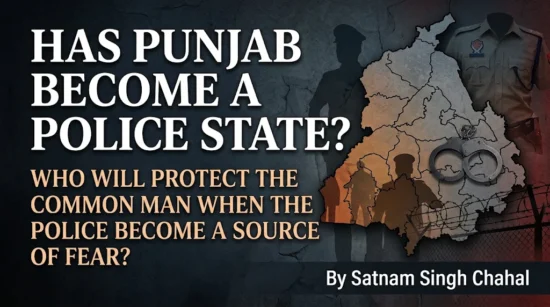
 Punjab is passing through a deeply concerning period in which the relationship between the police and ordinary citizens has become a serious public issue. The police are entrusted with the responsibility of protecting people, maintaining law and order and ensuring justice. However, allegations of police high-handedness, illegal detention, custodial torture, intimidation and misuse of official authority have raised an uncomfortable question: Has Punjab reached a situation where the police can act according to their own wishes while ordinary citizens are left helpless?
A police uniform represents responsibility, discipline and public service. It does not give any officer unlimited authority to behave as though the law does not apply to them. Every police officer, from a constable to the highest-ranking official, is bound by the Constitution and the law. Arrests, searches, questioning and detention must follow established legal procedures. No individual should be illegally detained, physically assaulted, threatened or humiliated simply because a police officer believes that he or she can exercise personal authority.
The most unfortunate situation is faced by ordinary people who have neither political influence nor financial resources. A poor labourer, farmer, shopkeeper, student or an ordinary family often finds it difficult even to approach senior police officials when facing alleged police misconduct. Wealthy and influential people can hire expensive lawyers, contact political representatives and seek intervention from powerful individuals. But who stands with a poor citizen whose complaint is against the very police machinery responsible for protecting them?
There is growing public concern that questioning police conduct or demanding accountability can expose ordinary citizens to additional pressure and harassment. Whether every allegation is established or not, the perception that police authority is unchecked is itself damaging public confidence. A democratic society cannot function properly when citizens become afraid of approaching police stations or expressing legitimate grievances.
Recent developments in Punjab have further intensified these concerns. Reports concerning allegations of illegal detention, custodial torture, deaths in custody and other forms of police misconduct have raised questions about the effectiveness of internal supervision. A judicial inquiry into the death of tutor Narinderdeep Singh of Goniana, Bathinda, reportedly raised serious concerns about the conduct of police personnel and supervisory responsibility. Such findings deserve transparent legal examination and appropriate action. Allegations must be investigated impartially, and responsibility must be established through due process.
The Punjab State Human Rights Commission also reportedly received 11,768 cases during 2025, with approximately 5,841 involving complaints against the Punjab Police. These complaints should not automatically be treated as proven violations, but their volume deserves serious attention from the government. When a substantial proportion of human-rights complaints concerns the police, the administration must examine whether existing accountability mechanisms are functioning effectively.
Another serious concern is the alleged politicisation of police administration. In a democratic system, the police must work independently and impartially under the law. They cannot become an instrument for protecting the interests of a ruling party, targeting political opponents or intimidating citizens who question government policies. Political leaders must understand that the police belong to the state and its people, not to any political party or individual occupying a position of power.
Punjab has witnessed changes of government and political leadership, but the basic concerns of ordinary citizens remain. People want security, justice, dignity and equal treatment. They do not want to depend on political recommendations to receive protection from the law. A citizen should not have to know an MLA, minister or senior police officer to ensure that a legitimate complaint is registered and investigated.
The treatment of peaceful protesters is another important test of democratic governance. Farmers, teachers, employees, students, journalists and social activists have the right to raise their concerns peacefully. Criticism of the government is not a crime, and demanding justice is not an act against the state. The police must distinguish between peaceful democratic expression and genuine criminal activity. Maintaining law and order cannot become an excuse for unnecessary force, intimidation or arbitrary detention.
The Punjab government and the Director General of Police must take concrete steps to restore public confidence. Allegations of custodial torture, illegal detention, planting of evidence and deaths in custody must be examined through independent and impartial investigations wherever appropriate. Police station CCTV systems must remain operational, recordings must be preserved and made available to authorised judicial authorities, and complainants and witnesses must be protected against intimidation. Officers found guilty of misconduct must face appropriate legal and departmental consequences, regardless of their rank or political connections.
Senior officers must also accept responsibility for effective supervision. Transferring an accused officer or placing someone under suspension cannot be treated as a substitute for a fair investigation. The government should strengthen independent police complaint mechanisms and ensure that citizens can report misconduct without fear of retaliation.
Punjab has a proud history of courage, sacrifice and standing against injustice. Its people have struggled for democratic rights, dignity and freedom. They deserve a police force that protects the weak, respects the law and treats every citizen equally. The government must understand that public confidence cannot be restored through statements and publicity campaigns; it can only be rebuilt through transparency, accountability and justice.
The most dangerous situation for any democracy begins when ordinary people lose faith in the institutions meant to protect them. Punjab must never reach a point where a citizen fears entering a police station more than facing a criminal. The police must remember that their authority comes from the Constitution, not from personal power.
Punjab needs a police force that serves the people, not a system in which people live in fear of the police. The uniform must represent protection, not intimidation; responsibility, not personal power; and justice, not fear.