
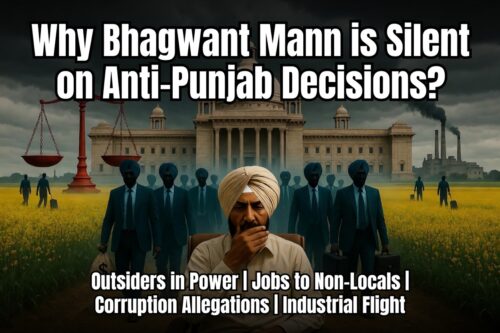
Punjab under Chief Minister Bhagwant Mann and the Aam Aadmi Party (AAP) government has faced persistent opposition charges that key decisions are eroding the state’s resources, businesses, employment opportunities for locals, and even administrative control. Critics from the Shiromani Akali Dal (SAD), Congress, and BJP argue that Mann remains largely silent or ineffective because real power rests with Delhi-based AAP leaders, turning Punjab into an extension of the party’s national apparatus rather than a government prioritising Punjabi interests. These claims centre on jobs allegedly going to non-locals, industries shifting out, outsiders dominating key offices, and specific schemes like the Mukhyamantri Teerth Yatra.
While the government strongly contests many of these as politically motivated, the pattern of criticism and internal AAP murmurs raises questions about autonomy, accountability, and long-term economic priorities.Outsiders Directing Governance: The Core Power Complaint. One of the strongest and most documented criticisms is the growing influence of non-Punjabi AAP functionaries from Delhi in Punjab’s administration. After AAP’s loss of power in Delhi, reports describe Delhi leaders camping in Chandigarh, using ministerial bungalows, and clearing important decisions on transfers, finances, and policy. Local AAP MLAs (speaking anonymously) and senior IAS officers have expressed frustration that “every important decision is being cleared by people from Delhi, who have little idea about the issues plaguing Punjab.
Punjab, they note, is not a city-state like Delhi; its agrarian crisis, drug problem, industrial structure, and social fabric demand local understanding. Opposition leaders and even some within AAP have pointed to appointments of Delhi loyalists to key boards and corporations: examples include roles in the Pollution Control Board, Industrial Development Board, health and education monitoring, media, and the Tirth Yatra Samiti. Critics describe Mann as a “willing host” or nominal head while Arvind Kejriwal and his circle function as the de facto authority. Officers close to Delhi leaders reportedly sideline elected Punjab representatives. This echoes historical Punjabi sensitivity to “Delhi durbar” interference and fuels the charge that the CM stays silent because challenging it would mean confronting his own party’s national leadership.
The government and AAP dismiss this as opposition propaganda, insisting Mann leads and that central coordination helps implement welfare schemes faster. Yet the repeated nature of these reports suggests a structural reality that limits Mann’s independent response on “anti-Punjab” issues.Jobs Going to People from Other StatesOpposition leaders, particularly SAD’s Sukhbir Singh Badal and Congress figures, have repeatedly accused the AAP government of opening government jobs to outsiders from Haryana, Rajasthan, and elsewhere, allegedly for political returns ahead of elections in those states. Specific claims include significant shares of junior engineer posts in the power utility, health systems corporation positions, police sub-inspectors, linemen in PSPCL, and veterinary inspectors going to non-Punjabis. Badal framed this as diluting Punjab’s culture and betraying local youth.The AAP government counters that recruitments are merit-based, that tens of thousands of government jobs have gone to Punjab’s youth, and that temporary employees were regularised.
Mann himself, before becoming CM, had criticised previous governments for recruiting non-Punjabis. Still, the opposition’s detailed numbers and the perception that locals are being edged out persist, contributing to youth frustration and migration. When such allegations surface, Mann’s public responses tend to focus on overall job numbers and freebie schemes rather than a robust defence of domicile preferences or transparent data on the origin of recruits.Loss of Businesses, Resources, and Industrial BasePunjab’s industrial challenges predate AAP, rooted in high power costs, law-and-order concerns, water issues, and competition from neighbouring states. However, opposition parties blamed the AAP government early on for accelerating an “exodus” of industries to Haryana, Himachal Pradesh, Rajasthan, and even Uttar Pradesh, citing a non-conducive atmosphere, deteriorating security, and policy uncertainty. SAD and BJP leaders argued this would lead to unemployment and unrest while Mann invited industrialists.
AAP has claimed the opposite: hundreds of industries shifting into Punjab due to ease-of-doing-business reforms. Independent reporting notes ongoing decline in industrial activity and capital movement to neighbours, alongside high youth emigration. Resource concerns remain structural. Mann’s public messaging emphasises free electricity, irrigation improvements, and welfare, with less aggressive pushback against specific industrial flight narratives. Critics interpret this relative silence as either denial or prioritisation of short-term populist measures over hard industrial revival.The Teerth Yatra Transport ClaimThe Mukhyamantri Teerth Yatra scheme, launched and expanded under Mann, provides free AC bus/train travel, accommodation, and facilities for senior citizens to pilgrimage sites across India. The government deploys a fleet of around 95 deluxe AC buses and hires private transporters. Strict monitoring of contractors has been reported.Claims that the transport business was preferentially handed to operators from other states lack clear public evidence from major reports.
Private transporters are engaged, and one Delhi-linked figure has been associated with the Tirth Yatra Samiti, but the operational details emphasise Punjab-based facilitation. This particular allegation appears weaker than the administrative control and recruitment issues. The scheme itself is presented by the government as a popular welfare measure.Accused Leaders in Corruption Cases and the CM’s InactionCompounding these concerns are persistent allegations of corruption involving AAP leaders, MLAs, ministers’ aides, and associates, where critics charge that Chief Minister Bhagwant Mann has failed to take decisive action against key party figures. While the government has publicised raids, FIRs, and probes against hundreds of officers and employees, high-profile cases linked to the ruling party draw accusations of selective silence or soft handling.
Examples include the early sacking and arrest of then-Health Minister Vijay Singla over alleged commission demands on tenders, only for a later closure report to trigger opposition claims of a “clean chit”; ongoing sand-mining irregularities where actual revenue falls drastically short of AAP’s pre-poll promises, with Enforcement Directorate raids on an AAP minister’s aide in illegal mining and land-allotment probes; and recent recruitment examination scams involving wireless cheating devices. Opposition parties argue that this pattern—protecting or downplaying cases involving party men while loudly targeting others—betrays AAP’s founding anti-corruption plank and reinforces the view that Mann prioritises party network preservation over uncompromising accountability.Why the Perceived Silence?Several interlocking factors explain the criticism of Mann’s response:Party hierarchy and dependence: AAP’s centralised culture means Punjab decisions often require heavy Delhi input. Challenging appointments or policy directions publicly would risk internal conflict.Political strategy: Focus remains on high-visibility welfare rather than confrontational industrial or domicile protection policies.Denial and counter-narrative: Mann and AAP routinely brand opposition charges as baseless or remnants of old regimes.
Isolation in crises: In recent controversies, Mann has often been the primary public defender while national leadership stayed quieter.These dynamics do not prove every specific claim of “anti-Punjab” intent. Government data on jobs created and claimed industrial inflows exist, and many problems are multi-decade issues. Yet the consistent pattern of outsider appointments, opposition documentation on recruitment, internal AAP discomfort with Delhi overreach, limited forceful local pushback, and selective handling of corruption cases involving party leaders give the silence narrative traction among critics.Punjab’s voters will ultimately judge whether the welfare focus outweighs the loss of administrative autonomy, economic control, and consistent anti-corruption enforcement. Transparent data on recruit origins, independent audits of industrial migration and mining revenues, and clearer separation between state governance and national party functionaries would address the core grievances more effectively than silence or dismissal. Until then, the charge that Punjab’s interests are secondary to party structure will continue to resonate.
Disclaimer: This article and accompanying images are for informational and illustrative purposes only. Some visuals may be AI-generated or digitally enhanced and may not depict actual events or persons.Views expressed are based on publicly available information and analysis.