
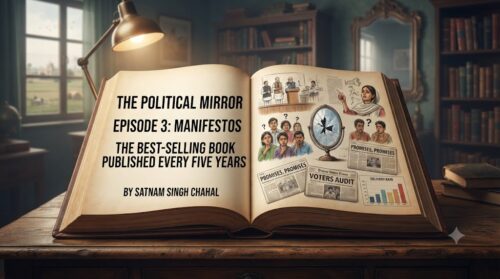
 Editor’s Note: The Political Mirror is a satirical commentary series that uses humour, irony, and public observation to reflect on the changing relationship between politicians and citizens. The purpose is not to target individuals or political parties, but to highlight the importance of transparency, accountability, and responsible governance.In a mature democracy, criticism is not an attack—it is a reminder that public office is a responsibility entrusted by the people. As Punjab enters a new era of informed voters, leaders must understand that promises are temporary, but performance is remembered forever.— Editor
Every five years, a remarkable literary event takes place in Punjab.Political parties release a document that promises to solve almost every problem known to humanity.It promises jobs for the unemployed, prosperity for farmers, better education, improved healthcare, industrial growth, clean cities, corruption-free governance, and a brighter future for every citizen.This extraordinary book is called the Election Manifesto.For a brief period, it becomes the most popular publication in the state.
Politicians launch it with great excitement. Party workers distribute thousands of copies. Leaders describe it as a historic roadmap for Punjab’s future.The only mystery is what happens to this famous book after the elections.Like many bestselling books, it often disappears from public view.Some copies may remain safely stored inside party offices, where they patiently wait for the next election season.The common citizen, however, has a different habit.
They keep old copies.They remember old promises.They save newspaper reports.They keep screenshots.Today’s voters have become the unofficial librarians of democracy.A politician may forget what was promised five years ago, but the voter remembers.This is the biggest change in Punjab politics.Earlier, election promises were like wedding invitations—beautifully printed, widely distributed, and quickly forgotten after the event.Today, promises have become contracts that citizens expect leaders to fulfill.The youth especially have changed the political conversation.
They are not only asking, “What will you give us?”
They are asking:”How will you deliver it?””When will it happen?””Where is the budget?””Who will be responsible if it fails?”These questions create a difficult environment for leaders who rely only on emotional speeches.The modern voter understands that governance is not magic.Money does not appear from nowhere.Jobs cannot be created only through advertisements.Industries cannot be attracted only through conferences.
Schools cannot improve only through painting buildings.Hospitals cannot function only through announcements.The people are asking for details.But manifestos continue to arrive with unlimited optimism.Every party claims it has the perfect solution.Every party promises a new beginning.Every party believes that voters will forget the past and focus only on future dreams.The problem is that Punjab’s voters have developed a powerful memory.They compare promises with performance.
They compare announcements with results.They compare speeches with reality.A manifesto is no longer a document to win elections.It is becoming a report card waiting to be checked.Another interesting tradition is the political calculator.Before elections, leaders calculate how many votes a promise may bring.After elections, citizens calculate how much of that promise was actually delivered.
Unfortunately, these two calculations often produce very different results.The future of Punjab politics will belong to those leaders who understand one simple truth:A promise is not an achievement.An announcement is not a completion certificate.A slogan is not a solution.People do not want beautifully written manifestos gathering dust in government offices.They want those promises converted into reality on the ground.
Because in today’s Punjab, voters are not just reading manifestos.They are auditing them.The Political Mirror Says…
“A manifesto may be printed on paper, but its real value is measured by what happens after the election ink dries.”
— The Political Mirror