
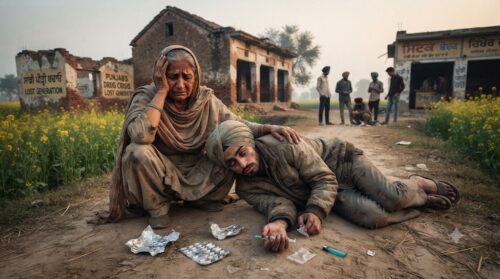
 Punjab’s drug crisis has reached a point where it can no longer be dismissed as a political slogan, an election-time allegation or a problem limited to a few border districts. A Parliamentary Standing Committee report has put the estimated number of drug users in Punjab at around 66 lakh—a staggering figure in a State with a population of roughly three crore. If this figure is even remotely close to the reality on the ground, Punjab is not facing an ordinary social problem. Punjab is facing a generational emergency.
The figures cited in the parliamentary report are deeply disturbing. Around 30.68 lakh people were reported as cannabis users, 21.36 lakh as opioid users and 9.93 lakh as users of sedatives or narcotic pills. Most alarming is the reported presence of children in this crisis. The report estimated that nearly 6.97 lakh children between the ages of 10 and 17 were using drugs. These numbers should shake every institution of the State—from the government and police to schools, universities, village panchayats, religious institutions and civil society.
The figures must, however, be understood correctly. These are estimates of drug users across different categories, and the categories may overlap. Therefore, the 66 lakh figure should not simply be described as 66 lakh “addicts.” But even when the data are interpreted cautiously, the scale of substance use is frightening enough to demand an emergency response.
The most painful part of this crisis is that Punjab is losing its young people. A State whose greatest strength has traditionally been its hardworking and energetic youth cannot afford to watch generation after generation fall into addiction. Every young person trapped in drugs represents not only an individual tragedy but a loss to the family, the village, the economy and the future of Punjab.
The AIIMS-linked Punjab Opioid Dependence Survey has also highlighted the seriousness of opioid dependence among young people. Research has estimated a substantial population dependent on opioids, particularly heroin and other opioids, with the overwhelming majority being male and a large proportion falling within the younger adult age groups. This evidence makes one point painfully clear: Punjab’s drug crisis is heavily concentrated among the age group that should be studying, working, building businesses, raising families and contributing to the State’s economy.
The consequences are everywhere. Families sell land and jewellery to pay for treatment. Parents borrow money to keep their children alive. Young marriages collapse. Children grow up without stable parents. Household income disappears into drugs. Crime and drug trafficking feed one another. Mental-health problems increase. Young people who should be preparing for careers instead spend their most productive years fighting dependency.
And yet Punjab has been discussing the drug menace for years.Governments have changed. Chief ministers have changed. Police officers have changed. Campaign slogans have changed. Committees have been formed. Special drives have been announced. Thousands of arrests have been publicised. But the fundamental question remains unanswered:Why has the drug supply continued if governments have been fighting the drug menace for so many years?This is where Punjab needs to move beyond political theatre.
A successful anti-drug campaign cannot be measured by the number of arrests announced at press conferences. Nor can success be measured by the number of small-time drug cases registered against addicts and petty carriers. The real test is whether the major supply networks have been dismantled, whether the financiers behind those networks have been identified, whether their illegal assets have been seized through due process and whether the number of new young addicts is actually declining.Punjab needs to follow the money.
The State must identify the major drug trafficking networks operating within Punjab and investigate their financial infrastructure. Where evidence establishes criminal proceeds, properties, vehicles, bank accounts and other assets should be pursued under the law. The people making enormous profits from Punjab’s addiction must face far greater scrutiny than the young person who has become dependent on the substance being sold.
At the same time, Punjab must stop pretending that every drug user can be dealt with through police action alone. Addiction is also a health and rehabilitation issue. A young person suffering from dependency needs professional treatment, psychological support, rehabilitation and a pathway back into education or employment.Treatment cannot end when a person walks out of a de-addiction centre.
What happens six months later? What happens one year later? Who follows up with the family? Who helps the recovering person find employment? Who prevents relapse? Who supports parents and siblings? These questions must become central to Punjab’s drug policy.The State also needs a completely transparent district-wise drug database. Punjab should publish annual figures showing the number of drug users identified, people seeking treatment, successful recoveries, relapses, overdose deaths, drug-related deaths, major traffickers arrested, convictions secured and assets seized from organised trafficking networks
Disclaimer: This article and accompanying images are for informational and illustrative purposes only. Some visuals may be AI-generated or digitally enhanced and may not depict actual events or persons.Views expressed are based on publicly available information and analysis.