
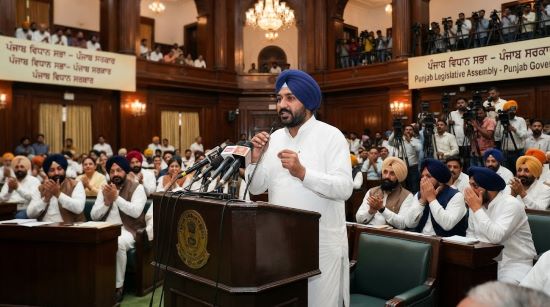
Do you know that in the Punjab Assembly, even the microphone apparently needs permission? Punjab politics has produced many miracles. Governments promise to transform Punjab overnight, debt keeps growing despite repeated assurances, and every election brings a fresh dictionary of development. But the latest miracle may be the most entertaining of all: Sukhpal Singh Khaira was finally seen speaking in the Punjab Assembly.
For much of the tenure, Khaira and the Assembly microphone seemed to be involved in a very strange relationship. Khaira would stand up. The microphone would remain silent. Khaira would raise his hand. The proceedings would move elsewhere. Khaira would ask for permission to speak. The Speaker would decide otherwise.
It almost looked as though the microphone itself had received instructions:
“Khaira sahib khadhe hon,
microphone tusi chup rehna.”
In March 2025, the issue became particularly contentious when Khaira was not allowed to speak during Zero Hour, prompting Congress MLAs to walk out of the Assembly. The Speaker maintained that deciding who would speak was within the Chair’s prerogative.
And then came the latest episode.
Khaira spoke.
Punjab immediately became curious.
What happened?
Was the microphone repaired?
Did the Assembly rules change overnight?
Did democracy finally get its turn?
Or did somebody quietly tell the microphone:
“Ajj Khaira sahib nu boln deo… kal fer vekhange.”
The reason, of course, is known to the Speaker.
And that is perhaps the funniest part of the whole story.
Because for ordinary Punjabis watching the Assembly proceedings, it can sometimes appear that the microphone has become more powerful than the MLA.
A Punjabi political proverb may soon have to be invented:
“Punjab Vidhan Sabha da microphone vi party membership dekh ke bolda hai.”
And another:
“Khaira sahib nu bolna mil gaya—Punjab vich ajj democracy ne attendance la ditti.”
For years, one could almost imagine a special government department operating inside the Assembly:
THE MINISTRY OF MICROPHONE PERMISSION
Its job would be simple.
MLA stands up.
Department checks file.
Speaker looks at clock.
Government benches look interested.
Opposition benches become restless.
Microphone waits.
And finally the department issues its historic decision:
“Permission denied.”
Or, on a particularly generous day:
“Permission granted for two minutes.”
There is even a possible parliamentary poem hidden in the whole saga:
**Khaira stood up, the microphone slept,
The Speaker looked, the silence kept.
Khaira asked, “May I have my say?”
The Chair replied, “Not today.”
But suddenly came a different scene,
Khaira spoke and could be seen.
Punjab rubbed its eyes in disbelief—
Was this democracy or special relief?
And then comes another question.
If an elected MLA has something to say, should the people of Punjab have to wait for the “right mood” of the microphone?
The Speaker undoubtedly has the responsibility to maintain order and regulate proceedings. Nobody disputes that. But the purpose of a legislative Assembly is debate. Governments need criticism. Ministers need questions. Opposition members need opportunities to raise public concerns.
Otherwise, the Assembly risks becoming less of a debating chamber and more of a well-rehearsed stage programme.
And Khaira, with his habit of speaking loudly, asking uncomfortable questions and refusing to disappear quietly into the background, is hardly the easiest politician to manage.
That may be precisely why his microphone has become such a political character.
The joke doing the rounds could be:
“Panjab Vidhan Sabha vich sawaal puchhna asaan hai—
bas pehla sawaal eh hona chahida:
‘Speaker sahib, main bol sakda haan?’”
And perhaps the microphone itself has developed an opinion:
“Khaira jadon khadhe hunde san,
mainu lagda si meri duty khatam.”
But this is where comedy meets a serious democratic concern.
The opposition is not supposed to be decorative furniture in a legislature. An MLA is elected to represent constituents, raise issues and challenge the government when necessary. Sometimes the opposition is irritating. Sometimes it is noisy. Sometimes it repeats itself. Sometimes it is politically inconvenient.
That is democracy.
A legislature where everyone speaks only when it is convenient is peaceful—but it may not be healthy.
So, congratulations to Sukhpal Singh Khaira.
Not because he finally got a microphone.
But because, after so much parliamentary suspense, he finally demonstrated that the microphone still works.
And congratulations to the Speaker too.
Because this episode has solved one great mystery of Punjab politics:
The microphone was never broken.
It was simply waiting for the right moment.
And what was the right moment?
Well…
The reason is known to the Speaker.
Punjab, meanwhile, is waiting for the next miracle:
Will Khaira be allowed to speak again—or was this a limited-time parliamentary offer?
Because in Punjab politics, even a microphone has become a matter of suspense.
And perhaps the newest Assembly slogan should be:
“Mic mera, awaaz teri,
permission Speaker di!”
Or, in the immortal Punjabi political version:
**“Khaira bole—wah ji wah!
Speaker bole—bas ji bas!
Punjab bole—hun dasso,
democracy kithe fas?”
Disclaimer: This article and accompanying images are for informational and illustrative purposes only. Some visuals may be AI-generated or digitally enhanced and may not depict actual events or persons.Views expressed are based on publicly available information and analysis.