
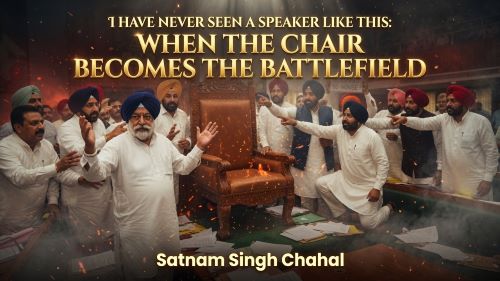
There was a time when the Speaker’s chair in the Punjab Vidhan Sabha was regarded as the one place in the House that stood above party politics. Governments came and went, opposition parties changed, tempers rose and fell, but the Chair was expected to remain neutral. The Speaker was not supposed to be the government’s representative inside the Assembly; he was supposed to be the custodian of the entire House.
Today, however, a disturbing question is being repeatedly raised by opposition members: has the Punjab Assembly witnessed such a visibly controversial relationship between the Speaker and the Opposition before?
The question is not merely about one argument, one MLA or one day of proceedings. It is about a pattern that opposition leaders say has developed over several sessions. And at the centre of that controversy stands Speaker Kultar Singh Sandhwan.
The strongest criticism has come from Congress MLAs, particularly Sukhpal Singh Khaira and Leader of Opposition Partap Singh Bajwa. Their complaint is remarkably consistent: when the Opposition wants to speak, the microphone appears to become silent; when the treasury benches want to speak, the House suddenly discovers plenty of time.
That perception itself is dangerous for a parliamentary institution.
The timeline tells its own story
The controversy did not suddenly begin in 2026.
March 2024 — The Opposition and the Speaker
The March 2024 Assembly session witnessed extraordinary scenes after Chief Minister Bhagwant Mann presented a small padlock to Speaker Sandhwan, jokingly asking him to lock the Opposition inside the House so that they would not walk out.
The episode was more than political theatre. It reflected the increasingly confrontational relationship between the treasury benches and the Opposition.
There was also controversy when the day’s proceedings began with discussion on the Governor’s address instead of the listed Question Hour, with the Opposition objecting to the manner in which business was being conducted.
March 2024 — Questions ignored?
During the same period, Leader of Opposition Partap Singh Bajwa alleged that Speaker Sandhwan disregarded an issue he had raised concerning the Citizenship Amendment Act.
The Opposition’s argument was simple: if an elected MLA raises a major constitutional and political issue in the Assembly, the Chair should provide an opportunity for the matter to be properly addressed rather than allowing it to disappear in the noise of the House.
September 2024 — Khaira raises the alarm
By September 2024, Sukhpal Singh Khaira had become openly critical of the manner in which the Assembly was functioning.
Khaira said he had never seen such “dismal, discriminatory and defeatist” proceedings during his three terms as an MLA and announced a boycott of the remaining two days of the session.
He alleged that instead of allowing debate on major issues including sacrilege, drugs, agriculture, the Lawrence Bishnoi interview controversy and the Budha Nullah pollution crisis, the House was being diverted toward other matters.
The allegation was serious: was the Assembly becoming a place where inconvenient questions were avoided rather than answered?
September 2024 — The Speaker’s changing stand
Another controversy emerged when Bajwa questioned what he described as a change in the Speaker’s position concerning a report from the DGP in an alleged bribery case involving an ASI.
According to reports, the Speaker had initially sought a DGP report after the House approved the move, but subsequently sought a report from the Home Secretary instead.
Bajwa questioned how the Speaker could change his stand after taking the “sense of the House.”
Again, the issue was not simply the individual case. It was about the authority and consistency of the Chair.
January 2024 — Even the telecast became controversial
Questions were also raised over the live telecast of Assembly proceedings.
Bajwa wrote to the Speaker seeking formal rules and guidelines for televising proceedings, arguing that the absence of such rules had contributed to allegations that the Opposition was being discriminated against in the way proceedings were telecast.
In a legislature, even the public’s window into the proceedings should ideally be governed by transparent rules—not political convenience.
March 24, 2025 — The microphone controversy
Then came the incident that perhaps best captured the Opposition’s grievance.
During Zero Hour, Bholath MLA Sukhpal Singh Khaira repeatedly sought the Speaker’s permission to raise issues. Leader of Opposition Partap Singh Bajwa also stood in support of him.
According to the reported proceedings, Speaker Sandhwan told Khaira that it was his prerogative to decide whom to allow to speak.
Khaira sat down.
A few minutes later, Khaira again rose and sought permission to raise farmers’ issues.
The Speaker instead allowed another MLA, Sandeep Jakhar, to speak.
Khaira protested.
The Congress MLAs eventually entered the well and walked out.
That episode produced perhaps the most direct political accusation yet.
Bajwa accused the Speaker of “highly biased and dictatorial behaviour” and said the Speaker was a custodian of the Assembly, “not the owner.”
That sentence deserves to be remembered.
Because the Speaker’s chair does not belong to the person sitting in it.
It belongs to the House.
March 2025 — “The Opposition voice is being stifled”
At the conclusion of the 2025 Budget Session, Bajwa again accused the AAP government of escaping questions raised by the Opposition.
He alleged that the government’s majority, combined with what he described as the Speaker’s biased conduct, had enabled the Opposition’s voice to be stifled.
At this point, critics could no longer reasonably describe the complaints as a single isolated quarrel.
There was now a timeline.
July 2025 — Another session, another controversy
During the July 2025 special session, Opposition members again objected to the structure and conduct of proceedings.
Congress MLAs protested the absence of Zero Hour and alleged that important matters were being avoided. The session also witnessed sharp exchanges between the treasury benches and the Opposition, followed by an Opposition walkout.
The Speaker eventually extended the session, but the controversy over the treatment of dissent remained.
A legislature cannot become democratic merely because microphones, cameras and chairs are present.
Democracy requires the uncomfortable voice to be heard.
March 2026 — Khaira versus the entire House machinery
Then came March 2026.
The Assembly passed a resolution referring a breach-of-privilege matter concerning Sukhpal Singh Khaira to the House Privileges Committee after the treasury benches accused him of making derogatory remarks about the Speaker, ministers and AAP MLAs.
Khaira’s conduct was defended by neither parliamentary decorum nor political civility if the allegations against him are accepted. But the controversy became bigger because the Opposition simultaneously sought action concerning alleged remarks by Chief Minister Bhagwant Mann.
Congress members questioned why action against Khaira could move forward while their demand concerning the Chief Minister was not treated in the same manner.
That is where the fundamental question arises:
Does parliamentary privilege protect the dignity of the House—or only the dignity of those sitting on the treasury benches?
The Speaker’s answer should be the same regardless of who is being accused.
May 2026 — The House descends into another confrontation
On May 1, 2026, another confrontation erupted after Chief Minister Bhagwant Mann objected to Khaira’s alleged use of a mobile phone during the reading of an official resolution.
The matter escalated into a major confrontation, with Opposition MLAs eventually walking out and the Speaker adjourning the House.
Again, the issue was not simply whether an MLA was using a phone.
The bigger question was whether the Speaker could maintain enough distance from the political confrontation to remain visibly neutral.
And now the most disturbing question: who owns the microphone?
The Punjab Vidhan Sabha is not a private meeting of the ruling party.
Every MLA sitting inside the House represents voters.
An AAP MLA represents AAP voters.
A Congress MLA represents Congress voters.
A BJP MLA represents BJP voters.
An Akali MLA represents Akali voters.
But once they enter the Assembly, they are all members of one constitutional institution.
That means the Speaker cannot have a political favourite.
He cannot decide that one MLA’s question is important while another MLA’s question is an inconvenience.
He cannot allow the government to enjoy unlimited political space while the Opposition is repeatedly told to sit down.
And he certainly cannot allow the public to develop the impression that the microphone belongs to the government and the mute button belongs to the Speaker.
A Speaker is not the government’s umpire
The most dangerous misunderstanding in any legislature is to confuse majority rule with unlimited rule.
Yes, AAP has the numbers.
Yes, the government has the right to pass legislation when it commands a majority.
Yes, the treasury benches have the right to defend their policies.
But the government does not have the right to eliminate scrutiny.
That is precisely why the Opposition exists.
A Speaker who allows the Opposition to speak is not helping the Opposition.
He is helping democracy.
A Speaker who allows criticism of the government is not weakening the government.
He is strengthening the Assembly.
And a Speaker who protects an Opposition MLA’s right to question the government is not behaving as an Opposition politician.
He is behaving as a Speaker.
The Khaira paradox
The treatment of Sukhpal Singh Khaira has become the symbol of this entire controversy.
For years, Khaira has been one of the most vocal and combative legislators inside Punjab politics. He is hardly the kind of politician who will quietly sit in his seat when he believes an issue deserves to be raised.
That may irritate governments.
It may irritate ministers.
It may irritate the Speaker.
But democracy was never designed to be comfortable.
The Opposition MLA who asks inconvenient questions is doing exactly what an Opposition MLA is supposed to do.
If Khaira crosses the line of parliamentary conduct, the rules should apply to him.
But if he raises a legitimate issue, the rules should also guarantee him an opportunity to speak.
Punish unparliamentary language if necessary—but do not punish inconvenient questions.
The bigger danger is not Khaira
This debate should not ultimately be about whether one likes Sukhpal Singh Khaira.
It should not even be about whether one likes Partap Singh Bajwa.
The real question is much bigger:
What happens to Punjab’s democracy if the Opposition loses faith in the Chair?
Once Opposition members begin believing that the Speaker is politically aligned with the government, every ruling from the Chair becomes suspect.
Every microphone decision becomes political.
Every adjournment becomes political.
Every privilege motion becomes political.
Every committee appointment becomes political.
And eventually, the Assembly itself loses credibility.
That concern has become even sharper after the 2026–27 committee appointments, when all 15 Assembly committees were reportedly assigned AAP MLAs as chairpersons. The Opposition has questioned whether such an arrangement weakens institutional oversight, particularly when committees such as the Public Accounts Committee are traditionally viewed as important mechanisms for scrutinising government expenditure.
Punjab deserves a Speaker above politics
The people of Punjab did not elect the Speaker to silence the Opposition.
They elected MLAs.
The MLAs elected a Speaker.
And the Speaker accepted a constitutional responsibility to conduct the House fairly.
That responsibility is bigger than party loyalty.
Bigger than AAP.
Bigger than Congress.
Bigger than Bhagwant Mann.
Bigger than Sukhpal Khaira.
Bigger than Partap Singh Bajwa.
The Chair belongs to the institution.
Perhaps the most painful criticism today is therefore not that the Speaker is harsh with one particular MLA.
It is that a growing section of the Opposition believes that the Chair is no longer visibly independent.
That perception must be addressed—not with another privilege motion, not with another political speech, and not by blaming the Opposition.
It can only be addressed through transparency, equal opportunity, consistent rules and one simple principle:
Let the government govern.
Let the Opposition question.
Let the Speaker protect both.
Otherwise, Punjab may eventually reach a point where people do not ask, “What did the Opposition say in the Assembly?”
They will ask a much more embarrassing question:
“Was the Opposition allowed to speak at all?”
And that would be a tragedy not for Congress, not for AAP, not for Sukhpal Khaira or Partap Bajwa.
It would be a tragedy for the Punjab Vidhan Sabha itself.