
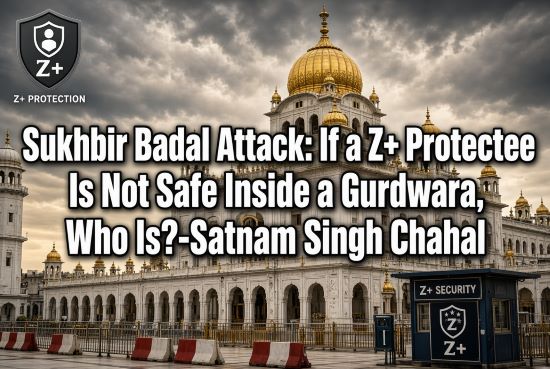
 The attack on Shiromani Akali Dal president and former Punjab Deputy Chief Minister Sukhbir Singh Badal at Gurdwara Mata Sahib Devan Ji in Nanded on Thursday has raised questions that go far beyond one political leader. Badal sustained an injury to his right forearm when an attacker allegedly approached him with a sharp-edged weapon. A security officer intervened and was also injured while protecting him. The attacker was subsequently taken into custody.
What makes the incident particularly serious is that Sukhbir Badal is a Z+ security protectee. This is not the first time his security has been tested at a Sikh religious site. In December 2024, he survived an assassination attempt outside the Golden Temple in Amritsar. The fact that he has now been attacked again at another prominent gurdwara raises legitimate questions about whether existing security arrangements are adequate when a high-profile protectee enters an open, crowded and emotionally sensitive religious environment.
Where were the security personnel?
This is perhaps the most important question arising from the Nanded incident.It would be premature to declare that the security personnel deliberately failed or that there was a specific security lapse before the official investigation establishes what happened. Reports, in fact, indicate that a security officer reacted quickly and intervened, helping prevent the attack from becoming even more serious.
But that does not remove the need for a detailed security review.If a Z+ protectee can be approached at close range by a person carrying a sharp weapon inside a religious complex, investigators must establish how the attacker entered the immediate security perimeter, whether he had been screened, who was responsible for access control, how the inner security ring was positioned, and whether the security plan properly accounted for the unique circumstances of a gurdwara visit.These are questions of public interest, not merely political questions.
What is the purpose of having so many security personnel?
The public naturally asks: If a person has a large security detail, what exactly is that security supposed to prevent?Security cover is not simply about having a large number of police officers or security personnel visible around a VIP. Its real purpose is to identify threats before they reach the protectee, control access, maintain a safe distance, establish escape routes and ensure that an attacker cannot get within striking distance.At the same time, security at a gurdwara presents a difficult challenge. A gurdwara is an open religious institution where devotees, sewadars and visitors may come into close proximity with political leaders. Security personnel cannot treat every worshipper as a potential criminal. Therefore, the responsibility of the security agencies becomes even greater: they must balance religious access, dignity and public interaction with the safety of the protectee.The Nanded incident should therefore trigger an examination of whether that balance was properly managed.Why do attacks repeatedly happen at gurdwaras?Another deeply disturbing aspect of this incident is the location.A gurdwara is supposed to be a place of prayer, humility, service and peace. It should never become a place where political differences, personal anger or violence are allowed to enter.
Yet Sukhbir Badal has now faced two serious attacks associated with Sikh religious sites within roughly two years. The earlier attack occurred at the Golden Temple in Amritsar in December 2024, while the latest occurred at a gurdwara in Nanded.That pattern deserves serious examination not because gurdwaras should be portrayed as unsafe, but precisely because their sanctity must be protected.If people begin to believe that political leaders can be attacked inside gurdwara premises, the consequences will be extremely damaging for the image of Sikh institutions. The answer cannot be to turn gurdwaras into heavily fortified areas. Instead, there must be intelligent, proportionate and respectful security planning whenever a person under serious threat protection visits a religious institution.
If a Z+ protectee can be reached, what about ordinary devotees?
This may be the most uncomfortable question of all.Sukhbir Badal had security personnel around him. He had a protected movement plan. He was accompanied by police and security officers. Yet an attacker still managed to get close enough to attempt an assault. Reports say a security officer intervened and was injured in the process.If such an incident can occur around a heavily protected political leader, ordinary devotees naturally have the right to ask: Who will protect them?Every day, thousands of people visit gurdwaras across India. Children, women, elderly people and families come to pray. They should be able to enter a gurdwara without fear of violence.
The answer, however, should not be indiscriminate security checks that destroy the peaceful character of religious institutions. Rather, management committees, local police and government agencies need to assess risks and strengthen arrangements according to circumstances, particularly when major political or public figures are visiting.
The investigation must answer the difficult questions
The Maharashtra government and police have already indicated that the incident will be investigated. The investigation should not be limited to identifying and prosecuting the attacker. It should also examine the entire security chain.Who knew about Badal’s visit? Was the visit properly coordinated with local police? What was the designated security perimeter? How did the attacker reach the immediate vicinity of the protectee? Was there adequate screening? Were the security personnel positioned correctly? Was the route from the vehicle to the gurdwara and back properly secured? Were local volunteers and sewadars incorporated into the security plan?Most importantly, were lessons from the 2024 Golden Temple attack incorporated into the latest security arrangement?These questions deserve factual answers rather than political accusations.
Violence inside gurdwaras must never become normal
There is also a much larger Sikh community concern.Political disagreements are inevitable in a democracy. People can support or oppose Sukhbir Badal, the SAD, Congress, AAP, BJP or any other political party. But political disagreement cannot be allowed to turn into physical violence—especially inside a gurdwara.The sanctity of the gurdwara must remain above political rivalry.The attack should therefore be condemned without qualification. It is equally important that the investigation determine the attacker’s motive without allowing speculation, communal narratives or political propaganda to replace facts.
Accountability must include the security system
The incident should not end with the arrest of one accused person.If a security failure occurred, responsibility must be established. If there was no security failure and the attacker exploited an unavoidable vulnerability associated with an open religious environment, authorities should explain that clearly as well.The public deserves transparency.Z+ security cannot become merely a label. It carries the expectation that the state has assessed a threat and deployed an appropriate protective mechanism. If that mechanism repeatedly fails to prevent an attacker from reaching the protected person, the system must be reviewed.The real test of security is not how many personnel are standing around a VIP. The real test is whether a genuine threat can be detected and stopped before it reaches the person being protected.
A warning for every gurdwara
The Nanded attack should serve as a warning not a reason for fear.Gurdwaras must remain open, welcoming and peaceful. But security cannot be taken for granted. Whenever a high-profile person visits, especially someone already targeted in the past, security agencies and gurdwara management must jointly prepare a proper risk assessment.The Sikh community should also reject the idea that violence can ever be justified because of political or ideological differences.
If even a Z+ protected political leader can be attacked inside a gurdwara, the question for authorities is simple: what are they doing to ensure that the next devotee who walks through those doors is safe?That is why the Nanded attack is not only a question about Sukhbir Badal’s security. It is a question about the security, sanctity and credibility of Sikh religious institutions—and about whether ordinary citizens can still expect to be safe in places where they come to pray.
Disclaimer: This article and accompanying images are for informational and illustrative purposes only. Some visuals may be AI-generated or digitally enhanced and may not depict actual events or persons.Views expressed are based on publicly available information and analysis