
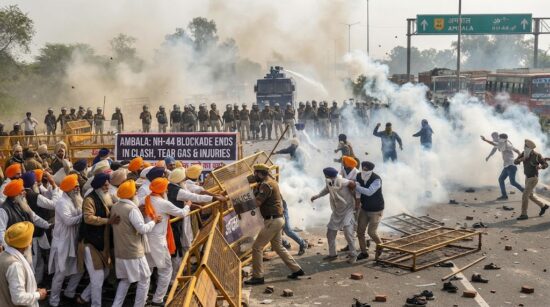
 AMBALA, HARYANA — Tension remains high in Ambala following a violent confrontation between Haryana Police and Sikh protesters on Thursday, August 13, after a protest over the arrest of Sikh youths and the ongoing dispute involving Gursimran Singh Mand, head of the International Anti-Khalistani Terrorist Front. The confrontation turned violent when police moved to clear a blockade of National Highway 44, with tear gas and lathicharge used to disperse protesters. Several police personnel and protesters were injured.
The protest began after a large gathering of members of the Sikh community assembled near Gurdwara Panjokhra Sahib. Protesters were demanding action against Mand, the release of Sikh youths arrested in connection with an earlier assault case, and cancellation or review of the FIR against them. According to police, around 1,500–1,600 people had gathered before the situation escalated and the Delhi-Ambala highway was blocked.
The confrontation became particularly serious when police attempted to reopen NH-44 and restore traffic. Haryana Police said repeated appeals were made to protesters to clear the highway, but the blockade continued. Police officials alleged that some protesters attacked officers with sharp-edged weapons. Ambala SP Ajit Singh Shekhawat said several police personnel were injured and alleged that a DSP suffered a severe hand injury during the confrontation.
Police subsequently fired multiple tear-gas shells and used force to clear the highway. After approximately six hours, traffic movement on the important Delhi-Ambala route resumed at around 9:15 p.m. The incident left at least six police personnel injured, including a DSP-rank officer, according to police and media reports.
The Sikh side, however, has strongly questioned the police action. Sikh leaders have alleged that the administration resorted to force while discussions were still taking place and that the situation could have been resolved through dialogue. The dispute has therefore developed into a wider confrontation over policing, arrests, religious-community concerns and the handling of Sikh protests in Haryana.
The latest intervention has come from the officiating Jathedar of Akal Takht, Giani Kuldip Singh Gargaj, who has called upon the Haryana government to respect Sikh sentiments and immediately release the arrested youths. He also demanded action against those accused of injuring devotees by allegedly driving vehicles into a congregation at Gurdwara Panjokhra Sahib. At the same time, he appealed to Sikh protesters to maintain discipline and conduct demonstrations peacefully.
Giani Gargaj has called for dialogue between the Haryana government and Sikh representatives rather than allowing the confrontation to deepen. He has also questioned why police action was taken while talks were reportedly underway, saying the circumstances leading to the use of force should be investigated.
The political fallout is also growing. Congress leaders have condemned the lathicharge and questioned the Haryana government’s handling of the situation, while former Haryana chief minister Bhupinder Singh Hooda has urged the government to adopt an impartial and sensitive approach and resolve the matter through dialogue rather than police action and the registration of additional cases.
The Ambala confrontation has now moved beyond a highway protest. What began with demands connected to arrests and the Gursimran Singh Mand controversy has become a serious test of the Haryana government’s ability to manage a sensitive Sikh-community issue without allowing law-and-order concerns to escalate into a wider confrontation.
For the moment, Ambala is reported to be relatively calm, but the underlying dispute remains unresolved. The immediate questions are whether the arrested Sikh youths will be released, whether the allegations against those accused of attacking police will be independently investigated, and whether the government will open a formal dialogue with Sikh representatives.
With both police personnel and members of the Sikh community injured, an impartial investigation and transparent communication have become increasingly important. The priority now must be to prevent Thursday’s confrontation from becoming a cycle of arrests, counter-allegations and further street mobilisation.
The Ambala crisis is no longer simply about a blocked highway. It has become a test of trust between the administration and the Sikh community — and that trust can be rebuilt only through restraint, accountability and dialogue.