
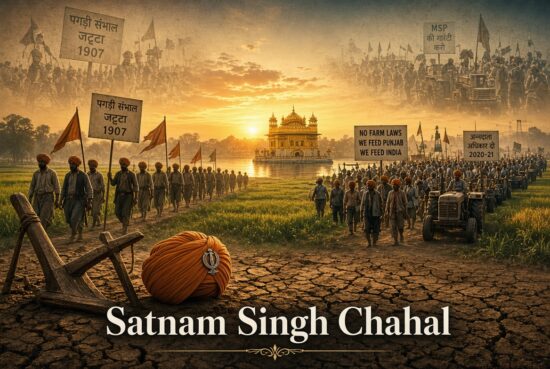
 Punjab has a long and proud tradition of protest. From farmers and workers to students, employees, religious organisations and political parties, people have historically taken to the streets, highways and government offices to make their voices heard. In a democracy, a dharna is not a crime, a protest is not rebellion, and criticism of the government is not sedition. Yet a disturbing question is increasingly being asked across Punjab: Why does the Punjab Police so often appear to reach for the lathi before reaching for dialogue?
The pattern is difficult to ignore. When citizens sit on a road, outside an office or near the residence of a public representative, the first response frequently becomes barricades, police deployment, detention, lathi-charge, water cannons or tear gas. The justification is usually framed in terms of maintaining law and order. But the larger democratic question remains: does maintaining law and order require suppressing the voice of the people?
Recent incidents have once again brought this debate into sharp focus. In June 2026, Punjab Police used force against apprentice linemen protesting outside the PSPCL headquarters in Patiala. More than 20 people were reported injured, while the police maintained that protesters had blocked entry and exit gates. The Punjab State Human Rights Commission subsequently sought a report from the DIG, Patiala Range, taking suo motu notice of the lathi-charge.
Then came the confrontation with MGNREGA workers in Khanna in July. The protesters were demanding regularisation and payment of salaries reportedly pending for eight months. Police used lathi-charge, tear gas and water cannons when demonstrators attempted to move beyond barricades. Protesters reported injuries, while police personnel were also injured in the confrontation.
The Barnala sanitation workers’ episode was even more politically damaging. Police action against protesting sanitation workers triggered widespread anger, demands for accountability and eventually a statewide bandh. The Barnala DSP was suspended following the controversy surrounding the alleged lathi-charge.
And now the question is becoming bigger than any single incident: Has the lathi become Punjab Police’s preferred language of negotiation?
There is an obvious distinction that must be recognised. Police have a legitimate responsibility to prevent violence, protect public property, keep emergency routes open and intervene when protesters attack people or attempt to forcibly breach protected locations. In several recent incidents, police have argued that protesters crossed barricades or blocked access. That explanation cannot simply be dismissed.
But the existence of a policing responsibility does not provide a blank cheque for excessive force. A barricade may be necessary; brutality is not. A police presence may be necessary; humiliation is not. Detention may sometimes be lawful; indiscriminate repression is not.
The real test of democratic policing is what happens before the lathi is raised.
Were representatives of the protesters invited for negotiations? Was a senior civil officer sent to listen to their demands? Was sufficient time given for dialogue? Were alternative protest locations offered? Were women, elderly protesters and vulnerable participants treated with particular care? Was minimum necessary force used? Was the entire operation recorded and independently reviewed afterwards?
These questions matter because a protest does not disappear when police disperse it. The grievance remains. In fact, excessive force can transform an administrative dispute into a political movement.
Punjab has seen this repeatedly. A group may initially come to a government office demanding jobs, salaries, recruitment, compensation or implementation of an assurance. If the response is dialogue, the issue may remain administrative. If the response is lathi-charge and detention, the issue can rapidly become one of dignity, justice and democratic rights.
That is how a salary dispute becomes a statewide protest. That is how a recruitment demand becomes a political confrontation. And that is how a government begins fighting not merely the protesters but the public perception created by its own response.
There is also an uncomfortable contradiction in political rhetoric. Leaders who condemn police force against protesters when they are in opposition often become remarkably comfortable with barricades and lathis once they occupy government offices. The colour of the government may change, but the colour of the police lathi somehow remains the same.
Punjab deserves better than this revolving-door politics.
A government cannot campaign on the promise of being a government of the common man and then treat that common man’s protest as an inconvenience to be cleared from the road. A worker demanding wages is not an enemy of the state. An unemployed youth demanding recruitment is not a security threat merely because he is angry. A farmer demanding his rights is not automatically a law-and-order problem. And a citizen sitting peacefully with a placard should not have to wonder whether the next sound he hears will be a loudspeaker announcing negotiations—or a police baton hitting the ground.
The police are supposed to protect citizens, not teach citizens to fear the police.
There is another serious issue: accountability. Whenever force is used, the government should make public the legal and operational basis for that action. Who ordered the operation? What instructions were given? What level of force was authorised? Were magistrates present? How many protesters were injured? How many police personnel were injured? Were arrests made? Were video recordings preserved? Was an independent inquiry conducted?
Without answers, every lathi-charge creates suspicion.
The Punjab State Human Rights Commission’s intervention in the Patiala linemen case demonstrates why independent scrutiny is important. If the police action was justified, an impartial inquiry should establish that. If excessive force was used, responsibility should follow. Neither the police nor protesters should receive immunity from accountability.
The solution is not to weaken the police. Punjab needs a strong police force—but strong does not mean brutal.
A professional police force should be capable of controlling a difficult crowd without automatically converting a peaceful demonstration into a battlefield. Modern crowd management is supposed to be based on communication, negotiation, proportionality, de-escalation and minimum necessary force. The lathi should be the last resort—not the first instinct.
Punjab’s police leadership should therefore consider a transparent Protest and Dharna Management Protocol. Every major protest should have designated liaison officers, advance dialogue with organisers, clear instructions on lawful boundaries, special safeguards for women and elderly protesters, body-camera or video documentation wherever operationally feasible, and mandatory review of any incident involving significant force.
And if police officers cross the line, disciplinary action must be swift and credible.
The recent suspension of the Barnala DSP sends one important message: uniformed authority does not mean unlimited authority. But one suspension is not enough. Punjab needs institutional reform rather than action only after a controversy becomes politically explosive.
The irony is that Punjab is a state born from protest, sacrifice and political mobilisation. Its history is filled with movements in which ordinary people challenged authority. The democratic right to disagree is therefore not some foreign concept imported into Punjab—it is deeply embedded in the state’s political culture.
A government that cannot tolerate a dharna eventually creates more dharnas.
A government that answers questions with force eventually produces louder questions.
And a police force that repeatedly uses the lathi to silence dissent may discover an uncomfortable truth: you can disperse a crowd with a baton, but you cannot disperse a grievance.
Punjab Police must remember that the people standing on the other side of the barricade are not the enemy.
They are the citizens whose taxes pay the salaries of the officers holding the barricades.
The ultimate measure of policing in a democracy should therefore not be how quickly the police can clear a road.
It should be how peacefully the police can resolve a protest without breaking the people standing on it.
Punjab does not need a police force that wins every confrontation.
Punjab needs a police force that prevents confrontations from becoming battles in the first place.