
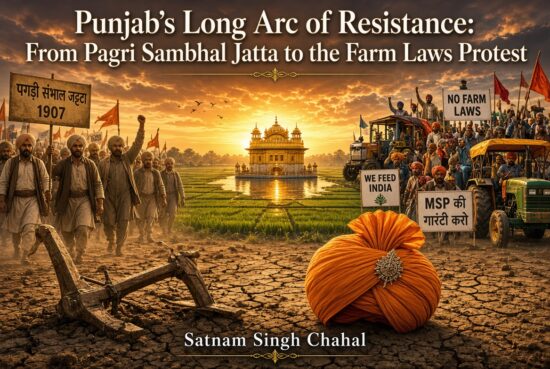
 Punjab has one of the richest and most continuous traditions of mass protest in India, deeply rooted in agrarian resistance, anti-colonial struggles, Sikh identity politics, and later democratic mobilisations. These movements have frequently blended economic demands—such as land rights, water access, fair prices, and debt relief—with political and cultural aspirations. Police responses, including the use of lathi charges, have remained a recurring feature across different eras.In the colonial period, one of the earliest and most significant peasant agitations was the Pagri Sambhal Jatta movement of 1907. Led by Sardar Ajit Singh, the uncle of Bhagat Singh, it opposed British land colonisation laws, restrictive inheritance rules, and higher water and revenue charges that threatened farmers’ rights in the canal colonies.
 Sustained protests across the region eventually forced the British to withdraw or amend key provisions, establishing an early template for organized rural resistance. Other pre-Partition struggles included tenant or muzara movements against landlords in princely states like Patiala during the late 1930s and 1940s, anti-land revenue campaigns, and the Gurdwara Reform Movement of 1920–25, which combined religious reform with anti-British mobilization and helped create institutions such as the Shiromani Akali Dal and the SGPC.After Independence, agrarian and political agitations continued. Tenant struggles in the PEPSU region carried on into the early 1950s and contributed to land reforms and the abolition of certain feudal tenures. The Anti-Betterment Levy agitation of 1958–59, led by the Punjab Kisan Sabha, saw large-scale peaceful protests against a tax intended to fund the Bhakra canal system. The Punjabi Suba movement of the 1950s and 1960s, driven by the Akalis, demanded a Punjabi-speaking state and featured hunger strikes by leaders such as Master Tara Singh in 1961 and Sant Fateh Singh in 1966, along with mass marches. This campaign culminated in the linguistic reorganisation of Punjab in 1966. During the Green Revolution era, modern farm unions took shape.
The Punjab Khetibari Zamindara Union, formed in 1972, evolved into the Bharatiya Kisan Union in 1980, focusing on issues like electricity dues, minimum support prices, debt, and subsidies, and organizing major gheraos and non-payment campaigns in the early 1980s.The 1980s marked a more turbulent phase when political protests by the Akalis, including the Dharam Yudh Morcha launched in 1982 to demand greater autonomy under the Anandpur Sahib Resolution, overlapped with the rise of armed militancy. This period saw intense state repression, Operation Blue Star in 1984, the assassination of Indira Gandhi, and subsequent anti-Sikh violence. Although distinct from purely agrarian protests, these events profoundly shaped Punjab’s relationship with the state and police for decades. Militancy largely subsided by the mid-1990s.In more recent decades, Punjab’s farm unions multiplied, reaching dozens by the 2010s. They developed strong village-level organization, the capacity to sustain long blockades, and broad rural support that extended beyond Jat Sikhs. The 2020–2021 farmers’ protest stands as the largest and most successful agrarian movement in independent India. It began in Punjab villages in June 2020 against three central farm laws that many saw as threatening the traditional mandi system, minimum support prices, and opening agriculture to large corporations.
The agitation escalated into the “Delhi Chalo” call in November 2020. Tens of thousands of farmers, coordinated under the Samyukt Kisan Morcha umbrella of more than forty unions, camped for over a year at the Singhu, Tikri, and Ghazipur borders. They used tractor rallies, dharnas, and village-based logistics while facing police barricades, internet restrictions, and occasional force. The laws were eventually repealed in November 2021, though hundreds of farmers lost their lives during the prolonged sit-in, mainly due to weather, health issues, and accidents. Punjab served as both the epicenter and the organizational backbone of the movement.Since 2021, smaller but persistent protests have continued over demands for legal MSP guarantees, debt relief, electricity issues, and job recruitment. Farm union factions have occasionally split, and renewed border marches have taken place.
Incidents involving lathi charges against sanitation workers, teachers, or unemployed youth have drawn criticism and revived older debates about the state’s use of force against dissent. Across more than a century, Punjab’s protest history shows clear patterns of continuity: movements often begin locally, spread through village networks, and combine economic survival with claims of dignity and identity. Strong unions and Sikh institutional networks have repeatedly proved decisive, while state responses have ranged from negotiation and concessions to preventive detention and physical force. Successful campaigns have forced meaningful policy changes, from colonial land laws and state reorganization to the repeal of the 2020 farm laws, and they continue to shape Punjab’s political culture of resistance.
Disclaimer: This article and accompanying images are for informational and illustrative purposes only. Some visuals may be AI-generated or digitally enhanced and may not depict actual events or persons.Views expressed are based on publicly available information and analysis