
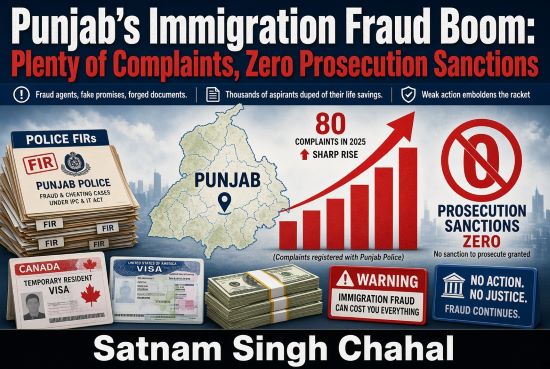
Punjab has once again produced a statistic that should make every parent, student and policymaker sit up: 80 complaints against illegal immigration/recruitment agents in 2025, compared with just 18 in 2024 and 56 in 2023. That means the complaints did not merely rise; they exploded. Over the three years, Punjab recorded 154 complaints, accounting for roughly 53 per cent of the 291 complaints reported across Punjab, Chandigarh, Haryana and Himachal Pradesh.
And then comes the part that sounds almost like political satire: between 2023 and 2025, Punjab apparently sought or received zero prosecution sanctions under the Emigration Act. In other words, the complaint box was getting heavier, while the prosecution file apparently remained on a diet.
This is not just a statistic. Behind every complaint is potentially a young Punjabi who believed an agent’s promise of a foreign job, a family that sold land or borrowed money, parents who mortgaged their future to finance their child’s future and a dream that may have ended in deportation, debt or deception.
Punjab’s fascination with going abroad is hardly a secret. For thousands of families, migration has become an economic strategy, a status symbol and, increasingly, an escape route from limited opportunities at home. That desperation creates fertile ground for unscrupulous agents who sell dreams at premium prices.
The most dangerous part is that these agents do not necessarily look like criminals. They can look like respectable businessmen sitting behind polished desks, posting attractive photographs on social media and promising admission letters, work permits, visas and “guaranteed” overseas jobs.
The government’s own records acknowledge that fraudulent and unauthorised recruitment agencies operate in Punjab. In March 2025, the Ministry of External Affairs told Parliament that complaints involving illegal migration and human trafficking are referred to state police for investigation and prosecution. It also said that a joint operation involving the Ministry and Punjab Police had resulted in 38 FIRs, with another 11 filed separately by Punjab Police.
So the obvious question is: if FIRs can be registered, raids can be conducted and agents can be identified, why does the final chapter so often disappear into the administrative wilderness?
Punjab does not need another awareness campaign telling people not to trust fraudulent agents. People already know fraud exists. What they need is a system in which an agent who cheats a family knows that the consequences will be faster and more painful than the profits.The irony becomes even sharper when one looks at the actual enforcement machinery. In June 2025, the Protectorate of Emigrants, Chandigarh, and Chandigarh Police raided an unregistered immigration operation and reportedly recovered laptops, mobile phones, fake overseas job offer letters and other material. A police case was registered.
That is welcome but enforcement cannot become a theatre in which cameras arrive for the raid and accountability disappears after the press release.The problem is not theoretical either. Following the deportation of Indians from the United States in 2025, Punjab Police formed an SIT to investigate illegal emigration and human trafficking. Multiple FIRs were subsequently registered against travel agents.And the issue has become serious enough for the Punjab and Haryana High Court to ask the Punjab government to decide on a representation seeking stronger action against illegal travel agents and measures to improve monitoring of authorised agents.
Meanwhile, the immigration business continues to operate in an environment where social media can turn a dubious agent into a celebrity overnight.Perhaps Punjab needs to introduce a new qualification for immigration consultants: before you are allowed to sell the American Dream, you should first prove that you are not selling an Indian family’s nightmare.There is also a broader political question here. Governments routinely celebrate employment figures, investment summits and development statistics. But perhaps another number deserves equal attention: how many young Punjabis feel compelled to leave because they cannot see a viable future at home?
When thousands are desperate to leave, fraudsters don’t have to create desperation. They simply monetise it.And that is why “zero prosecution sanctions” is more than a bureaucratic number. If the figure is accurate for the relevant Emigration Act process, it raises a fundamental question about enforcement: who is actually afraid of the law—the victim or the agent? Punjab cannot afford a system where complaints travel at express speed but prosecutions move at bullock-cart speed.
Disclaimer: This article and accompanying images are for informational and illustrative purposes only. Some visuals may be AI-generated or digitally enhanced and may not depict actual events or persons.Views expressed are based on publicly available information and analysis