
 In May 2026, I wrote an open letter to Prime Minister Narendra Modi after the “Cockroach Janta Party” meme swept through social media. The immediate trigger was a judicial observation, but the response was triggered something much larger. A generation accustomed to digital speed was expressing its frustration with institutions that still make citizens wait, plead and mocked by the ecosystem. The erosion of confidence in the institutions is something to take serious note of. (Link Below)
My argument then was that this anger should not be dismissed as another passing internet storm. It was a warning that trust in the judiciary, the bureaucracy and the everyday machinery of government was beginning to eroding. It was also an opportunity to reform before this anger hardens into permanent alienation.
Three months later, two important interventions have brought that question back into focus.
Captain Amarinder Singh, writing in The Indian Express, has argued that “Modi-ism” must evolve from leader-centred mobilisation into institution-centred nation-building. He acknowledges the gains of the Modi years, but says they now need deeper foundations. Parliament must deliberate seriously, appointments to constitutional bodies must inspire confidence, federal consultation must precede decisions affecting the states, and the BJP must develop institutional depth beyond one personality. Written by Capt Amarinder Singh is something to take note of. He is visionary. When he speaks, people listen. (Link Below)
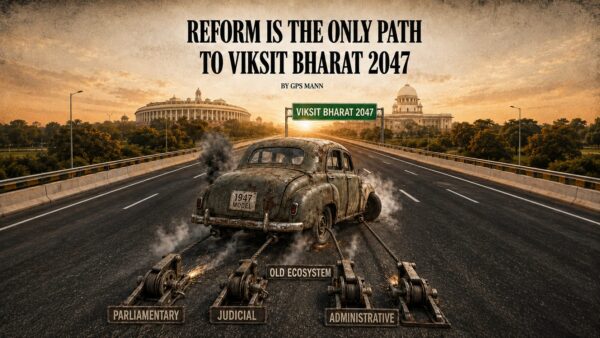
Even if the driver is excellent, the vehicle should be equally good, the tyres should be aligned, the engine regularly and properly tuned. The vehicle cannot run a lakh Km without a mandatory check up every 10000 KM.
Manish Tewari, writing in The Tribune a day earlier, is more plain. He points to declining parliamentary sittings, poorly functioning state assemblies, judicial vacancies, crores of pending cases and the failure to meaningfully devolve power to local institutions. His conclusion is blunt: the institutional balance is breaking down and public confidence is paying the price. (Link below)
Both arguments are important. But the issue goes beyond constitutional health. India’s institutional crisis has now become an economic constraint.
The reforms of 1991 released Indian industry from much of the licence-permit raj. Private enterprise was allowed to invest, compete, innovate and export. Agriculture, however, was largely left outside that reform process. As I wrote recently, the factory owner received freedom while the farmer remained a controlled supplier of cheap food. PM Modi had shown his intent and taken a baby step for agri reforms in 2020 but that initiative failed.
The farmer can produce, but his market is repeatedly disrupted. Export bans arrive when prices improve. Imports are opened when domestic prices rise. Stock limits discourage investment in warehouses and value chains. The Commission for Agricultural Costs and Prices must balance farmers’ interests against consumer prices and inflation. The National Food Security Act creates a legitimate obligation to provide affordable food, but its procurement compulsions influence the entire pricing system.
We praise the farmer as annadata while quietly using him and his economic shoulder, as an instrument of food subsidy.
Economist Surjit Bhalla has made the same point directly: practically every major sector was reformed in 1991 except agriculture; in some respects, “agriculture experienced negative reform”. He also connects weak private investment with policy uncertainty, restrictive investment rules, retrospective taxation, bureaucratic risk aversion and the absence of sustained structural reform. (Link below)
The contrast with China is revealing. China’s reform process began in rural areas. Agricultural households received greater responsibility, production incentives and decision-making freedom before reform expanded into industry, foreign trade and investment. China did not become an economic power merely by building roads and factories. It repeatedly altered the rules and incentives governing economic activity.
Reform is never comfortable. Reforms are tough, painful, vested interests oppose them, they feel threatened, they feel territorial encroachment. But without reforms, viksit bharat 2047 will be difficult. The ecosystem resists change. A department sees a single-window authority as an encroachment on its territory. An official may see the change as threat to his “other income”. A well-meaning official may prefer the safety of refusing a decision to taking the risk of approving one.
This is why reform cannot be announcing a portal or passing a law. The old ecosystem often survives inside the new structure. Files may become digital, but objections will remain analogue. A single window is opened, but the departmental walls behind it remain intact.
The warning from investors should be taken seriously, but stated accurately. An August 2026 Bank of America survey ranked India as the least-preferred Asia-Pacific equity market, excluding Japan, replacing Indonesia at the bottom. Thirty-two per cent of the fund managers surveyed were underweight India, while concern about the lack of reforms had increased. Weak growth, limited exposure to the artificial-intelligence boom and high valuations were also factors. So, we can forget attracting investors without tangible reforms. (Link Below)
Gross FDI reached a record $94.5 billion in 2025–26. But net FDI was only $7.7 billion. The amount of capital pulled out from Indian markets in last 2 years is staggering. The foreign capital has many alternatives. India cannot assume that its population and large market will persuade investors to accept indefinite delay, unpredictable regulation or slow dispute resolution. Here comes the need for a well thought of Tax reforms which are stable, consistent and not whimsically erratic or erratically whimsical.
India’s economic Vehicle has to travel at 90 kilometres per hour to reach 2047 Vikist Bharat destination, but its institutional “speed governors” remains calibrated at 40 KMPH. Judicial pendency clogging the system and eroding the confidence, bureaucratic discretion, regulatory uncertainty and sectoral protectionism repeatedly chokes and brakes the 1947 make engine, which needs an urgent overhaul, the vehicle needs new tyres, which are properly aligned and balanced to run on the expressways made by Nitin Gadkari. At the existing speed, Viksit Bharat 2047 may remain an distant destination which will be reached long after the scheduled arrival time.
India now needs a second generation of reform. Judicial appointments and vacancies need transparent timelines. The back log has to be cleared. Case management must curb endless adjournments. Commercial disputes require speed and predictability. Civil servants should be assessed for outcomes, innovation and timely decisions not merely for avoiding controversy. Parliament and state assemblies must recover their deliberative role. Federal consultation must become routine rather than ceremonial.
Agricultural reform must give farmers markets and choice, but also income protection, risk cover and a credible transition path. Those who genuinely lose from reform should be supported. Those who merely lose a monopoly, commission or discretionary power cannot be allowed to veto the future.
Strong leadership and strong institutions are not rivals. Leadership creates momentum, but institutions preserve it and carry it beyond one individual or one government.
Captain Amarinder is right that the present political energy must mature into institution-building. Manish Tewari is right that the deterioration is already visible. Surjit Bhalla is right that six per cent growth, however respectable, will not automatically deliver the ambition of 2047.
Reform will be tough. It will create anxiety and opposition. But postponing it risks losing investment, competitiveness, jobs and, “most importantly the youth itself.” Remember the Tinamen Square of 1989?Wise nations reform before pressure becomes crisis. India still has that opportunity. An opportunity given by the political potholes. The engine is powerful, the destination is clear and the driver has political authority.It is time to reset the speed governor and release the handbrake which is in the hands of pre independence era mindset.