
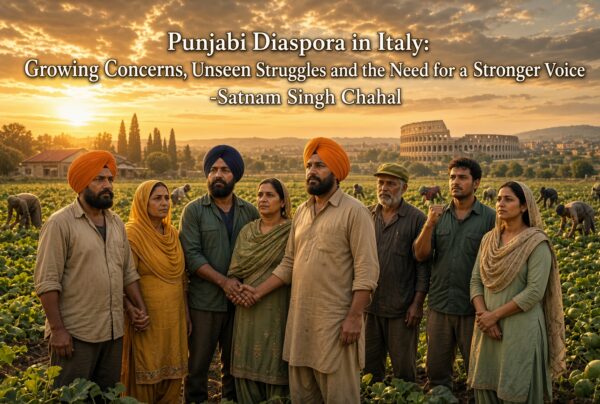
The Punjabi community in Italy has become an important part of the country’s migrant population. Over several decades, Punjabis—particularly Sikhs from Punjab, India—have built families, businesses, farms, religious institutions and community networks across different parts of Italy. Their contribution to agriculture, dairy, logistics, manufacturing, restaurants and other sectors is significant. Yet behind this story of migration and economic contribution are a number of serious issues that continue to affect the community.
One of the biggest concerns remains labour exploitation. The problem has been particularly documented in the agricultural areas of Lazio, including the Latina province, where a large Punjabi Sikh community has developed. Academic research has documented cases involving temporary or irregular contracts, excessively long working hours, unpaid overtime, low wages and inadequate workplace protections.
The issue is not simply about difficult employment. In some cases, researchers have described a system in which vulnerable migrant workers can become dependent on intermediaries or so-called caporali who control access to employment. Such arrangements can make workers reluctant to complain because they fear losing their jobs, accommodation or immigration security. Research on Punjabi workers in the Latina area has repeatedly highlighted the relationship between labour exploitation, illegal recruitment and social vulnerability.
Workplace safety is another major concern. Agricultural workers can be exposed to dangerous machinery, pesticides, extreme weather, long working hours and physical exhaustion. A 2025 report concerning a Punjabi farmworker in the Latina province highlighted allegations involving exhausting working conditions, short-term contracts, low wages and exposure to pesticides without adequate protection.
The community also faces a language barrier. Many first-generation Punjabi migrants arrived in Italy primarily to work and may not have received sufficient opportunities to learn Italian. Limited language skills can make it difficult to understand employment contracts, communicate with government offices, access healthcare, challenge unfair treatment or understand legal rights. Language therefore becomes not merely an integration issue but also a question of economic and personal security.
Another concern is immigration and documentation. Residence permits, citizenship applications, family reunification, employment documentation and other bureaucratic procedures can be complicated. For migrants who do not fully understand the Italian administrative system, delays or dependence on intermediaries can create additional vulnerability.
Housing and social isolation are also important concerns. Some Punjabi workers, particularly those employed in rural agriculture or livestock operations, live far from urban centres and public services. Research has found that agricultural and livestock employment can provide housing while simultaneously contributing to social isolation and limited interaction with wider Italian society.
The concerns extend beyond the workplace. Punjabi women in Italy have their own set of challenges. Recent research in central Italy found that Punjabi women may simultaneously perform paid employment, household work and caregiving while their economic contribution remains undervalued. The research also identified problems involving precarious employment, welfare exclusion and restrictions associated with traditional family expectations.
The second generation presents another challenge. Punjabi children growing up in Italy often live between two cultural worlds. Their parents may expect them to maintain Punjabi language, traditions, religion and family values, while Italian schools and wider society shape their identity in a different environment. The community needs to ensure that young people can maintain their heritage without feeling that they must choose between being Punjabi and being fully integrated members of Italian society.
Education and professional advancement deserve much greater attention. A community that remains concentrated in low-paid or physically demanding occupations can face difficulties in achieving upward mobility. Punjabi families should encourage young people to pursue higher education, professional qualifications, entrepreneurship, technology and skilled occupations rather than allowing the migration story to remain limited to agricultural and manual labour.
There is also a need to address social discrimination and stereotypes. The overwhelming majority of Punjabi migrants are hardworking people who contribute to Italian society, pay taxes and raise families. Yet isolated incidents, negative stereotypes or discrimination can affect the wider community. Punjabi and Sikh organisations should respond to such problems through legal awareness, community engagement and constructive dialogue with Italian institutions rather than allowing grievances to remain hidden.
Access to healthcare is another area requiring attention. Workers who spend long hours in physically demanding occupations may ignore health problems because taking time off can mean losing income. Lack of knowledge about the healthcare system, language difficulties and fear of employers can further discourage workers from seeking assistance.
The community must also look seriously at mental health and family pressures. Migration can involve debt, separation from relatives, demanding employment, financial obligations to families in Punjab and pressure to succeed in a foreign country. These pressures are rarely discussed openly. Community organisations and gurdwaras could play a greater role in creating confidential support systems and connecting families with professional services.
At the same time, the Punjabi community should recognise its own responsibilities. Community leadership cannot focus only on cultural celebrations and religious events. It must also address employment rights, education, women’s participation, youth development, legal awareness, healthcare, housing and integration.
The gurdwaras and community organisations in Italy can become powerful centres of education and empowerment. Along with religious programmes and langar, they can organise Italian-language classes, employment-rights seminars, legal clinics, youth programmes, women’s support groups, citizenship guidance and information sessions about workplace safety.
The Italian government and local authorities also have a responsibility. Punjabi migrants should not be viewed merely as a source of inexpensive labour. They are residents, workers, taxpayers, parents and members of Italian society. Stronger enforcement against illegal labour recruitment, wage theft and unsafe working conditions is essential.
The Punjabi community itself must also become more organised. Workers should know their legal rights, retain copies of employment documents, understand their contracts and seek qualified legal or union assistance when necessary. Community leaders should build relationships with Italian institutions rather than operating only within the Punjabi social circle.
There is also a broader lesson for Punjab. Thousands of Punjabis have travelled to Italy in search of a better future, often after families invested enormous amounts of money to send them abroad. The human cost of migration should therefore not be measured only by remittances and houses built in Punjab. The safety, dignity and long-term wellbeing of migrants must be equally important.
The Punjabi community in Italy has already demonstrated remarkable resilience. From agricultural workers and dairy employees to entrepreneurs, professionals and community leaders, Punjabis have established a meaningful presence in Italian society. But the next phase of the diaspora’s development must be about rights, dignity, education, integration and political representation—not merely survival.
Italy’s Punjabi community needs a stronger collective voice. Its achievements should be celebrated, but its problems must not be hidden. The future should be one in which a Punjabi migrant is respected not because he or she can provide cheap labour, but because every human being deserves fair wages, safe working conditions, equal treatment and dignity.
The community has contributed enormously to Italy. It is now time to ensure that the contribution of Punjabis is matched by justice, opportunity and respect.
Disclaimer: This article and accompanying images are for informational and illustrative purposes only. Some visuals may be AI-generated or digitally enhanced and may not depict actual events or persons.Views expressed are based on publicly available information and analysis