
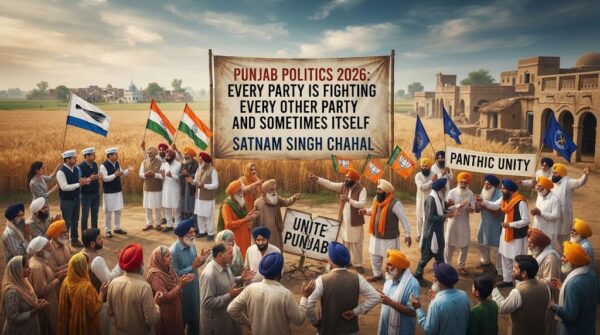
Punjab has entered the most unpredictable phase of its politics in years. With the 2027 Assembly election less than a year away, virtually every major political party is claiming that it is preparing to form the next government but beneath the speeches, rallies and social-media campaigns lies a much more complicated reality. The old Punjab political formula of Congress versus Shiromani Akali Dal has already been broken. The Aam Aadmi Party (AAP) destroyed that traditional arrangement in 2022 by winning 92 of the 117 Assembly seats. Now, however, AAP is itself facing the classic problem of an incumbent government: after four-and-a-half years in office, every promise made in 2022 is being compared with what voters believe actually happened.
At the same time, Congress is attempting a comeback, the BJP is trying to transform itself from a mainly urban party into a statewide contender, the Badal-led Shiromani Akali Dal is fighting for political survival and relevance, while newer Panthic formations are attempting to capture voters who feel alienated from the traditional parties. The result is not a two-cornered or even necessarily a three-cornered contest. Punjab could be heading toward a fragmented multi-party election in which vote percentages, alliances and candidates matter enormously.
AAP: The ruling party has government machinery -But also the biggest anti-Incumbency burden
Chief Minister Bhagwant Mann remains the central face of AAP’s Punjab campaign. The party has the enormous advantage of being in government and can point to welfare programmes, free electricity, health initiatives, education reforms and other schemes.AAP is already shifting into election mode. Mann and Arvind Kejriwal are appearing together at public programmes, while the government is increasingly presenting its welfare and governance programmes as an electoral report card. A recent influencer conclave in Kharar, for example, is being positioned as an effort to reach younger voters and communicate the government’s achievements through digital platforms.But governing Punjab is not the same thing as campaigning in Punjab.
The government’s biggest political vulnerability is anti-incumbency. Questions surrounding Punjab’s finances, employment, government employees’ grievances, law and order, drugs, agriculture, industrial investment and the delivery of promises are all likely to become election issues.The ongoing government-employee agitation is particularly significant. Reports indicate that roughly 7.5 lakh employees and pensioners are involved, with the potential political impact extending to millions of family voters. That makes employee dissatisfaction far more than a labour issue; it can become an election issue.The government’s pending DA/DR liabilities have also become a political vulnerability, with the Punjab and Haryana High Court directing the government regarding payment of pending dues.
AAP is therefore attempting to fight the 2027 election on two tracks:
“Look at what we have delivered” and “Look at what the old parties failed to deliver.”The difficulty is that after five years, voters may increasingly ask a third question:
“What happened to the promises you made in 2022?”That is the real AAP election test.
Congress: The biggest opposition opportunity -And perhaps the biggest internal problem
Congress has perhaps the clearest opportunity to become the principal alternative to AAP.But there is a major contradiction.The party has political space, experienced leaders, a statewide organisation and a long history in Punjab. Yet it continues to struggle with internal factionalism.Punjab Congress president Amarinder Singh Raja Warring, Leader of Opposition Partap Singh Bajwa, former Chief Minister Charanjit Singh Channi, Sukhjinder Singh Randhawa and other senior leaders have not always appeared to be operating from the same political script.Recent events have again exposed those divisions. At the Baba Bakala Rakhar Punya conference, Channi demonstrated considerable political strength, while Warring and his supporters were absent — an episode that once again highlighted the unresolved leadership tensions inside Punjab Congress.Sukhjinder Singh Randhawa has also publicly attacked Warring and questioned Bajwa’s leadership, demonstrating that the internal argument is not merely a media creation.This creates an extraordinary situation.
AAP wants to defeat Congress. BJP wants to defeat Congress. SAD wants to defeat Congress. Panthic groups want to take away sections of its vote. And Congress sometimes appears to be helping its opponents by fighting itself.Congress therefore has to answer one fundamental question before 2027:
Who is actually going to lead Punjab Congress into the election?
If the party can establish a credible united leadership structure, it could become the strongest challenger to AAP.
If the factional war continues, Congress could once again waste an opportunity that appears politically available.
BJP: No longer content with being content with being a junior partner
The BJP’s Punjab strategy has changed dramatically.For decades, the party depended heavily on its alliance with the Shiromani Akali Dal and traditionally contested a limited number of Assembly constituencies. That political model is now being reconsidered.The BJP wants to become a full-fledged statewide political force.Punjab BJP president Kewal Singh Dhillon has recently projected the party as prepared to contest all 117 Assembly seats.
That statement is politically important because it sends two messages:
First, BJP believes it can expand beyond its traditional urban base.Second, it does not want to automatically accept the old arrangement in which SAD was the senior partner and BJP contested a much smaller number of seats.The BJP is working on outreach to Dalit communities, including the Ravidassia community, and is trying to strengthen its organisational network across rural Punjab. Its broader pitch is built around central-government connectivity, development, investment and the “double-engine” government argument.
But BJP faces a major Punjab-specific challenge:
It has to convince rural Punjab that it understands Punjab rather than merely governing Punjab from Delhi.Farm laws, federal relations, agricultural policy, MSP, Punjab’s river waters, Chandigarh, Sikh issues and relations between Punjab and the Centre remain politically sensitive.Interestingly, even BJP’s own Punjab leadership has recently had to respond to Sikh-community sensitivities. Kewal Singh Dhillon publicly criticised the visit by three BJP MPs to Sajjan Kumar’s residence, calling the episode painful and unfortunate.That illustrates the difficult political balancing act BJP faces.
SAD: The Badal party’s fight is not just against AAP-It is for survival
The Shiromani Akali Dal remains one of the most important political institutions in Punjab, but its political position today is dramatically different from the era when it routinely competed for government.The party’s greatest problem is that its traditional political space has been attacked from multiple directions.AAP captured large portions of the anti-Congress vote.Congress retained sections of the traditional opposition vote.BJP expanded among urban and Hindu voters.New Panthic organisations began competing for Sikh voters.And internal divisions weakened the Akali structure.Sukhbir Singh Badal therefore faces a huge political challenge in 2027.The BJP-SAD relationship is particularly important.There is considerable speculation about a possible revival of the old alliance, but the negotiations are complicated. BJP increasingly sees itself as the stronger partner, while SAD needs an alliance that can help it recover lost ground without appearing politically subordinate.
Recent reports indicate disagreements over the number of seats, leadership and the possible Chief Ministerial arrangement. One report says BJP is seeking around 50–55 seats, a dramatic departure from the 23 Assembly seats it traditionally contested under the old alliance formula.That explains why an alliance announcement has not been straightforward.
The political question is simple:
Who needs whom more — BJP needs SAD’s Punjab network, or SAD needs BJP’s national machinery?
That will determine the alliance.
The Akali split : Punjab’s politicals has become a house divided
Perhaps nowhere is Punjab’s political fragmentation more visible than within the Akali/Panthic space.There is the Sukhbir Badal-led SAD, the SAD (Punar Surjit) associated with Giani Harpreet Singh, Akali Dal (Waris Punjab De) associated with Amritpal Singh, SAD (Amritsar) associated with Simranjit Singh Mann and other smaller Panthic formations.The extraordinary development is that factions that were once bitterly opposed are now discussing possible electoral cooperation.SAD (Punar Surjit) has explored possibilities involving BJP, the Badal-led SAD and Waris Punjab De, although no comprehensive final arrangement should be treated as settled simply because discussions are taking place.At the same time, internal relationships have remained unstable. Manpreet Singh Ayali resigned from SAD (Punar Surjit) earlier this year amid differences over the party’s alliance arrangement.This is why the 2027 election may become a referendum not simply on governments but on the future direction of Panthic politics itself.
Waris Punjab De: The Amritpal Factor
The emergence of Akali Dal (Waris Punjab De) has introduced a completely new variable.Amritpal Singh’s political appeal, particularly among sections of younger Sikh voters and voters dissatisfied with established parties, gives the organisation a constituency that traditional parties cannot simply dismiss.The challenge is converting personal popularity and Panthic sentiment into a statewide political organisation.That is much harder.Winning one or several constituencies is one thing. Building a 117-seat election machine is another.The organisation’s relationship with other Panthic parties will therefore be crucial.
The biggest question is:
Can the various Panthic groups divide each other’s votes — or can they create enough unity to become a genuine third force?
The answer could significantly affect the 2027 result.
BSP: Mayawati has just changed the Calculation
The Bahujan Samaj Party has now announced that it will contest the 2027 Punjab Assembly election independently, ruling out an alliance.This decision should not be underestimated.Punjab has one of India’s highest Scheduled Caste population proportions, yet the Dalit vote has never been permanently consolidated behind one party.That makes BSP potentially important even if it does not win a large number of seats.
Why?
Because in a close three- or four-way contest, even a few percentage points can change the winner in dozens of constituencies.BSP can therefore become a spoiler, vote-divider or surprise winner depending on its candidate selection and organisation.Its challenge is rebuilding the grassroots machinery that once gave the party much greater influence in Punjab.
The Communist and smaller left groups
The traditional Left parties CPI, CPI(M) and other smaller formations no longer possess the electoral strength they once enjoyed in Punjab.But they continue to have influence in specific constituencies and among sections of farmers, workers, employees and progressive organisations.Their importance may therefore be greater in issue-based politics and alliances than in their standalone seat count.Punjab’s farmers’ movement, labour politics and government-employee struggles give the Left potential political space, but translating that space into Assembly seats remains the difficult part.
The biggest election issue may not be religion-It may be performance
Punjab’s political parties are increasingly talking about identity, religion, Panthic politics, nationalism and alliances.But ordinary voters will also be asking very practical questions:
Where are the jobs?
What happened to the drug menace?
What is happening to Punjab’s debt?
Why are government employees protesting?
What is happening to agriculture?
Where is industrial investment?
Why are young Punjabis still leaving the state and the country?
What is happening to law and order?
Can Punjab afford another cycle of borrowing and expenditure?
Where is the promised transformation?
These questions could ultimately matter more than political speeches.AAP will defend its record.Congress will attack AAP’s record.BJP will attack both.SAD will argue that Punjab needs a regional political voice.Panthic groups will argue that Punjab needs political and religious revival.BSP will focus on Dalit representation.
But the voter may simply ask:
“Which party can actually fix Punjab?”
The real battle: Rural Punjab
Punjab elections cannot be won merely through television studios, Chandigarh press conferences and social media.The decisive battlefield remains rural Punjab.Farmers, agricultural labourers, small traders, government employees, unemployed youth, women, Dalit voters and village-level political networks will determine the outcome.AAP has government machinery.Congress has an established rural network.SAD possesses decades of organisational experience.BJP is aggressively building a new network.Panthic parties are attempting to mobilise identity-based voters.BSP is trying to consolidate Dalit support.That creates a highly fragmented battlefield.
Social media has become another election battlefield
Punjab’s 2027 election is also likely to be the state’s first major election in which AI-generated political videos, memes, influencers and digital propaganda play an enormous role.Recent reporting has already documented the growing use of AI-generated videos targeting Mann, Badals, Warring and other political leaders.Political parties can now manufacture an entire campaign narrative within hours.
The danger is obvious:
In 2027, voters may not merely have to decide which politician is telling the truth. They may first have to determine whether the video itself is real.Who is currectly strongest?
It is too early to responsibly declare a winner.There is no reliable basis at this stage for treating social-media “opinion polls” as genuine electoral forecasts.But politically, the present situation can be described this way:
AAP
Strength: Government, Bhagwant Mann’s visibility, welfare programmes, organisational machinery and incumbency resources.Weakness: Anti-incumbency, employee unrest, governance controversies, financial pressures and internal dissent.
Congress
Strength: Large historical organisation, anti-incumbency opportunity and experienced leadership.Weakness: Internal factionalism and uncertainty over who ultimately controls the campaign narrative.
BJP
Strength: Central government, resources, organisational expansion and ambition to contest all 117 seats.Weakness: Rural Punjab and Sikh-community acceptance remain major challenges.
SAD Badal
Strength: Deep historical roots, Sikh institutional connections and a statewide political identity.Weakness: Severe erosion of its traditional vote base and continuing leadership/credibility questions.
Panthic factions
Strength: Ability to mobilise identity, emotion and younger voters dissatisfied with established parties.Weakness: Fragmentation and difficulty converting Panthic sentiment into a statewide governing coalition.
BSP
Strength: Dalit political space and independent identity.Weakness: Organisational weakness and limited recent electoral performance.
The most important question of 2027:Will Punjab vote as one state or as many state or as many as many different states ?
This may ultimately be the defining question.Urban Punjab may vote differently from rural Punjab.Malwa may behave differently from Majha and Doaba.Farmers may have different priorities from government employees.Young voters may have different priorities from older voters.Dalit voters may not vote as a single bloc.Sikh voters may not vote uniformly on Panthic issues.Hindu voters may not vote uniformly for BJP.And traditional party loyalties are weakening.That means Punjab’s 2027 election could be decided constituency by constituency rather than through one statewide wave.
Final assessment :: Punjab politically wide open
The most striking feature of Punjab politics in August 2026 is not that one party is clearly winning.It is that almost every major political party has a realistic path to becoming relevant but every party also has a serious weakness capable of destroying that path.
AAP has the government but carries incumbency.Congress has the opportunity but carries factionalism.BJP has resources and ambition but faces the challenge of building deeper Punjab roots.SAD has history and regional identity but is fighting to recover its lost political space.The new Panthic forces have emotional and ideological appeal but remain fragmented.BSP has a potentially important Dalit constituency but must rebuild its organisation.And the voter is standing in the middle of this political circus, watching everybody promise to rescue Punjab.The 2027 election may therefore not be about who has the loudest slogan.It may be about who can convince an increasingly impatient Punjab that its next government will be different from its last government.For the first time in decades, the old question Congress or Akali Dal? is almost irrelevant.
The new question is:
AAP, Congress, BJP, SAD, Panthic forces, BSP or a completely unexpected combination?
Punjab has less than a year to answer.And if the current political fragmentation continues, 2027 could produce one of the most unpredictable Assembly elections in Punjab’s modern political history.This assessment reflects publicly reported developments available through August 29, 2026; alliance discussions and party positions can change rapidly before the election.
Disclaimer: This article and accompanying images are for informational and illustrative purposes only. Some visuals may be AI-generated or digitally enhanced and may not depict actual events or persons.Views expressed are based on publicly available information and analysis