
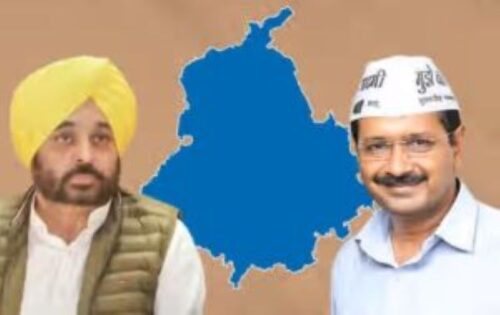
 The Aam Aadmi Party (AAP) came to power in Punjab in March 2022 with an extraordinary mandate of 92 out of 117 Assembly seats. The victory reflected the people’s desire for political change, better governance, employment opportunities, freedom from corruption, improved education and healthcare, and relief from the state’s long-standing problems. Chief Minister Bhagwant Mann and his government inherited enormous expectations. More than four years later, it is important to examine what the government has achieved, where it has fallen short and what questions remain unanswered.
One of the government’s most visible achievements is the implementation of 300 units of free electricity per month for domestic consumers. This initiative has provided financial relief to a large number of households, particularly lower- and middle-income families. For many people, the reduction in electricity bills is a direct and visible benefit. AAP can reasonably present this scheme as one of its major achievements. However, the growing financial burden of electricity subsidies also raises questions about the long-term sustainability of the scheme and its impact on Punjab’s finances.
Employment is another area where AAP can claim progress. The government has reported providing approximately 65,000 government jobs and creating around 5.5 lakh employment opportunities. Recruitment in different government departments has benefited many young people and families. However, the government must clearly distinguish between permanent government appointments, contractual employment and private-sector opportunities. Punjab continues to face concerns about unemployment, educated youth migrating abroad and the shortage of suitable employment opportunities within the state.
Healthcare has been another important area of government activity. The establishment of Aam Aadmi Clinics has expanded access to primary healthcare, free consultations, medicines and diagnostic services. For residents of villages and smaller towns, these facilities can reduce the need to travel long distances for basic treatment. The government has also introduced the Mukh Mantri Sehat Yojna, offering cashless treatment coverage of up to ₹10 lakh under its announced scheme. Nevertheless, the real success of these initiatives must be measured by the availability of doctors, medicines, diagnostic facilities and quality treatment rather than simply counting the number of clinics opened.
Education was a major part of AAP’s political identity, and the Punjab government has introduced Schools of Eminence, improved some school buildings, organised teacher training programmes and promoted modern classroom facilities. These initiatives have the potential to improve government education. However, parents and students need to see improvements across the entire government-school system, not just selected institutions. Teacher vacancies, learning outcomes, examination results and the availability of laboratories and other facilities should be independently assessed.
The government has also continued free bus travel for women, providing financial relief to thousands of passengers who travel for employment, education and household responsibilities. This is a visible welfare measure. Similarly, initiatives involving canal irrigation, crop diversification and rural infrastructure have been presented as steps towards improving agricultural and village life. Chief Minister Bhagwant Mann has claimed significant expansion in canal irrigation coverage. These achievements should be assessed through actual agricultural acreage receiving water, improvements in water availability and the number of farmers benefiting.
AAP can also point to action against corruption and the arrest of certain politicians, officials and other individuals accused of wrongdoing. The government has repeatedly presented these investigations as evidence of its commitment to a corruption-free administration. However, the public expects more than arrests and announcements. Investigations must be impartial, transparent and consistent, regardless of political affiliation. Convictions, recovery of public money and improvements in administrative accountability are more meaningful indicators of success.
On the other hand, the drug problem remains one of the biggest challenges facing Punjab. During the 2022 election campaign, AAP made strong commitments to eliminate the drug menace. The government has conducted enforcement operations, registered thousands of cases and reported substantial heroin seizures and arrests. These are important enforcement activities, but the larger question remains: why does the drug supply network continue to operate, and why are families still struggling with addiction? The government must demonstrate whether drug availability has actually declined, whether major suppliers and financiers have been prosecuted and whether rehabilitation facilities are delivering meaningful results. Arresting small-time offenders cannot substitute for dismantling the larger trafficking networks.
Law and order is another area attracting public concern. Punjab has continued to witness incidents involving gangster activity, extortion demands, targeted shootings, illegal weapons and attacks on individuals. Businessmen, traders and ordinary residents want to feel secure in their homes and workplaces. The government can point to police operations and arrests, but people ultimately judge the administration by the level of safety they experience in everyday life. The police must demonstrate that they can prevent organised crime and act independently without political interference.
Punjab’s financial condition is perhaps one of the most serious long-term concerns. The state inherited a substantial debt burden from previous governments, but the present administration is responsible for managing its finances and preventing the situation from deteriorating. According to the PRS analysis of the 2025–26 Punjab Budget, outstanding debt was projected at approximately 44.5 per cent of GSDP. The state also faced a projected fiscal deficit of ₹34,201 crore and a revenue deficit of ₹23,957 crore. The government must explain how much additional borrowing is being used for productive development and how much is financing routine expenditure. Punjab needs a credible strategy to increase revenue, attract investment and reduce its dependence on borrowing.
The free electricity scheme and other welfare programmes have provided relief to many households, but their financial implications cannot be ignored. Welfare is an important responsibility of any elected government, particularly in a state where many families face economic difficulties. However, the government must maintain a balance between public assistance and investment in roads, schools, hospitals, agriculture, industry and employment. Punjab cannot depend indefinitely on borrowing to finance recurring expenditure. The real challenge is to provide relief today without compromising the economic future of tomorrow.
Employment and migration remain major concerns among Punjab’s younger generation. Despite government recruitment, many educated young people continue to look towards Canada, the United States, Australia, the United Kingdom and other countries for better opportunities. This reflects concerns about the availability of suitable jobs, wages, career development and economic security. Punjab needs a strong private-sector economy, industrial expansion and opportunities for skilled professionals. Government recruitment alone cannot resolve the state’s employment crisis.
Industrial development is another area where the government must demonstrate measurable results. Investment summits and memorandums of understanding can generate publicity, but the real test is how much investment actually reaches Punjab, how many factories begin production and how many permanent jobs are created. Punjab must compete with neighbouring states for industrial investment. Entrepreneurs need reliable infrastructure, uninterrupted power, efficient administration and a secure business environment. Without these conditions, investment announcements may not translate into meaningful economic development.
Another politically significant issue is the relationship between Punjab’s elected leadership and AAP’s national leadership. Critics have repeatedly questioned whether important decisions concerning Punjab are being influenced by party leaders outside the state, particularly those based in Delhi. AAP maintains that Bhagwant Mann and his elected Cabinet are responsible for governing Punjab. Nevertheless, the public deserves transparency about decision-making, administrative appointments and the independence of the state leadership. Punjabis elected a government to protect Punjab’s interests, and the administration must demonstrate that the state’s priorities come first.
Farmers’ issues also remain unresolved. AAP came to power with significant expectations among the farming community, but demands concerning guaranteed minimum support prices, agricultural debt, crop diversification, compensation and groundwater conservation continue to require attention. Although the government has introduced certain agricultural initiatives, Punjab needs a comprehensive policy that protects farmers’ incomes while addressing the environmental damage caused by excessive groundwater extraction and the dependence on paddy cultivation.
The government’s handling of major policy decisions has also attracted criticism. The controversy surrounding the 2025 Land Pooling Policy and subsequent judicial intervention raised questions about consultation, transparency and the preparation of policies before implementation. A government must ensure that major decisions affecting farmers, landowners and ordinary citizens are properly examined and discussed with stakeholders. Accepting legal scrutiny and correcting policy mistakes should be considered part of responsible governance.
Police accountability and democratic freedoms are equally important. There have been allegations by Opposition parties and sections of civil society concerning the treatment of political opponents, peaceful protesters and critics of the government. These allegations require examination on a case-by-case basis. A democratic government must protect the right to peaceful protest, respect freedom of expression and ensure that the police operate without political pressure. Law enforcement must serve the Constitution and the public rather than any political organisation.
The delayed implementation of the promised ₹1,000 monthly financial assistance for women has also created questions about the government’s election commitments. Women were an important part of AAP’s 2022 electoral support, and the promise generated considerable expectations. The government must explain the delays, the eligibility conditions and the actual implementation of the scheme. Voters have the right to compare election promises with what has been delivered during the government’s term.
Ultimately, AAP has achievements that its supporters can point to, particularly free electricity, women’s bus travel, government recruitment, primary healthcare and education initiatives. At the same time, the government faces serious questions about drugs, law and order, unemployment, farmers’ concerns, industrial development, financial management and the fulfilment of election promises. Neither the achievements nor the shortcomings should be ignored.
The biggest question is whether Punjab is economically, socially and administratively in a stronger position than it was when AAP assumed power in 2022. The government should publish a comprehensive report comparing its original election guarantees with actual performance, supported by independently verifiable figures. It should clearly identify completed promises, partially completed commitments and outstanding guarantees.
Punjab does not need political publicity or competing claims of success and failure. It needs accountable leadership, a sustainable economy, secure employment, effective law enforcement, protection for farmers, better education and healthcare, and institutions that work independently. The people of Punjab gave AAP an overwhelming mandate in 2022. That mandate also came with a responsibility to answer difficult questions and deliver measurable results.
The ultimate measure of any government is not the number of announcements it makes, the number of opponents it criticises or the number of achievements it advertises. It is whether ordinary Punjabis experience a better, safer, more prosperous and more secure life.
Disclaimer: This article and accompanying images are for informational and illustrative purposes only. Some visuals may be AI-generated or digitally enhanced and may not depict actual events or persons. Views expressed are based on publicly available information and analysis