
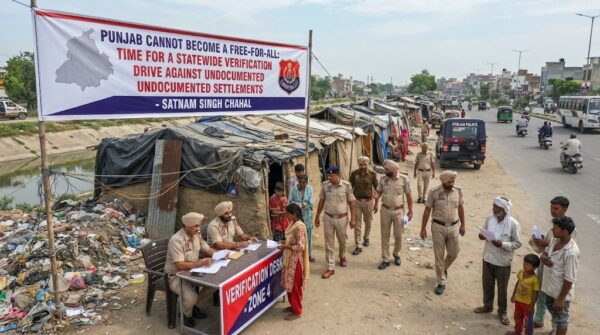
Punjab is facing an issue that can no longer be brushed under the carpet: the rapid growth of unverified migrant settlements in and around several towns, cities and rural areas. There are widespread public concerns that large numbers of people whose identity, citizenship and legal status have not been properly verified are living in makeshift colonies, roadside settlements and huts. The exact number is not officially established, and therefore claims running into several lakhs must be independently verified through a transparent government survey. But the scale of the concern is serious enough to demand immediate attention.
The question is not about targeting any particular religion, language, state or community. Punjab has historically welcomed hardworking people from different parts of India, and migrant workers have contributed substantially to agriculture, construction, industry and other sectors. The real issue is legal status, verification, land ownership, public resources and law and order. A person who is legally entitled to live and work in Punjab should have nothing to fear from verification. At the same time, the administration cannot permit anybody Indian citizen or foreign national—to occupy government land or private property illegally.
One of the most disturbing concerns being raised by residents is the mushrooming of temporary huts and informal settlements on government land, along roads, drains, railway-side areas, vacant plots and other public spaces. In some locations, residents allege that encroachments gradually begin with a few huts and eventually develop into sizeable settlements. Once such settlements become politically or administratively difficult to remove, the encroachment becomes permanent. Punjab cannot afford a situation in which government land is first occupied illegally and later treated as an established settlement.
There is another important question: who is paying for the basic services reaching such settlements? Residents have raised allegations of unauthorized electricity connections, free or subsidized electricity, water connections and other public facilities being extended without proper verification. These allegations should not simply become political slogans. The Punjab Government should conduct a district-wise audit of electricity meters, connections, water supply, ration cards, Aadhaar-linked benefits and other government services in unauthorized settlements and make the findings public.
Punjab is already under severe financial pressure. At a time when the state struggles to meet the demands of employees, farmers, pensioners, students and ordinary taxpayers, every rupee of public money must be accounted for. If electricity is being supplied illegally, it is theft. If a genuine government subsidy is being wrongly obtained through false documentation, it is fraud. If government land is occupied without authorization, it is encroachment. The law should be applied equally in every case.
Equally concerning are complaints from local residents about intimidation, street fights, public drinking, nuisance, harassment and involvement of some individuals from unauthorized settlements in criminal activities. These allegations must be investigated not collectively attributed to an entire migrant community. If even a small percentage of residents are involved in crime, the police must identify the individuals, register cases where evidence exists and take action according to law. Law-abiding migrants should not be stigmatized because of the criminal conduct of others.
Punjab Police should therefore undertake a comprehensive identity-and-criminal-record verification exercise in areas where residents have reported serious problems. This should include verification of names, permanent addresses, identity documents, employers and, wherever legally permissible, criminal records. Foreign nationals without valid documentation should be dealt with under the applicable immigration and foreigners laws through due process. Indian citizens from other states must not be treated as foreigners merely because they speak another language or have migrated for employment.
The Government of India has itself recognized that illegal immigration and abnormal settlement patterns can have implications for sovereignty, national security, law and order and social structure. In May 2026, the Union Government announced a High-Level Committee specifically to scientifically assess demographic changes associated with illegal immigration and recommend mechanisms for identification, detention and deportation of illegal immigrants, along with stronger Centre-State coordination.
Punjab should not wait for another crisis before acting. The state government should immediately prepare a district-wise map of unauthorized settlements and encroachments, identify the ownership of the land, determine the citizenship and legal status of residents, examine how electricity and water connections were obtained, and investigate whether government welfare benefits are being accessed through fraudulent documentation.
At the same time, Punjab must distinguish between illegal immigration and ordinary internal migration. Millions of Indians move between states every year for employment, education and business. A worker from Bihar, Uttar Pradesh, Rajasthan, Odisha or any other Indian state does not become an illegal immigrant merely because he has come to Punjab for work. The law must be precise, evidence-based and free from communal or linguistic profiling.
The solution is neither political hatred nor administrative inaction. The solution is verification, documentation, enforcement and accountability.
If an individual is legally entitled to live in Punjab, the government should protect his rights. If someone has illegally occupied private or government land, the encroachment should be removed according to law. If someone has obtained electricity or government benefits through fraud, action should follow. If someone is involved in crime, the police should prosecute that individual. And if a foreign national is found residing in India without valid authorization, the competent authorities should follow the law governing such cases.
Punjab cannot afford selective enforcement. The state needs one law for everyone.
The people of Punjab deserve answers: How many unauthorized settlements exist? How much government land has been encroached upon? How many electricity connections are unauthorized? How many residents possess valid identity and address documents? How many cases of criminal activity have been registered from these areas? And who allowed these settlements to grow unchecked?
These questions should no longer be dismissed as political rhetoric. They deserve a professional, transparent and data-driven investigation.
Punjab has always had the tradition of sarbat da bhala—the welfare of all. But compassion cannot mean surrendering government land, public resources, law and order or the rights of local residents. Hospitality and humanity must go hand in hand with legality and accountability.
The Punjab Government should therefore launch a time-bound statewide verification and encroachment survey, publish district-wise findings, recover illegally occupied public land, disconnect unauthorized utility connections, investigate welfare fraud and take lawful action against proven offenders while simultaneously protecting innocent and law-abiding migrant workers from harassment or collective blame.Punjab belongs to everyone who lives here lawfully but nobody should be allowed to treat Punjab’s public land, public money and public services as if they have no owner.
Disclaimer: This article and accompanying images are for informational and illustrative purposes only. Some visuals may be AI-generated or digitally enhanced and may not depict actual events or persons.Views expressed are based on publicly available information and analysis