
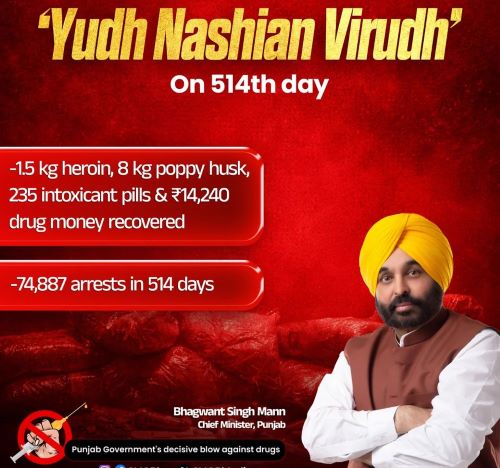
 Punjab has heard the phrase “war against drugs” for years. Governments have changed, political slogans have changed, ministers have changed and police officers have changed—but the fundamental question remains painfully unchanged: Why are drugs still reaching Punjab’s villages, towns and cities? A government can announce a campaign, hold meetings, conduct raids, arrest small-time sellers, seize consignments, organise awareness programmes and release photographs of confiscated drugs. But none of these things, by themselves, constitute victory. The real measure of success is much simpler: Are drugs becoming harder to obtain? Are young people being saved? Are the major supply networks being dismantled? Are the financiers being identified? Are the powerful people allegedly protecting the trade being brought before the law? Punjab deserves honest answers.
The drug crisis is not merely a law-and-order problem. It is a social, economic, health, policing and governance crisis. Behind every addicted young person there is often a devastated family. Behind every family tragedy there is a wider network of dealers, suppliers, financiers and facilitators. And behind every major drug network there must be money, logistics and protection. That is why Punjab cannot win this war by concentrating only on the person standing at the street corner selling a packet. If the government genuinely wants to end the drug epidemic, it must attack the entire ecosystem that makes the trade possible.
For years, ordinary Punjabis have been asking a basic question: Who is supplying the drugs? It is easy to arrest a small dealer. It is much harder to follow the money, identify the financiers, uncover the transportation network, trace communications and establish who controls the larger supply chain. That is precisely where the real war must begin. If a dealer is arrested today and another dealer appears tomorrow, the problem is not simply the dealer. The problem is the system that continuously replaces him. Punjab needs investigations that move upward—not merely sideways.
Every major seizure should lead investigators toward the next level. Every suspicious financial transaction should be examined within the limits of law. Every major trafficking network should be mapped. Where evidence establishes wrongdoing, prosecutions must follow irrespective of political connections, social status or influence. Otherwise, Punjab will continue to celebrate arrests while the drug market continues to replenish itself.
The political class must also stop treating drugs merely as an election slogan. Every political party in Punjab knows that drugs are an emotional and devastating issue, and consequently the drug menace repeatedly becomes an election issue. But Punjab’s parents have heard enough political speeches. They want to know what happened after the speeches ended. They want to know how many major trafficking networks were dismantled, how many financiers were prosecuted, how much illicit money was traced and how many young people were actually rescued from addiction. Most importantly, they want to know whether their children are safer today than they were yesterday.
A government should not measure its war against drugs by the number of press conferences it holds. It should measure it by the number of families it saves.
The reported death by suicide of 47-year-old Gulzar Singh of Dirba, Sangrur, after he publicly raised questions about the continuing availability of “chitta” and his son’s addiction has added another deeply disturbing dimension to Punjab’s drug debate. According to reports, Gulzar Singh questioned Punjab Finance Minister Harpal Singh Cheema at a public event and subsequently allegedly faced pressure from some local people. His family has sought justice, while police have reportedly registered a case of abetment to suicide. These are allegations that must be established through a fair investigation. But precisely because the circumstances are so serious, there can be no attempt to dismiss the matter as merely another political controversy.
A citizen has every democratic right to question a minister about an issue destroying families across Punjab. If a person raises a question about drugs, the appropriate response from government should be an answer, an investigation and action—not intimidation, humiliation or pressure. The circumstances leading to Gulzar Singh’s death must therefore be investigated transparently. CCTV footage, mobile-phone records, videos from the event, witness statements and other relevant evidence should be preserved and examined. If anyone is found to have threatened, coerced or otherwise abetted him, the law must take its course.
The tragedy has also resonated deeply among Punjabis living in North America, Europe, Australia and elsewhere. The Punjabi diaspora remains emotionally and financially connected to Punjab. Families abroad continue to worry about relatives back home, and parents living overseas fear that the young people they left behind may become victims of addiction. The drug crisis is therefore not simply a Punjab issue—it is a global Punjabi concern. When disturbing incidents involving drugs, intimidation and deaths emerge from Punjab, they immediately travel through social media and diaspora networks. The growing message from Punjabis abroad is clear: Punjab cannot be allowed to normalise the destruction of another generation.
The police have an important role, but the police alone cannot defeat addiction. A serious anti-drug strategy must combine prevention, enforcement, treatment and rehabilitation. Young people must be prevented from entering the drug economy in the first place. Schools and colleges need meaningful awareness and counselling programmes rather than occasional ceremonial events. Law enforcement must aggressively pursue traffickers and financiers. People already suffering from addiction need accessible, affordable and scientifically sound treatment. Those who recover need rehabilitation, employment opportunities and social support so that they do not return to the same environment that contributed to their addiction.
One of the most important weapons in the fight against organised drug trafficking is financial investigation. Drug trafficking is ultimately a business, and it generates money. That money has to move somewhere. It may be invested in property, businesses, vehicles or other assets, or moved through complicated financial channels. Punjab’s anti-drug strategy must therefore go beyond the seizure of narcotics. Follow the money. Identify the financiers. Investigate unexplained wealth. Trace the financial networks. Build strong cases that survive in court. A trafficker should not be able to continue operating simply because one shipment has been seized.
There is another uncomfortable question Punjab must be willing to ask: What happens when a police officer, government employee or politically connected individual is suspected of facilitating the drug trade? The answer must be the same as it is for everyone else: investigate the evidence and prosecute where the evidence establishes criminal conduct. No government can credibly claim to be fighting organised crime while appearing unwilling to examine serious allegations involving powerful individuals. The war against drugs must therefore include strong internal accountability and independent examination of allegations of corruption or collusion.
At the same time, Punjab must distinguish between the person who profits from addiction and the person trapped by addiction. A drug trafficker deliberately recruiting young people into the trade is not the same as a young person who has become dependent and needs medical and psychological help. Punjab must be uncompromising with organised trafficking while becoming far more compassionate and effective in treating addiction. Families should not have to sell land, jewellery or borrow heavily simply to obtain treatment for an addicted child. Rehabilitation centres must be properly regulated, patients must be treated with dignity and treatment outcomes should be independently monitored.
Punjab’s government should also publish regular, independently verifiable information about its anti-drug campaign. Citizens deserve to know how many major trafficking networks have been dismantled, how many financial investigations have been launched, how much illicit property has been identified through lawful proceedings, how many convictions have been secured, how many officials have been investigated for suspected collusion, how many people are receiving treatment and what rehabilitation outcomes are being achieved. If the government is winning the war, show the evidence. If it is losing the war, admit it and change the strategy.
Punjab’s drug crisis is too serious to become a competition over which political party can produce the strongest slogan. The opposition should demand accountability, but it should also offer constructive solutions. The government should accept legitimate criticism rather than treating every question as a political attack. Civil society organisations, doctors, educators, parents, recovered addicts, law-enforcement experts and the Punjabi diaspora should all have a meaningful role in shaping policy.
The issue is bigger than AAP, Congress, SAD or BJP. It is about Punjab.
Punjab’s war against drugs will ultimately be judged not by slogans such as “war,” “zero tolerance” or “crackdown.” It will be judged in the homes of Punjabi families. It will be judged by whether a mother sleeps peacefully at night because she knows her son is safe. It will be judged by whether a father can walk into a village without fearing that his child will be introduced to drugs. It will be judged by whether a young person can find opportunity, dignity and employment without being pulled into addiction or the drug economy. And it will be judged by whether an ordinary citizen can stand before a minister and ask a difficult question without fear.
Punjab needs a genuine war against drugs—but a war fought intelligently, transparently and without political favouritism. The government must go after the supply chain, the financiers and organised networks. Police officers and officials found guilty of corruption or collusion must face the law. Addicted persons must receive treatment. Families must receive support. Young people must receive opportunity. And citizens must be allowed to ask questions.
Because the biggest danger is not merely that drugs are destroying Punjab. The bigger danger is that Punjab could become so accustomed to the destruction that it stops demanding answers. That must never happen.
Punjab has lost too many young lives. Too many families have suffered. Too many promises have been made. Now the time for slogans is over.
The war must begin with one simple principle: Save the youth. Break the supply chain. Follow the money. Expose criminal networks. Punish the traffickers. Treat the addicted. Protect families. And hold the government accountable.
Punjab cannot defeat an enemy it refuses to fully expose.
Disclaimer: This article and accompanying images are for informational and illustrative purposes only. Some visuals may be AI-generated or digitally enhanced and may not depict actual events or persons.
Views expressed are based on publicly available information and analysis