
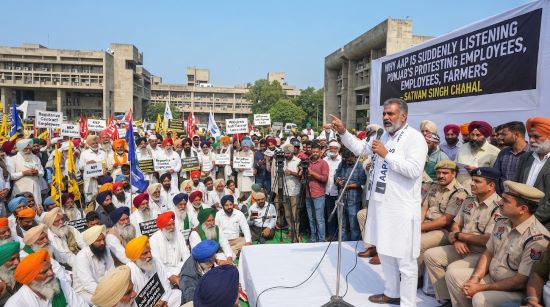
Amid growing criticism over law-and-order issues, AAP ministers and MLAs go from “no work, no pay” to prioritising dialogue with demonstrators.A visibly softer approach by Aam Aadmi Party (AAP) ministers and legislators towards protesting employees and farmers in Punjab over the past few days has raised questions, as their stance is in contrast to the government’s earlier use of “force” and warnings against various protest groups.On September 13, hundreds of employees under the banner of the Sanjha Mulazam and Pensioners Front reached the residence of Cabinet Minister and AAP Punjab president Aman Arora in Sunam
From “No Work, No Pay” to Dialogue: A Timeline of a Noticeable Change in the Mann Government’s Approach.Punjab’s Aam Aadmi Party government appears to have adopted a noticeably more conciliatory approach towards protesting government employees, pensioners and farmers in September 2026. The change is particularly striking because it follows weeks of confrontation, warnings and administrative measures against sections of the protesting workforce.
The immediate question is not whether dialogue is desirable it clearly is but why the emphasis on dialogue has become so prominent now, after months of confrontation? The answer may lie in the scale and persistence of the protests, the widening number of groups joining the agitation and the increasingly difficult political environment facing the government ahead of the 2027 Punjab Assembly election. These are political circumstances, rather than proof of any single motive.
On September 13, hundreds of employees and pensioners associated with the Sanjha Mulazam and Pensioners Front reached the residence of Punjab Cabinet Minister and AAP state president Aman Arora in Sunam.Instead of allowing the confrontation to develop into another prolonged standoff, Arora came out to meet representatives of the protesters. He described protest as a democratic right and appealed to employees to resolve their grievances through dialogue and mutual understanding. The protesters subsequently called off their demonstration after meeting him.That approach is significant because the government had only recently been dealing with employee agitation through considerably tougher administrative language.
Just one day before the Sunam episode, hundreds of government employees, pensioners and scheme workers intensified their protest outside the private residence of Health Minister Dr Balbir Singh in Patiala. The protesters breached police barricades and staged a sit-in, raising demands relating to job security, pending dues and other service issues.The developments demonstrated that the employee movement was no longer confined to conventional demonstrations at government offices. Ministers’ residences had become protest destinations.
The escalation followed the government’s decision to enforce a “no work, no pay” approach against employees participating in the agitation. The ministerial employees’ pen-down strike had been extended until September 11, and the government sought to discourage absence from duty through financial and administrative consequences.Employee organisations, meanwhile, had announced intensified statewide agitation beginning September 8 over long-pending demands, including DA arrears, pension-related issues and other service matters.This is the first major contrast in the September timeline: the government was talking about discipline and attendance at the beginning of the escalation; within days, senior AAP leaders were publicly emphasising dialogue.
Even before the September 8 escalation, the government had begun making efforts to contain the dispute. With employee and pensioner organisations preparing for intensified agitation, the administration attempted to engage with them and address at least some of their concerns.The underlying dispute was substantial. Employee organisations have been demanding clearance of roughly ₹14,200 crore in pending DA and related arrears, while the government has argued that Punjab’s financial position and inherited liabilities make immediate settlement difficult. The debate has also highlighted the difference between improved tax collections and the state’s continuing fiscal pressures.
The September confrontation did not emerge suddenly. Employee and pensioner organisations had been building pressure through August, with large numbers of government employees and pensioners participating in statewide agitation over their demands.The dispute has included the Old Pension Scheme (OPS), DA arrears, regularisation, salaries, disciplinary action and other service-related issues. Under the Mann government, some employee agitations have resulted in partial concessions, but several major demands have remained unresolved.
There is an interesting contrast in Aman Arora’s own public messaging.On July 26, while addressing the PSPCL employees’ strike, Arora urged striking power employees to withdraw their agitation, arguing that the strike was affecting farmers during the paddy transplantation season and disrupting essential services. The message was essentially a request to end the strike because of its consequences.
By September 13, however, the emphasis was substantially different: the right to protest was acknowledged and dialogue was placed at the centre of the response.The employee agitation is only one part of the current problem for the Punjab government.Farmers have also returned to the streets. A five-day programme announced for September was to target the residences of Punjab Vidhan Sabha Speaker Kultar Sandhwan and several AAP ministers, including Aman Arora. The protests came at a time when employee and pensioner agitation was already putting pressure on the government.
On September 12, farmers also protested outside the residences of four Punjab ministers over concerns related to the proposed Free Trade Agreement.For the government, the significance is that different constituencies are now raising grievances simultaneously—employees, pensioners, farmers and other organised groups.The contrast becomes even sharper when the timeline is extended backwards.
In March 2025, police action against farmers during the agitation included detentions and dispersal operations. The Wire reported that more than 300 farmers, including senior farmer leaders, were detained during the police action.The events surrounding the Shambhu and Khanauri farmer protests subsequently remained a source of tension between sections of the farmer leadership and the Punjab government.
In February 2026, another confrontation occurred in Moga when members of the Kisan Mazdoor Morcha attempted to reach an event involving Chief Minister Bhagwant Mann. Police stopped the farmers, after which the administration arranged a meeting with secretary-level officials. The farmers then lifted their protest.That episode provides an important clue: the government has not followed one consistent model throughout. It has alternated between policing, administrative pressure and negotiations.
The government’s experience with the land-pooling policy was another significant episode in its relationship with rural Punjab.The policy triggered substantial opposition among farmers and rural communities. After sustained backlash, the Punjab government eventually withdrew it. Contemporary reporting described the withdrawal as a response to mounting public and political opposition.Whatever one’s political interpretation, the episode demonstrated the practical difficulty of pushing controversial rural policies when organised farmer resistance becomes widespread.
What has changed in September 2026?
The emerging pattern is therefore worth examining.First, employee protests have become broader and more persistent.Second, pensioners have joined the mobilisation, increasing the social reach of the agitation.Third, farmers have simultaneously announced programmes targeting ministers and senior political figures.Fourth, the government is facing criticism over law-and-order and governance issues, including the continuing political controversy surrounding the death of Gulzar Singh in Sangrur. Opposition parties have made the issue a major attack on the Mann government.
Fifth, the 2027 Assembly election is approaching. Reporting has already characterised the employee agitation as a significant political challenge for AAP because government employees and pensioners represent a large organised constituency.None of these factors, individually, establishes why AAP leaders have changed their tone. But together they explain why dialogue has become increasingly important as a governing response.The most important question now is what happens after the meetings.
Punjab’s employees have heard assurances before. The government has also issued the Old Pension Scheme notification, while implementation and other employee demands have remained subjects of dispute. Previous agitations have sometimes produced partial concessions rather than complete settlements.Therefore, the credibility of the government’s latest softer approach will ultimately depend on whether dialogue produces written commitments, definite timelines, financial settlements and implementation, rather than merely temporary de-escalation.
The same applies to the farmers. Meeting farmer representatives can reduce immediate confrontation, but unresolved agricultural issues will inevitably return if substantive solutions are not found.The September developments present AAP Punjab with a difficult governance equation.If the government confronts protesters too aggressively, it risks extending and broadening the agitation. If it simply promises dialogue without delivering results, employee and farmer organisations may conclude that meetings are being used to buy time.
The sudden movement from “no work, no pay” and administrative pressure to “protest is a democratic right” and dialogue is therefore one of the most significant political developments in Punjab’s current governance cycle.For the protesters, the next question is straightforward: will dialogue finally translate into decisions?
For the Mann government, the question is equally important: can a government facing multiple simultaneous agitations restore confidence through negotiation before confrontation becomes the dominant language of Punjab politics?The answer will depend less on the statements made outside ministers’ residences and more on what happens at the negotiating table in the weeks ahead.
Disclaimer: This article and accompanying images are for informational and illustrative purposes only. Some visuals may be AI-generated or digitally enhanced and may not depict actual events or persons.Views expressed are based on publicly available information and analysis