
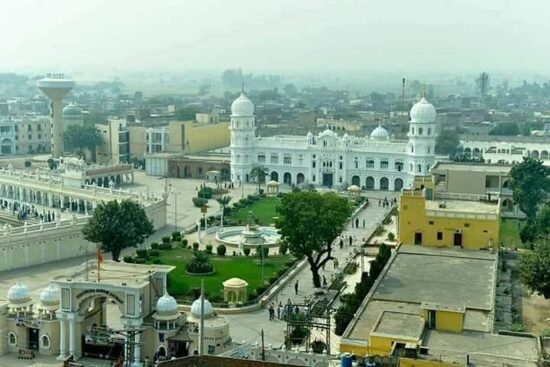
 Milpitas (California) USA/Lahore/Queta — : The North American Punjabi Association (NAPA) has urged the Government of Pakistan to seriously consider establishing a special international religious and heritage status for Nankana Sahib, the birthplace of Sri Guru Nanak Dev Ji and one of the most revered pilgrimage destinations for Sikhs around the world. In separate representations to the Prime Minister of Pakistan and Maryam Nawaz Sharif, Chief Minister of Punjab, NAPA has proposed that Pakistan examine the feasibility of creating a specially protected international Sikh religious and heritage zone at Nankana Sahib. NAPA executive Director Satnam Singh Chahal said the proposal should be examined through a comprehensive legal, administrative, heritage and diplomatic consultation process while fully respecting Pakistan’s sovereignty and constitutional framework.
NAPA said the concept could be described as a “Vatican City for Sikhs”, but clarified that the proposal does not necessarily call for the creation of a separate sovereign state. Instead, the objective would be to explore a special status within Pakistan that could provide long-term guarantees for the protection of Sikh religious sites, preservation of historic properties, pilgrimage access, heritage conservation and international Sikh participation in cultural and educational activities. “Nankana Sahib is not merely another historic religious site. It is associated with the birth of Sri Guru Nanak Dev Ji, whose message of equality, humanity, peace and universal brotherhood transcends national boundaries,” said Satnam Singh Chahal, Executive Director of NAPA.
NAPA said the proposal deserves consideration because the geographical location of Nankana Sahib and its religious importance create a unique international heritage situation. Millions of Sikhs living in India and across North America, Europe, Australia and other parts of the world have a direct spiritual and historical connection with the birthplace of Guru Nanak Dev Ji. The organisation suggested that Pakistan could establish a high-level expert committee involving Pakistani Sikh representatives, heritage conservation experts, historians, legal specialists, government authorities and representatives of internationally recognised Sikh organisations. Such a committee could examine possible models for special protection, pilgrimage facilitation, conservation, security and international cultural cooperation. Chahal also pointed to the Kartarpur Corridor as evidence that innovative arrangements for Sikh pilgrimage can be developed even when broader India-Pakistan relations remain complicated.
According to NAPA, the experience of Kartarpur could provide useful lessons while recognising that Nankana Sahib would present a substantially broader heritage and administrative challenge. The organisation proposed that Nankana Sahib could eventually be developed as an international centre for Sikh heritage preservation, historical research, religious education, archival work, cultural exchange and interfaith dialogue, alongside its role as a pilgrimage destination. Chahal emphasised that the proposal is being made in the spirit of peace, religious respect and preservation of shared Punjab heritage, and not as a demand intended to undermine Pakistan’s territorial sovereignty. “The question before Pakistan is not simply whether Nankana Sahib can be compared with Vatican City. The real question is whether a unique international framework can be created to protect the birthplace of Guru Nanak Dev Ji and make it more accessible to Sikhs from around the world,” Chahal said. NAPA further urged the Punjab Government to begin a formal feasibility discussion and coordinate with the federal Government of Pakistan and relevant Sikh institutions before considering any detailed model