
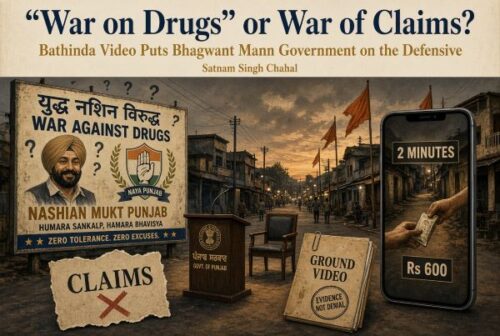
 Every election in Punjab seems to bring a familiar promise: drugs will be eradicated, the drug network will be crushed, and a “Drug-Free Punjab” will soon become reality. Political parties hold rallies, launch campaigns, make dramatic announcements and compete over who can speak the loudest about the drug menace. But after the microphones are switched off and the election banners come down, Punjab is left with the same fundamental question: Where are the measurable results?
The drug crisis is far too serious to become an election-season spectacle. Punjab’s young people, families and communities do not need another round of slogans. They need evidence, accountability and a transparent assessment of what has actually been achieved.
Different political parties and governments have made claims about arrests, seizures, rehabilitation, village-level campaigns and the dismantling of drug networks. The current Punjab government has also publicised large numbers of arrests, FIRs, village defence committees and people identified for rehabilitation. At the same time, opposition parties have accused the government of failing to meet earlier promises and deadlines. These competing claims should not be settled through political speeches. They should be settled through facts.
That is why the Punjab Government should immediately publish a comprehensive White Paper on the Drug Crisis and the Anti-Drug Mission.
And this should not be another government publicity document. It should be a detailed, independently verifiable account covering the performance of successive governments over a meaningful period of time. If political parties are prepared to promise a drug-free Punjab, the people have every right to know what happened under previous governments and what is happening under the present administration.
The White Paper should provide year-wise figures on drug-related deaths, NDPS cases, arrests, chargesheets, convictions, acquittals and pending cases. It should disclose the quantity and estimated value of drugs seized, the action taken against the financial assets of alleged drug traffickers, and the number of major networks actually dismantled.
Most importantly, Punjab must stop measuring success simply by the number of arrests. An arrest is an action; it is not necessarily an outcome. The public needs to know how many cases reached conviction, how many investigations resulted in successful prosecution, how many alleged major suppliers were permanently removed from the illegal trade, and how many cases collapsed because of weak investigations or lack of evidence.
The same transparency is needed on rehabilitation. How many people entered government-supported treatment programmes? How many completed treatment? How many returned to substance use? How many received vocational training or employment support after rehabilitation? Without such information, even genuine rehabilitation efforts cannot be properly evaluated.
Political parties also need to publish their own record. Before asking Punjab for another vote on the promise of ending drugs, every major party should place its previous commitments, timelines and achievements in the public domain. The question should not be who can make the biggest anti-drug speech; the question should be who can present the clearest evidence of results.
Punjab also needs to recognise that the drug problem cannot be solved by policing alone. The supply chain must be attacked through professional investigation and financial intelligence, while demand must be reduced through prevention, education, treatment, mental-health support, employment, sports and community programmes.
There must also be accountability at every level. If officials, politicians, influential individuals or criminal networks are found to have facilitated the illegal drug trade, the law must apply equally. At the same time, allegations must be investigated through due process rather than converted into political accusations without evidence.
An independent panel of experts including public-health specialists, law-enforcement professionals, economists, educators, rehabilitation experts and civil-society representatives could review the government’s White Paper and publicly identify gaps between claims and independently verifiable outcomes.
The people of Punjab have heard enough promises about the “final war” against drugs. They have seen campaigns, marches, rallies, slogans, photographs and political speeches. What Punjab has not seen enough of is a single, transparent scoreboard showing exactly what has worked, what has failed and why.Election campaigns will come and go. Governments will change. Political slogans will change with them. But a generation cannot be treated as an election statistic.
Punjab does not need another promise that drugs will be eliminated. Punjab needs the government to open the books, publish the facts and let the people judge the results.The time has come to replace the politics of “Drug-Free Punjab” slogans with the accountability of a “Drug-Free Punjab” performance report.No more political theatre. No more moving deadlines. No more competing claims without evidence. Punjab deserves the truth and the truth should be published in a White Paper.
Disclaimer: This article and accompanying images are for informational and illustrative purposes only. Some visuals may be AI-generated or digitally enhanced and may not depict actual events or persons.Views expressed are based on publicly available information and analysis