
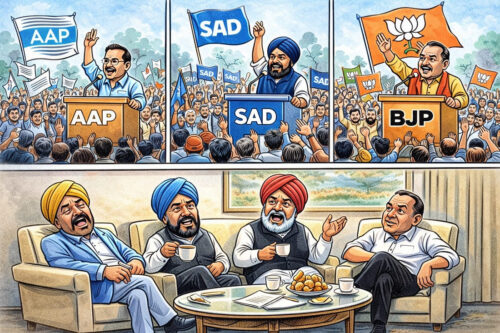
Punjab has a long and distinguished political tradition. The state has produced political leaders who were known for their political convictions, public service and ability to speak on issues affecting Punjab’s farmers, workers, employees, youth and ordinary citizens. Political battles were often intense, but political debate was expected to revolve around policy, ideology, governance and the future of the state. Today, however, there is growing concern that the standard of political discourse in Punjab has declined, with political parties increasingly appearing more interested in electoral positioning, personal attacks, publicity and blame games than in sustained debate over the structural problems confronting Punjab.
The problem cannot be placed at the door of one political party. AAP, Congress, SAD and BJP have all contributed to a political environment in which electoral strategy frequently overshadows long-term policy discussion. The current political landscape provides several examples. The AAP government faces criticism over drugs, finances, employees’ demands and governance, while the Congress is struggling with internal differences. The BJP is using the drug crisis as a major political campaign issue, while the SAD is attempting to rebuild its political relevance and has again become the subject of speculation over its relationship with the BJP.
The Aam Aadmi Party entered Punjab politics promising a major transformation in governance. The 2022 election victory created enormous expectations, particularly regarding corruption, employment, drugs, education, health, electricity and administrative reform. After more than four years in office, however, the political conversation surrounding the Mann government increasingly revolves around whether its promises have been fulfilled and whether Punjab’s financial position can sustain its welfare commitments. Recent reporting has highlighted the state’s fiscal pressures and the debate over the cost of schemes including free electricity and cash assistance.
The AAP government’s handling of the drug issue has become one of the most visible examples of the growing political blame game. The government has repeatedly highlighted its anti-drug campaign, while opposition parties argue that the problem remains serious. Congress Punjab president Amarinder Singh Raja Warring has recently attacked the Mann government over alleged continuing drug deaths and questioned its earlier promises. These are political allegations and should be tested against official crime, seizure, treatment and mortality data rather than accepted merely because they are made by an opposition leader.
The government’s critics, however, cannot simply point to problems without offering workable alternatives. If Congress, BJP or SAD believes that the AAP government’s strategy has failed, the public deserves to know precisely what they would do differently, what resources would be required and how success would be measured. Punjab has heard promises to eliminate drugs for many years. What is needed now is evidence-based policy rather than another cycle of political declarations.
The question of Punjab’s finances presents another test for political maturity. Employees’ organisations have recently argued that the state should clear approximately Rs 14,200 crore in pending DA and related arrears, citing increased tax and other revenues. The government and economists have a different perspective on the state’s fiscal capacity. This is precisely the kind of issue that deserves a transparent financial debate rather than a political slogan.
Congress, meanwhile, faces a different problem: internal political management. The party has been trying to challenge the AAP government while dealing with differences among its own senior leaders. Recent reporting has described continuing tensions between the camps associated with former Chief Minister Charanjit Singh Channi and state Congress president Raja Warring. The absence of several senior leaders from a Warring-led protest in Chandigarh was another public illustration of those differences.
This raises a fundamental question about opposition politics. If a party wants to convince Punjab that it can provide stable and effective governance, it must demonstrate that it can manage its own internal disagreements through democratic mechanisms. Political factions are normal in a large party, but when factional disputes repeatedly overshadow public issues, voters are left wondering whether political energy is being spent on Punjab or on internal positioning.
The Congress also has a substantial political record in Punjab that deserves scrutiny. It has governed the state at different periods and therefore cannot present itself solely as an outsider criticising the current government. Its previous decisions on agriculture, employment, law and order, fiscal management and administration should also be examined. A serious opposition should be willing to place both its past record and its future programme before the electorate.
The BJP has adopted a particularly visible strategy around the drug issue. In September 2026, the party launched a statewide Nasha Mukt Punjab Yatra involving four simultaneous routes covering nearly 4,000 kilometres and most of the state’s 117 Assembly constituencies. The campaign has been explicitly linked to the political contest ahead of the 2027 Assembly election.
The BJP has also announced a pledge to eradicate the drug menace within two years if it comes to power. Such a commitment deserves to be tested through specific questions: What administrative structure would be created? How would trafficking networks be dismantled? What would happen to addicts requiring treatment? What measurable indicators would determine whether the target had been achieved? Political parties should be encouraged to make ambitious commitments, but voters should also demand the implementation plan behind those commitments.
The political exchange between BJP and AAP over drugs illustrates another problem. Rather than concentrating exclusively on the present crisis and the solutions available today, the two sides have traded accusations about past performance. During the BJP’s Nasha Mukt Punjab campaign, Chief Minister Bhagwant Mann questioned the BJP’s record during its earlier alliance with the SAD, while BJP leaders pointed to AAP’s previous deadlines for eliminating drugs.
The Shiromani Akali Dal faces perhaps the most complicated challenge of political renewal. The SAD has historically been one of Punjab’s most influential political organisations and has played a major role in the state’s political and religious affairs. But after its electoral decline and the break with the BJP over the farm laws, the party has been attempting to rebuild its political position.
The recent meeting between SAD president Sukhbir Singh Badal and Prime Minister Narendra Modi, together with SAD support for certain key bills, has revived speculation about a possible renewal of the SAD-BJP relationship. Whatever the eventual political arrangement, the episode demonstrates how dramatically Punjab’s political alliances can change when parties prepare for an election.
The SAD therefore faces questions that go beyond alliances. Can it rebuild public confidence through a clear programme for Punjab? Can it explain its past record while presenting a credible future agenda? Can it reconnect with farmers, rural voters, youth and the wider Sikh community without relying primarily on its historical political identity? These are questions for the party and ultimately for the electorate.
AAP, Congress, SAD and BJP also share one common characteristic: all four are increasingly operating in an election environment in which political positioning has become unavoidable. The 2027 Assembly election is already influencing political messaging. But elections should not become a substitute for governance between elections.
Punjab’s young people are looking for employment. Farmers are looking for economic security. Government employees are seeking resolution of long-pending demands. Industry wants investment and infrastructure. Families affected by drugs want rehabilitation as well as effective action against traffickers. Punjab needs answers on debt, water, agriculture, education, healthcare, law and order and industrial development.
These issues cannot be solved by rallies alone.They cannot be solved by social-media posts.They cannot be solved by blaming the previous government.And they cannot be solved by promising that everything will change after the next election.
Punjab needs political parties to publish detailed programmes with measurable targets. If AAP says its governance model has transformed Punjab, it should publish comprehensive performance data. If Congress says it can provide better governance, it should explain how and at what cost. If BJP promises to eradicate drugs, it should provide a detailed implementation plan. If SAD seeks a political revival, it should clearly explain its programme for Punjab and how it intends to restore public confidence.
The people of Punjab also deserve greater honesty about difficult choices. Free electricity, welfare benefits, employee liabilities, subsidies and development expenditure all have financial consequences. Governments should explain those consequences instead of presenting every benefit as though it carries no cost. Opposition parties should similarly explain how their own promises would be financed.
The decline in political standards is therefore not simply about the language used by politicians. It is about the increasing distance between political promises and measurable accountability. It is about the tendency to treat every public issue as an opportunity for electoral mobilisation. It is about political parties asking voters to remember the failures of their opponents while asking them to forget their own past records.
Punjab deserves better than a permanent election campaign.
AAP, Congress, SAD and BJP should all be judged in the same political marketplace: by their policies, records, promises, financial explanations and willingness to accept scrutiny. No party should receive a permanent political exemption because it is in government, and no opposition party should receive one merely because it is out of government.The responsibility ultimately extends beyond political parties. Punjab’s media, civil society, intellectuals, professional organisations and voters also have a role. Political debate becomes weaker when sensational statements receive more attention than documents, budgets, legislative proceedings and measurable outcomes.
Punjab’s political history deserves a higher standard. The state needs leaders who can debate without personal hostility, oppose without misinformation, govern without excessive publicity and accept criticism without treating every question as a political conspiracy.The real challenge before Punjab is not simply deciding which party will govern after the next election. The deeper challenge is whether Punjab can raise the quality of its political conversation itself. The people deserve competing visions, transparent financial plans, measurable promises and honest accountability.Punjab does not need more political noise. It needs more serious politics.
Punjab Outlook Investigative Analysis
Disclaimer: This article and accompanying images are for informational and illustrative purposes only. Some visuals may be AI-generated or digitally enhanced and may not depict actual events or persons.Views expressed are based on publicly available information and analysis